David Alfred Bywaters's Crossword Cavalcade & Fortnightly Victorian Novel Recommender. Every Saturday! Either a new language-torturing puzzle or an old novel by an unjustly neglected Victorian author. Why waste time on other amusements?

Novels

Novel 155: Charlotte Yonge, The Pillars of the House (1873)
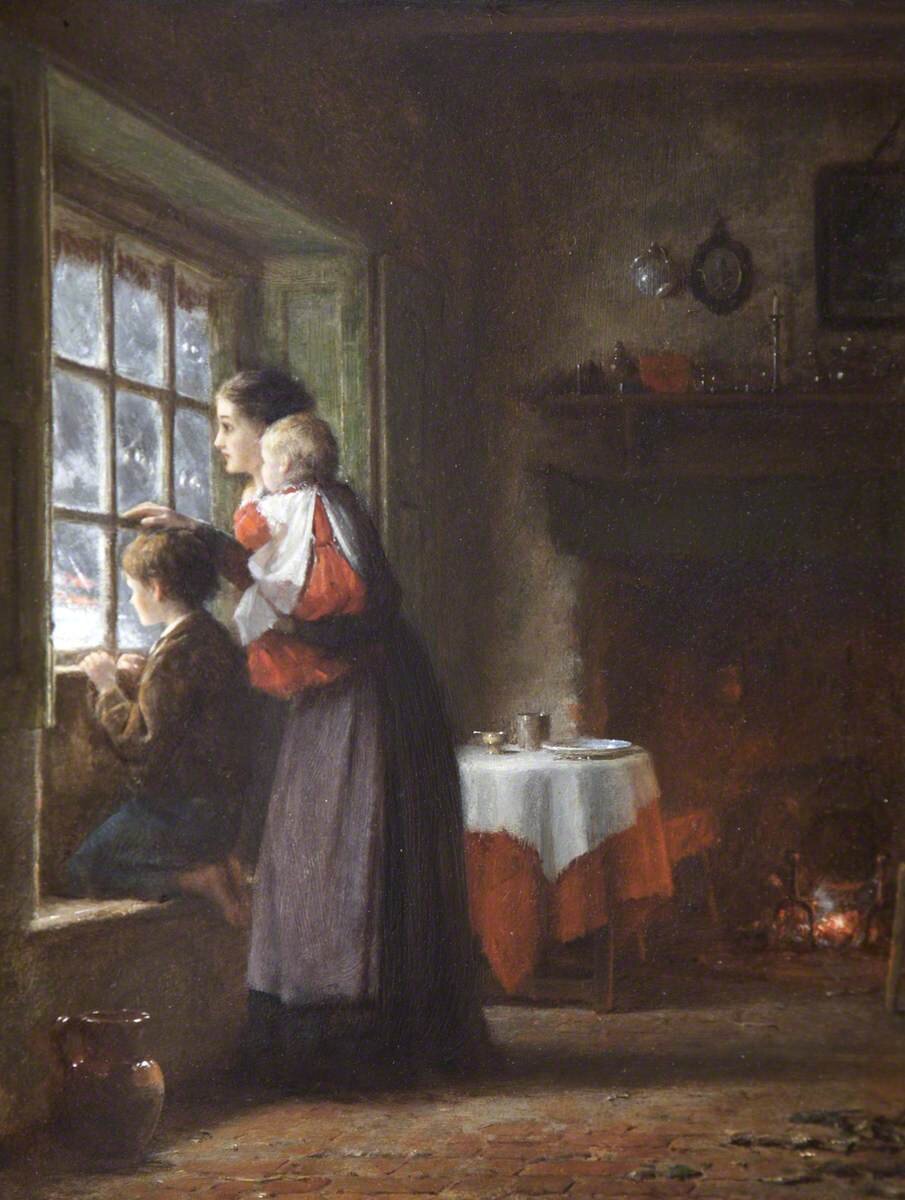
Frederick Daniel Hardy, An Anxious Time

A large orphaned family grows up in genteel poverty.


I have not yet read all Charlotte Yonge’s novels (see Novels 003, 053, 103), but of those I have read, this is the masterpiece.  It is twice as long even as the average Victorian three-volume novel, but you will wish it longer.

“We do not think that many of those who begin the four volumes will be content to leave them unfinished; and few who do finish them will not feel as if a great group were added to their intimate friends. . . .  Miss Yonge’s dramatis personæ have the reality which others seek in vain to give. . . .  It is intimate realization of her own characters, as living people, that gives to Miss Yonge’s stories, in spite of their apparent want of construction, a consistency, a tendency to one point which we sometimes miss in novels more ambitiously composed, and involving an obvious and avowed ‘plot’. . . .  Her skill in drawing a number of people, all of whom have a family likeness, while each is yet unmistakably distinct from all the others . . . and, at the same time, perfectly consistent in his or her own development, was never more severely tested than in this history of the thirteen young Underwoods, whose fortunes she follows for eighteen years. . . .  The charm consists . . . in the admirably accurate delineation of the daily ‘hopes and fears, passions and pleasures,’ which mould the quiet natures and sway the otherwise uneventful lives of” her characters.  Athenaeum, September 27, 1873

“Her range is of the narrowest, but within it she shows herself thoroughly the artist.  Nearly all her characters here . . . have a distinct life and individuality of their own.” Examiner, December 6, 1873

Download this week’s novel:
v.1 http://access.bl.uk/item/viewer/ark:/81055/vdc_00000004CC9E#?c=0&m=0&s=0&cv=0&xywh=-1724%2C-221%2C4882%2C2504

v.2 http://access.bl.uk/item/viewer/ark:/81055/vdc_00000004F1A0#?c=0&m=0&s=0&cv=0&xywh=-1710%2C-125%2C4854%2C2489

Novel 154: Mary E. Mann, The Parish of Hilby (1883)

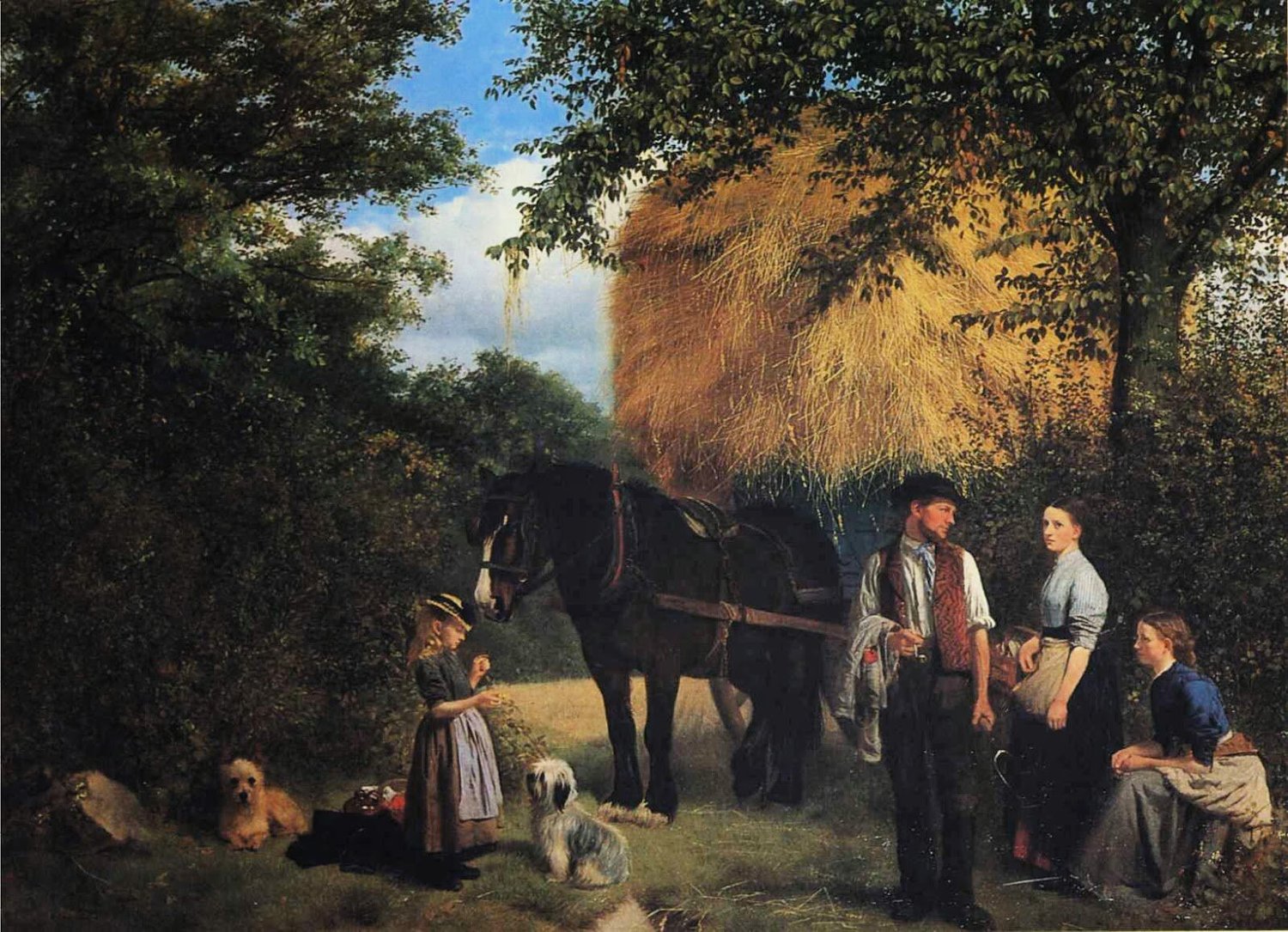
William Edward Millner, The End of the Day

A farmer falls in love with one woman while entangling himself with another.


For Mann, see Novel 016.  This is her first novel, justly praised for its unpretending plot and careful characterization.

“The whole book is pervaded by a keen sense of those subtle class distinctions which play so great a part in country life.” Academy, March 31, 1883

“Mrs. Mann writes a sensible, characteristic, and thoroughly entertaining ‘story of a quiet place.’  She affects nothing and makes no pretence; her tale of the parish of Hilby is refreshingly straightforward, and she succeeds admirably in her modest undertaking. . . .  Few more genuine or delightful romances have recently made their appearance.” Athenaeum, April 7, 1883

“Though it does not make great promises, at all events it performs as much as it has undertaken, after a thorough and enjoyable fashion which is not always to be met with in more ambitious works.”  It provides “a good and carefully-drawn picture of tranquil country life. . . .  Mrs. Mann has the excellent gift of being able to put herself in the place of the individuals she writes about, looking at things from the point of view they would be likely to take, and sympathizing with their sentiments, and this gift imparts real human nature to her work, and enables her to render faithfully delicate gradations of disposition and feeling which are not very easy to put into words, though it is by no means unusual for people to have a vague impression of their existence.”  Spectator, April 14, 1883

Download this week’s novel:
http://solo.bodleian.ox.ac.uk/permalink/f/89vilt/oxfaleph014791028

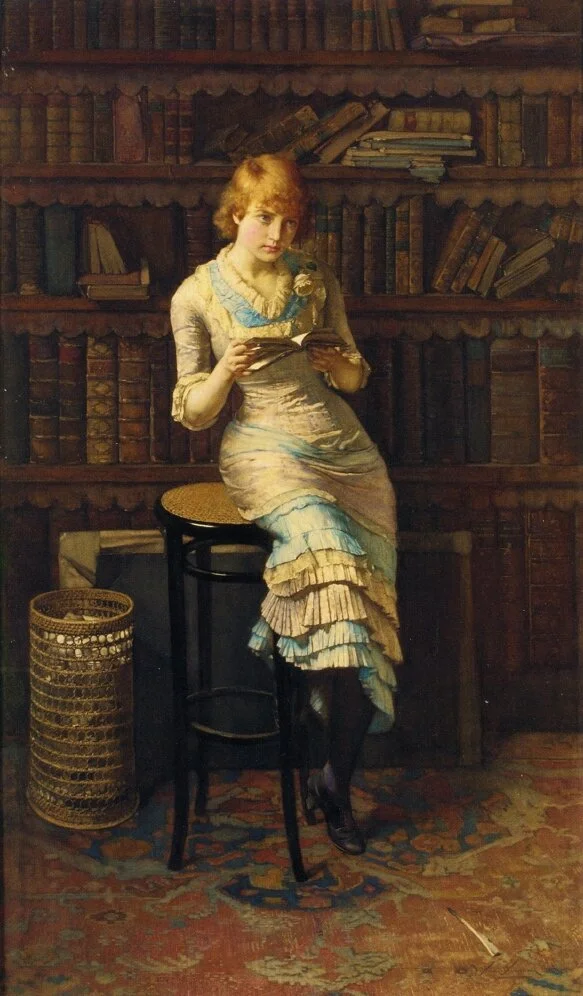
Novel 153: Frances Cashel Hoey, Falsely True (1870)

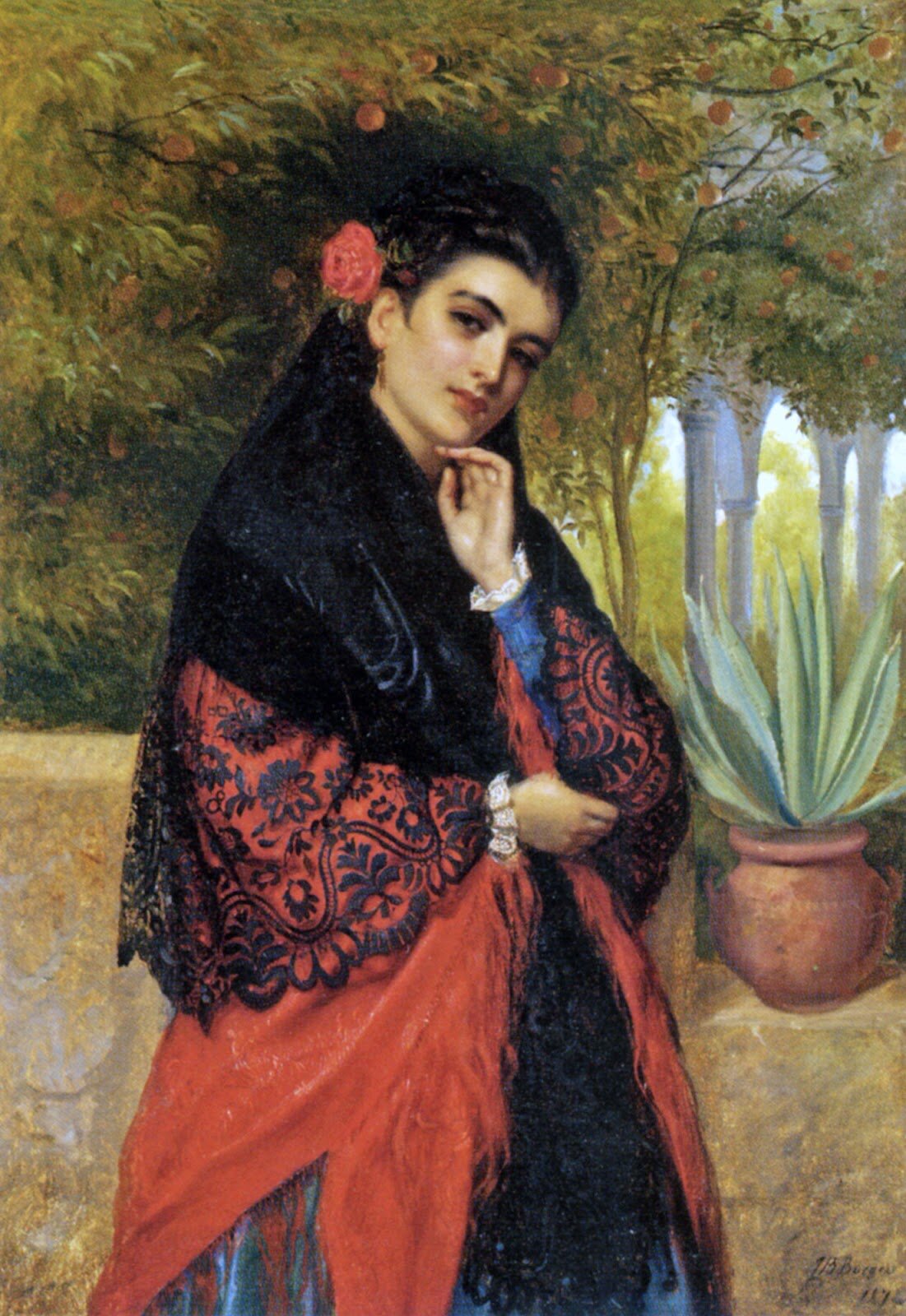
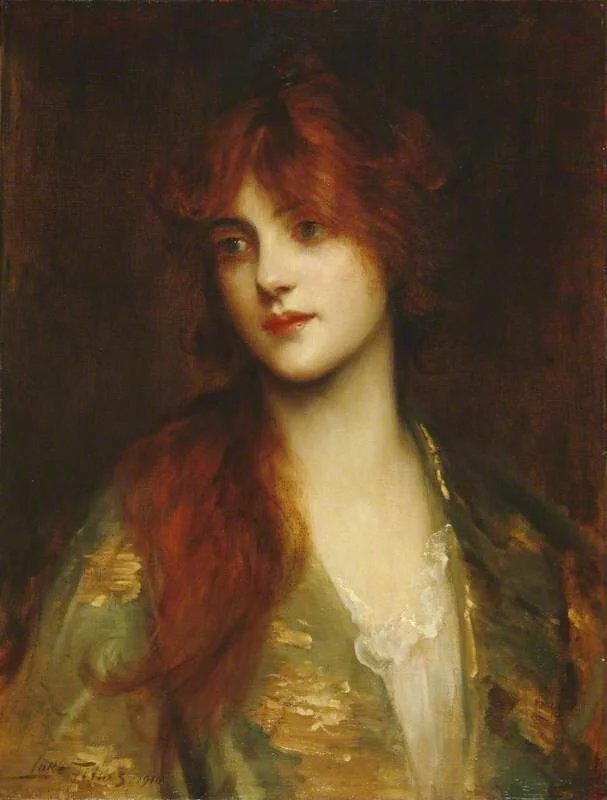
John Bagnold Burgess, A Spanish Beauty in a Red and Black Lace Shawl

Prevented by tragic family history from marrying the virtuous young lady he loves, a young man seeks his fortune in Brazil.


Here is another novel by Hoey (see Novel 067), with a plot not unreasonably censured by the critics, but several vivid, conflicted characters.

“Upon the whole an interesting and carefully written book.” Athenaeum, September 3, 1870

“There is a great deal of power in this story; and not a little of it is shown in the sketches of character, though less, we think, in the conception of the plot, which is very finely conceived, if not quite as well executed”; it will “earn for Mrs. Cashel Hoey a reputation far above that of the most successful manufacturer of ‘novels of the season.’” Spectator, September 24, 1870

Download this week’s novel:
v.1 http://access.bl.uk/item/viewer/ark:/81055/vdc_00000003F408#?c=0&m=0&s=0&cv=6&xywh=-317%2C-1%2C3052%2C1951

v.2 http://access.bl.uk/item/viewer/ark:/81055/vdc_00000003F40E#?c=0&m=0&s=0&cv=6&xywh=-305%2C-1%2C3061%2C1957

v.3 http://access.bl.uk/item/viewer/ark:/81055/vdc_00000003F414#?c=0&m=0&s=0&cv=0&xywh=-1217%2C-125%2C3900%2C2493

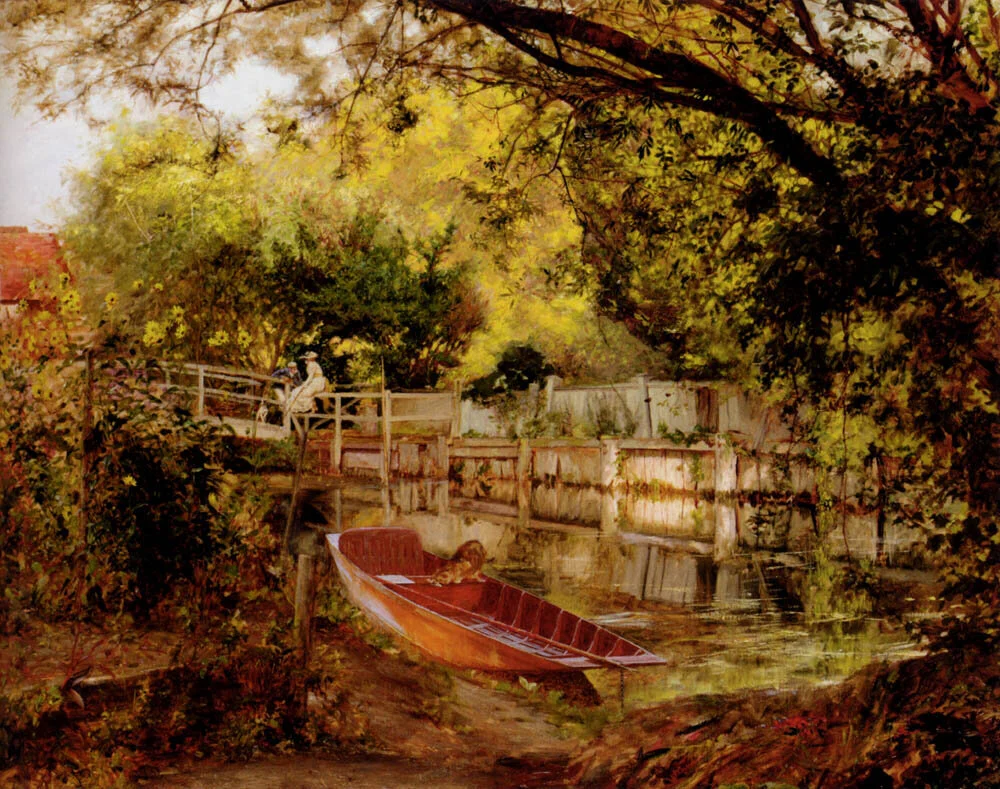
Novel 152: Margaret Oliphant, Hester (1883)

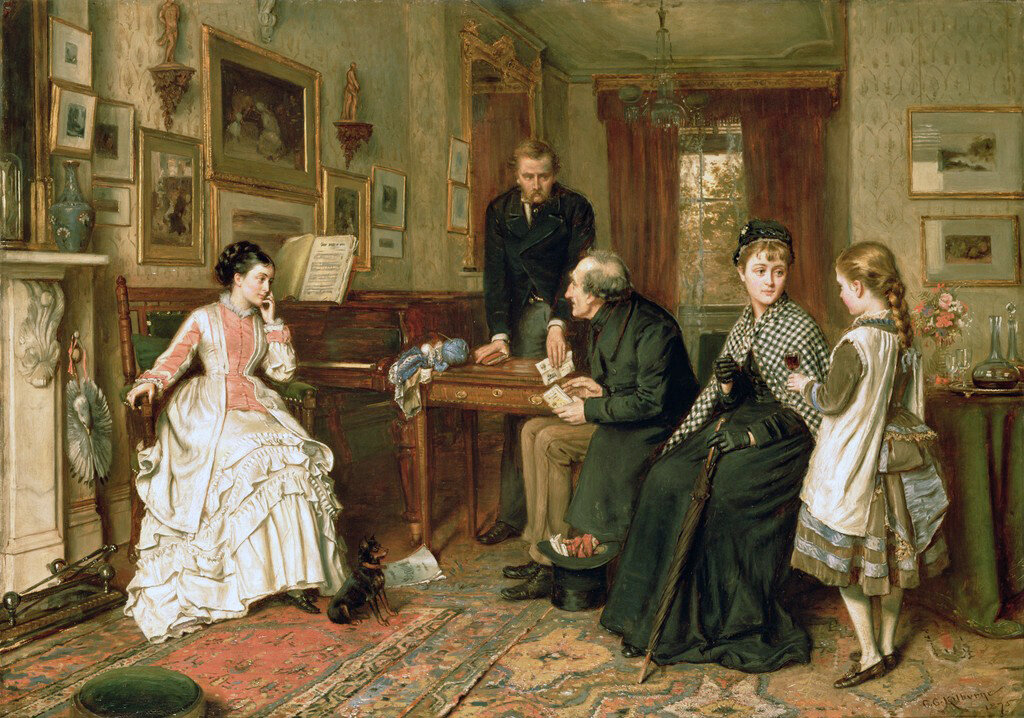
George Goodwin Kilburne, Poor Relations

A rich, powerful female banker neglects one cousin, a talented young woman, and favors another, a dashing young man.


Here is another novel by Oliphant (see Novels 007, 008, 056, 107).  It lacks concision, but it  represents some particularly interesting, internally conflicted major characters, and some particularly amusing minor ones.

“The author has drawn powerful pictures of this country town, and introduced into her tale a number of remarkable character sketches.  No other writer describes as well as Mrs. Oliphant all the lights and shades and the almost invisible barriers which serve to divide into as many distinct classes the dwellers in provincial neighbourhoods. . . . The scenes as the dénoûment approaches are very powerful, the climax artistically foreshadowed.”  Morning Post, January 2, 1884

“I have had so much pleasure in the book—its immeasurable delicacies of observation, its keenness of perception, its many moving touches of humour and wit and fine creativeness. . . . It has a certain distinction of manner, an easy mastery of method, and a fine superiority of mental attitude.” Academy, January 5, 1884

Download this week’s novel:
http://solo.bodleian.ox.ac.uk/permalink/f/89vilt/oxfaleph014632723

Novel 151: Laurence William Lockhart, Fair to See (1871)

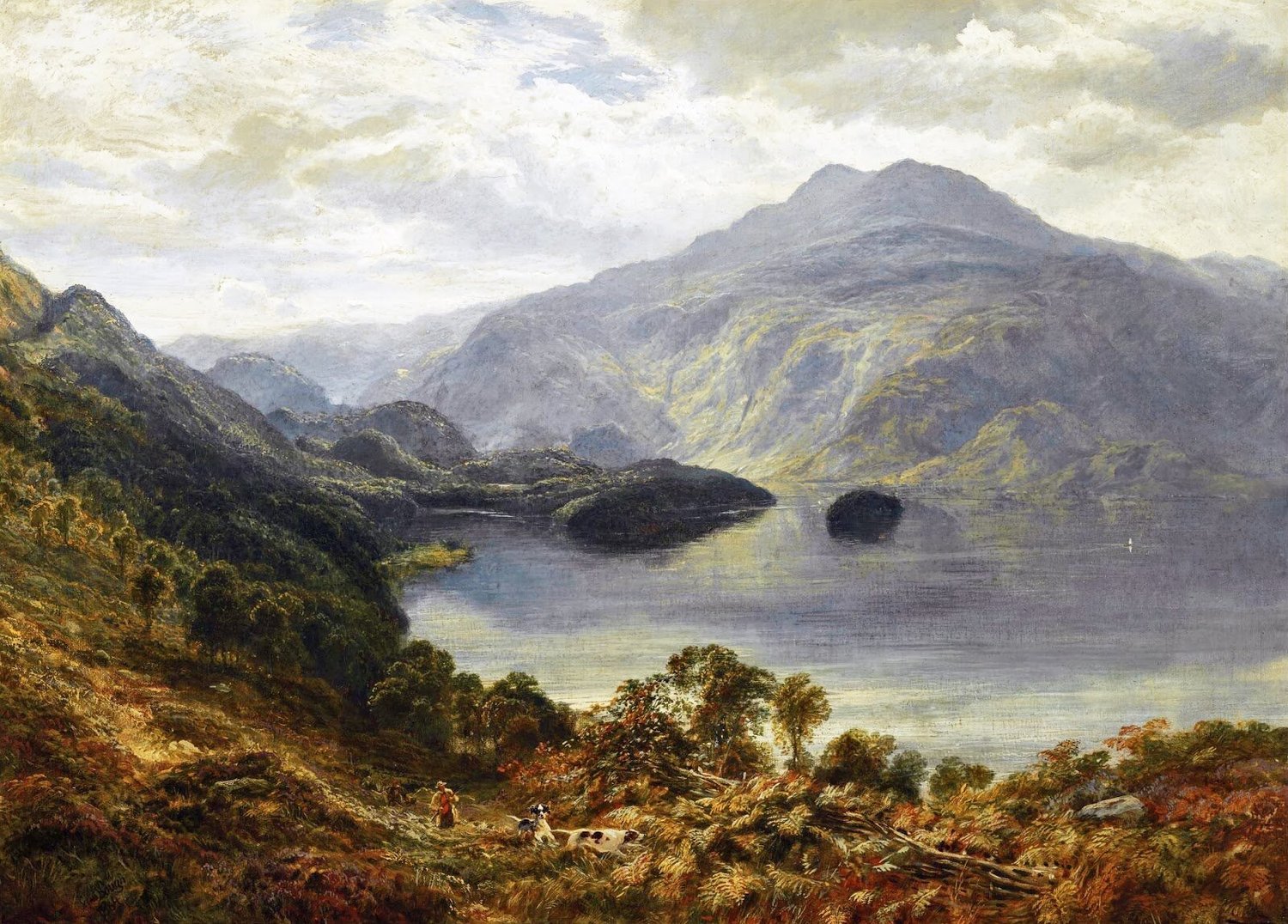
Samuel Bough, The Highland Shoot

A young soldier goes to Scotland to shoot birds and falls unwisely in love.


Laurence William Lockhart (1831-1882), was an army officer (he was present at the siege of Sebastopol) and newspaper correspondent (he was nearly executed during the Franco-Prussian War) as well as the author of three novels, of which this is the second.  Despite a slow start, and aside from a couple of overdrawn caricatures, it has vivid characters and an excellent plot.

“Just as we are usually better pleased by a painter who gives us a faithful view of some place well known to us . . . than by one who represents wonderful scenes with which we are not familiar, so is it with the story-teller: and thus a novel like the present, the incidents of which involve what is more or less the only form wherein romance presents itself in the lives of ordinary people, pleases far more than the productions of the criminal school, which appeal to the experiences of (fortunately) a very limited portion of the public.”  Athenaeum, November 18, 1871

“Next to the masterpieces that are apparently things of the past, we like the clever novel that grows on one”; Lockhart “shows power in the numberless little touches that lighten love scenes and descriptions; in slight liftings of the corner of the veil that hides the future from us; in felicitous ways of putting things.”  Saturday Review, January 20, 1872

“Fair to See is so pleasant a novel to read that one does not care to ask too curiously whether it is written according to the rules of art.”  Spectator, March 23, 1872

Download this week’s novel

v.1 https://archive.org/details/fairtoseenovel01lock

v.2 https://archive.org/details/fairtoseenovel02lock

v. 3 https://archive.org/details/fairtoseenovel03lock

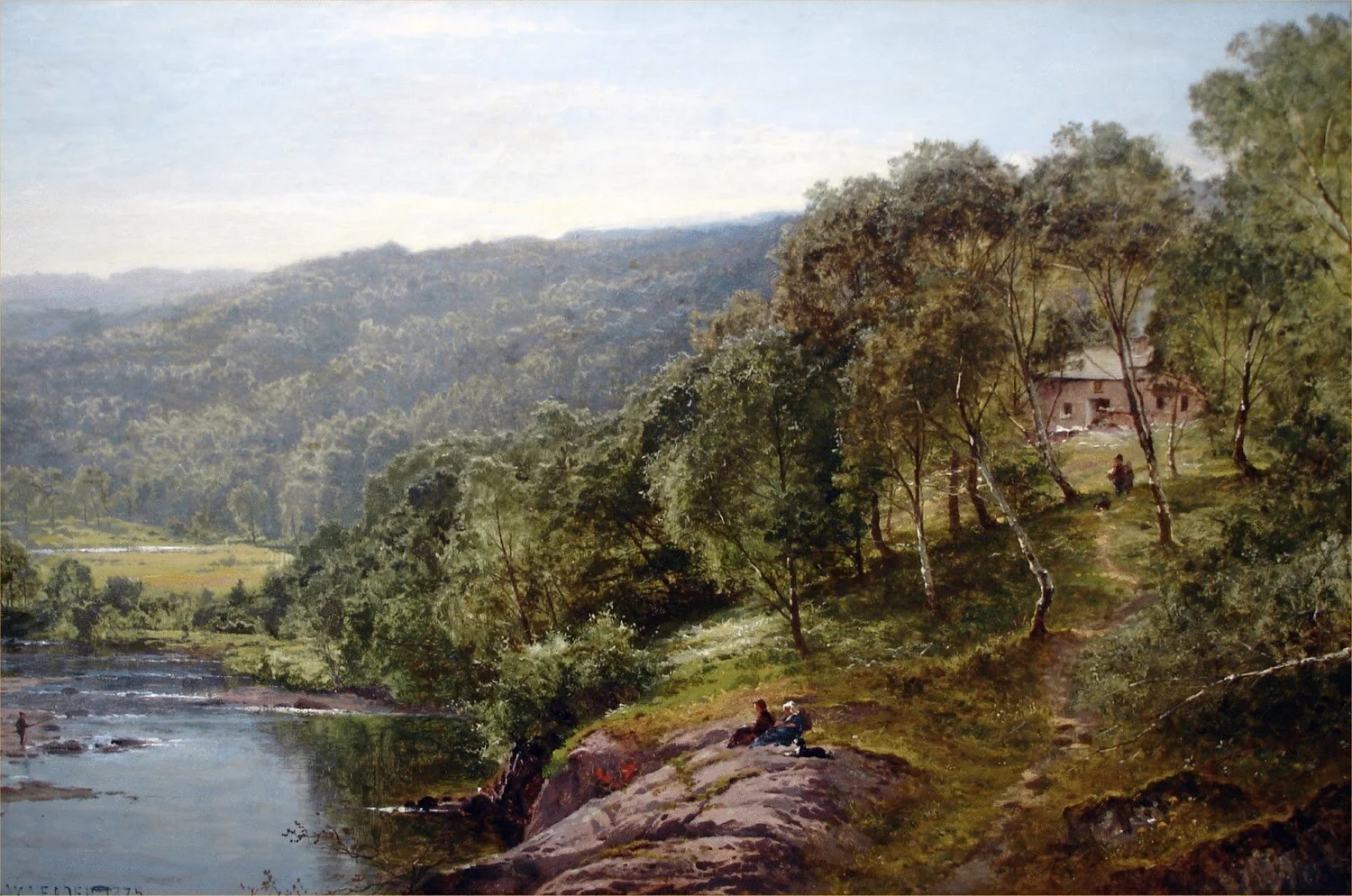
Novel 150: Albany de Grenier de Fonblanque, Jedwood Justice (1892)

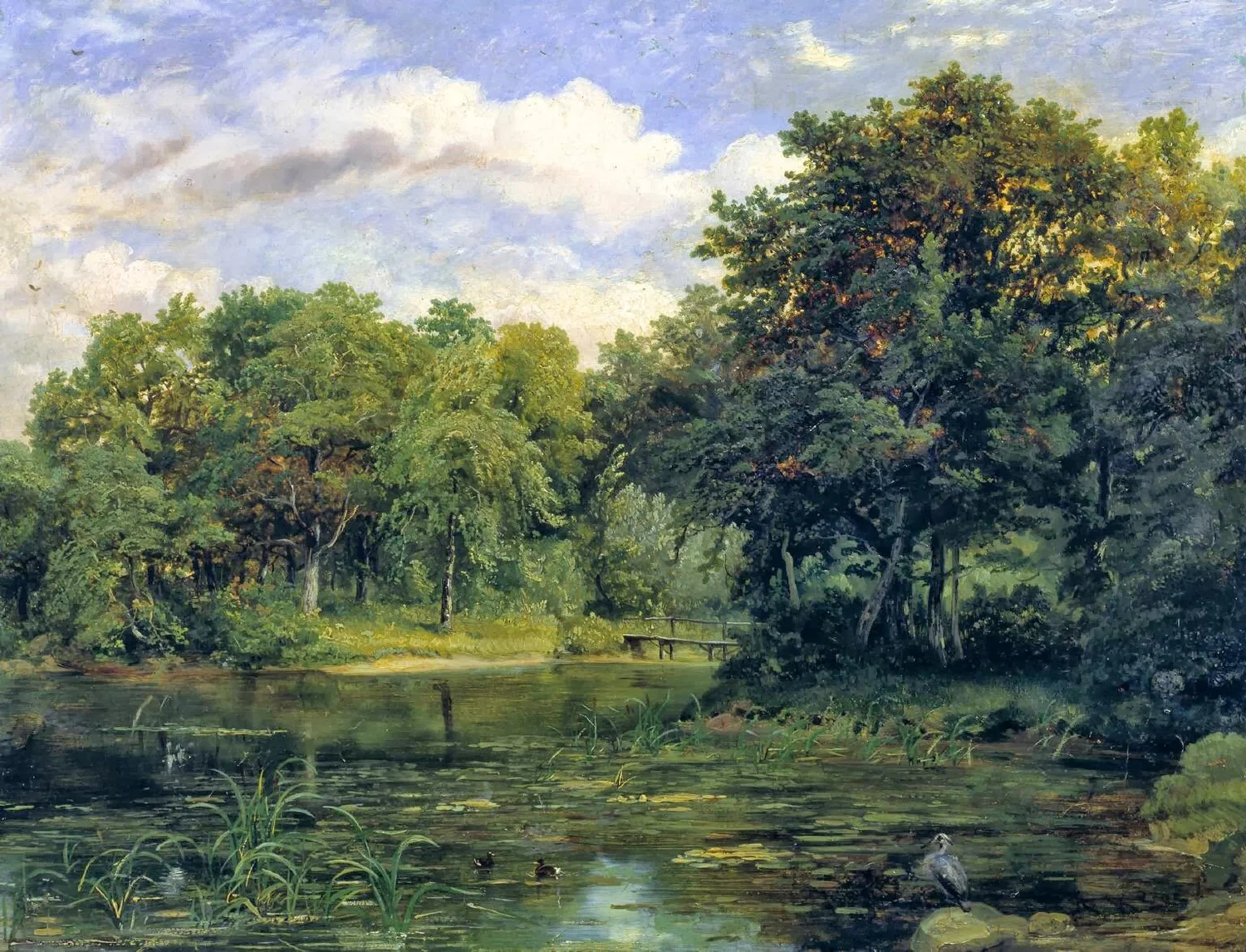
Frederick Richard Lee, Lake in a Park

A popular young man is rumored to have run off with a cruel baronet's wife.


This, like the same author’s A Tangled Skein (Novel 089), is an intricately plotted mystery with vivid characters, written in a lively style.

“The machinery of the plot is intricate and uncommonly well worked.  And although ingenuity and multiplicity of incident are the cardinal features of Mr. De Fonblanque's book, there are many passages which rise to a higher level” and are “full of insight and expressive power.”  Athenaeum, January 2, 1892

“It is written throughout with force; it has a carefully constructed plot, and ends with a dénouement which the reader, even though experienced at guessing surprises, will hardly have expected.” Spectator, January 30, 1892

“There is no flagging in Jedwood Justice: the country society is well sketched.” Academy, February 6, 1892

Download this week’s novel:
v.1 http://access.bl.uk/item/viewer/ark:/81055/vdc_00000004D292#?c=0&m=0&s=0&cv=4&xywh=-286%2C-1%2C2952%2C1962

v.2 http://access.bl.uk/item/viewer/ark:/81055/vdc_00000004D298#?c=0&m=0&s=0&cv=4&xywh=-279%2C-139%2C3208%2C2132

v.3 http://access.bl.uk/item/viewer/ark:/81055/vdc_00000004D29E#?c=0&m=0&s=0&cv=4&xywh=-287%2C-1%2C2947%2C1959

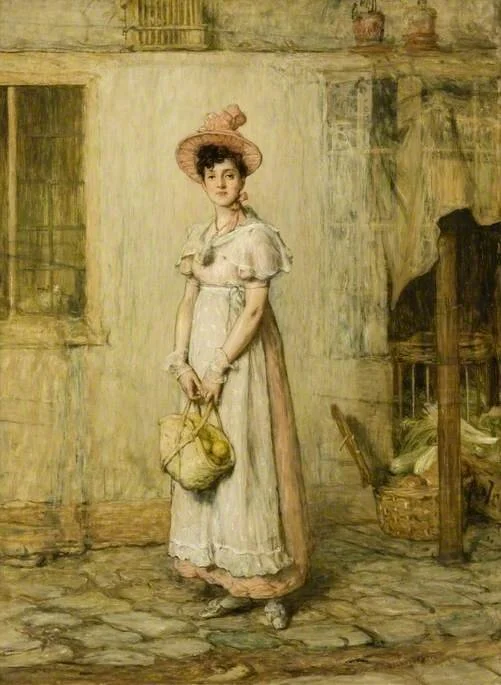
Novel 149: Victoria Baker, Half-a-Dozen Daughters (1871)

Charles Edward Perugini, Playing at Work

A gentleman loses his competence in foolish speculations and tries to support his six daughters by running a chemist's shop in Yorkshire.


Victoria Baker (1838-1913) wrote five novels between 1864 and 1894 under the pseudonym J. Masterman.  This one is a lively  treatment of several common Victorian themes.

“Without being exactly a work of genius, this is a very pleasant, wholesome novel, showing considerable descriptive power, and introducing us to some very agreeable and amiable characters.  The author writes in a fresh, lively style, and his dialogue is singularly crisp and natural. He has a keen sense of humour, and at times is unaffectedly pathetic.”  Illustrated Review, November, 1871

“In tracing the quiet annals of this interesting family the reader will find many domestic pictures full of homeliness and beauty.  The characters are drawn with individuality and distinctness, the narrative is easy, and the episodes are life-like and natural.”  Morning Post, November 20, 1871

“Half-a-Dozen Daughters is one of those healthy, natural books which remind one of a breezy day in the country.” Saturday Review, December 16, 1871

Download this week’s novel:
v.1 http://access.bl.uk/item/viewer/ark:/81055/vdc_00000004616A#?c=0&m=0&s=0&cv=4&xywh=-314%2C-1%2C3274%2C1975

v.2 http://access.bl.uk/item/viewer/ark:/81055/vdc_0000000437EE#?c=0&m=0&s=0&cv=4&xywh=-299%2C-1%2C3276%2C1976

Novel 148: Percy White, Andria (1896)

George Frederick Watts, Lady Dalrymple

A thoughtful and beautiful young lady is wooed by a painter, a rich young man, and (catastrophically) a philosopher.


Here is another engaging social comedy—or tragicomedy—by White (see Novel 075).

One character is “a finished picture and a masterpiece. . . .  one of the most brilliantly executed portraits in modern fiction.”  Pall Mall Gazette, December 2, 1896

“A clever novel, subtle and discriminating in its character-drawing, containing at least one remarkable portrait, and full of excellent things that make it worth reading.” The Standard, January 1, 1897.

Download this week’s novel:
https://archive.org/details/andria00whitgoog

Novel 147: Rosa Mackenzie Kettle, Lewell Pastures (1854)

William Holman Hunt, Morning Prayer

A younger son settles on an unpromising farm left him by his godfather.


Rosa Mackenzie Kettle (1818-1895) wrote some 26 novels between 1839 and 1895.  This one has an involving (if sometimes contrived) plot and vivid (if sometimes exaggerated) characters.

“It is very pleasantly and unaffectedly written, is full of excellent description, and very true, but not common-place, analysis of character. . . .  The cleverest and truest portraits in the book, delicately, yet most forcibly touched” are those of an unhappily married couple.  “We have rarely seen that vague and baffling scourge of married life, incompatibility, analysed with a more masterly hand.”  Leader and Saturday Analyst, August 5, 1854

“The story is ingenious, and extremely well told; although the materials are very simple, the interest is kept up, and those who begin to read will not be likely to put it down before they come to an end. . . .  Those who are looking for a pleasant novel cannot do better.” Athenaeum, August 12, 1854

Download this week’s novel:
v.1 https://archive.org/details/lewellpastures01kett

v.2 https://archive.org/details/lewellpastures02kett

Novel 146: Thomas Cobb, The Dissemblers (1900)

James Jacques Joseph Tissot, Room Overlooking the Harbor

A selfish woman sends emissaries after her runaway orphan niece, with unanticipated consequences.


Here is another novel by Cobb (see Novel 043), just as well-plotted, and witty, and brief as the last.

“In The Dissemblers, Mr. Cobb has constructed an amusing intrigue on the basis of a most ordinary domestic situation. . . .  It is continually funny, not in phrase, but in its predicaments.”  Academy, November 3, 1900

“The Dissemblers . . . shows that Mr. Cobb has by no means exhausted his large fund of pleasant invention nor abated one jot of his vivacity and sharp staccato treatment. . . .  In his limited range it would be hard to find an English novelist to equal Mr. Cobb, and we must cherish all the light comedy that the national temperament allows us.”   The Speaker, November 17, 1900

“This is as dainty a comedy of errors as has appeared for many a month.  The plot is as meagre as such a web of trifles should be, the portraiture is delicate and truthful, and there is a steady flow of deft and sprightly wit, with several unimpeachably skilful situations.”  Saturday Review, November 17, 1900

“Mr. Cobb has proved again in ‘The Dissemblers’ that he is a first-rate author with whom to spend an idle hour.  He imposes no tax upon the mind or emotions, and is always amusing and entertaining.  All his characters are delightful people who keep doing interesting things with a vengeance, and, however seriously they may take themselves, there is an element of quizzicality in his handling of them that is a direct appeal to the reader’s sense of humor.” Chicago Tribune, November 24, 1900

Download this week’s novel:
https://books.google.com/books?id=9t8NAAAAYAAJ

Novel 145: Eleanor Frances Poynter, My Little Lady (1870)

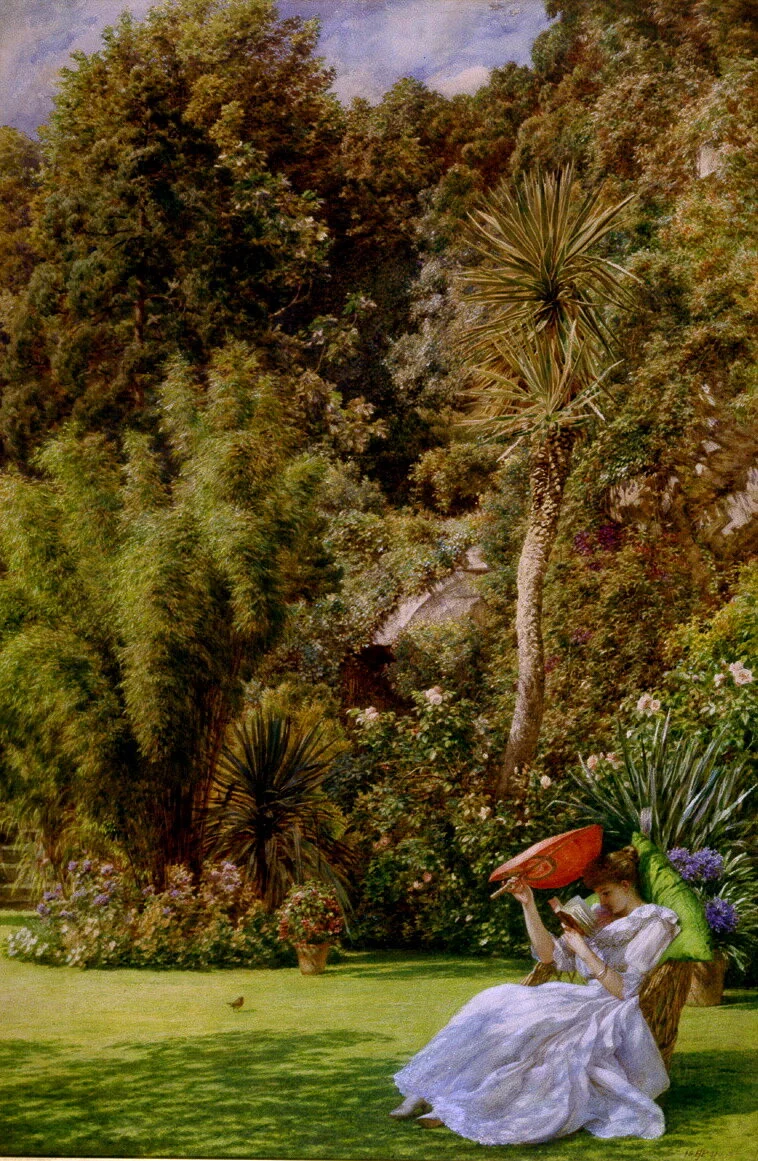
Sir Edward John Poynter, In a Garden

An impulsive French girl, raised by a gambler, is aided by an English doctor.


Eleanor Frances Poynter (1840-1929), the sister of the painter Sir Edward John Poynter and of the translator Clara Bell, wrote some seven novels between 1870 and 1892, of which the first is this poignant story of vulnerable innocence in a hard and confusing world.

“It is an agreeable task to record a book which can be read with genuine pleasure.  My Little Lady’s history” is “written in a simple graceful style.” Athenaeum, December 17, 1870

“The whole book is charming; quietly told, quietly thought, without glare or flutter, and interesting in both character and story.”  Saturday Review, December 17, 1870

“It is really pleasant to read a novel like ‘My Little Lady’—a simple story, so vividly potraying a few characters that we can imagine we have known them, felt all their troubles, and rejoiced in their happiness.”  Examiner, January 7, 1871

Download this week’s novel:
v.1 http://access.bl.uk/item/viewer/ark:/81055/vdc_00000004766A#?c=0&m=0&s=0&cv=6&xywh=-629%2C0%2C3742%2C1962

v.2 http://access.bl.uk/item/viewer/ark:/81055/vdc_00000003F32A#?c=0&m=0&s=0&cv=6&xywh=-652%2C0%2C3781%2C1982

v.3 http://access.bl.uk/item/viewer/ark:/81055/vdc_00000003F330#?c=0&m=0&s=0&cv=0&xywh=-1679%2C-126%2C4802%2C2518

Novel 144, Ellen Wallace, Margaret Capel (1846)

Sir Luke Fildes, Carina

An innocent and virtuous young lady falls in love with her uncle's ward.


Here is another novel by Wallace (see Novel 074), with the same merits (quiet, vivid characterization, a good style) and the same defect (a painfully hard-to-swallow lovers’ misunderstanding).

“This is one of the best kind of ‘fashionable novels’: it is not only free from the vulgar impertinences of the ‘silver-fork school,’ but has the tone of good society, and, better still, a vein of pure and healthful sentiment.  It gives an animated picture of country life among the upper class of gentry at the present day, sketched with the skill and tact of a nice observer; who possesses the art of indicating scenes and persons with a few graphic touches, and the power of making characters act and talk naturally.”  Spectator, January 17, 1846

“It is a very fairly drawn picture from the life.  It deals with the men and manners of our own time, and the author has been content to take the world as he finds it, without attempting to create imaginary persons or impossible events. . . .  Altogether this is one of the best fictions the season has produced.” Critic, January 24, 1846

“Here is the best novel of the Austen school we have ever seen, with real men and women, natural situations, brilliant dialogue; but there are no stage tricks in it, no startling effects, no murders, adulteries, or seductions, and only one death of any sort—consequently it has received very moderate praise in England, and no one in America seems aware of its existence. . . .  There have been very very few better novels written for the last six years.”  Literary World, March 27, 1847

Download this week’s novel:

v. 1 https://archive.org/details/margaretcapelnov01wall

v. 2 https://archive.org/details/margaretcapelnov02wall

v. 3 https://archive.org/details/margaretcapelnov03wall

Novel 143: Francis E. Paget, Lucretia; or, The Heroine of the Nineteenth Century (1868)

John Henry Henshall, Thoughts

A young lady tries to live like the heroine of a novel.


Francis Edward Paget (1806-1882), rector of Elford, wrote half a dozen novels promoting his High Church views, beginning in 1833.  This, a satire on the novels of M.E. Braddon and her kind (though it alludes also to Scott and Bronte), features an intriguing narrator, foolishly credulous and at the same time cleverly self-aware.

“This satire is quite just, because it exactly hits the great artistic fault of the sensational novel, the use of illegitimate means to produce an effect upon the reader.” Spectator, August 8, 1868

“A happier thought than the combination of a ludicrously sensational plot with a ludicrously sentimental heroine . . . could not have been devised.”  Athenaeum, October 17, 1868

Download this week’s novel:

http://explore.bl.uk/BLVU1:LSCOP-ALL:BLL01016843384

Novel 142: Mrs. Alfred Sidgwick, The Inner Shrine (1900)

Edward John Gregory, The Spoils Of Opportunity

A poor young lady, dislocated from her quiet home, is taken up by some distant (and dubious) relations with a taste for travel.


Here is another fine novel by Sidgwick (see Novel 082):  it features a virtuous heroine at the mercy of an amusingly selfish and self-deluded couple.

“A novel from the pen of Mrs. Alfred Sidgwick is always welcome, for while she steers a middle course between the rose-coloured optimism of the mid-Victorian novelists and the devotion to the doleful of their successors, the excellence of her matter is always enhanced by the alertness and vivacity of her style.”  Spectator, November 17, 1900

“As usual, Mrs. Sidgwick has written a good book.  She possesses, above the ordinary run of writers, the power to treat a comparatively slight plot in such a manner that it becomes absorbing, engrossing, a thing of paramount interest, till the last line is read; the power, too, to draw, with certain touch, a weak, or a false character, without a hint of cruelty or exaggeration.”  Bookman, December 1900

“Many poorer novelists seem more discussed than Mrs. Alfred Sidgwick . . . yet she has staunch admirers, and in the memories of discriminating readers lingers as a writer of pleasant and wholesome, yet not common, stories.  ‘The Inner Shrine’ is worthy to rank with these by virtue of an agreeable manner and good matter, a quiet thoughtfulness and a restful sense of humour.  The people in it are interesting, because the author has found a way of making them reveal themselves; they and the situations in which they are placed are at times arresting and even poignant, though the verge of caricature or sensationalism is never approached.” Athenaeum, January 12, 1901

Download this week’s novel:

https://books.google.com/books?id=jSU8AQAAMAAJ

Novel 141: E.S. Maine, Among Strangers (1870)

Benjamin Leader, A Woodland Path, North Wales

A young Scotswoman, living with her rector uncle in a Welsh village, is wooed by various men.


Eliza Sophia Maine (1838-1891) wrote five novels in the 1870s, of which this is the first.  Its ironically self-aware narrator and deftly-handled plot ought to have made its author better known than apparently she became.

A “pleasant little novel” that “deals with domestic life and never ventures beyond the natural limits of feminine knowledge.” Saturday Review, September 24, 1870

“The story is simple and unpretentious, but is told in so fresh and graceful a manner as to render it most acceptable.”  Athenaeum, October 8, 1870

“Life and character in the remote Welsh valley are well drawn, and the narrator tells her story with vivacity in a natural, unaffected tone.”  Spectator, January 28, 1871

Download this week’s novel:

https://books.google.com/books?id=XvUBAAAAQAAJ

Novel 140: Elizabeth Anna Hart, A Very Young Couple (1873)

Sir William Quiller Orchardson, The Young Housewife

Newlyweds struggle to get by on an inadequate income.


Here is another novel by Hart (see Novel 006).  It begins as a touchingly comic domestic story and ends in exciting sensationalism.  Its heroine is well delineated in both parts.

“Though the story is slender, it has some capital sketching, and abounds in the characteristic humour and observation of life which distinguish the writings of this author. . . .  We may recommend the story as delightful reading, and also the binding, paper, and printing of the book as most creditable to its popular and enterprising publisher.” Illustrated Review, January, 1874

“A very lively and pleasant little tale, vivid in its interest, and the harrowing part of it not too prolonged for endurance.”  Spectator, January 31, 1874

“We confess to having been much amused.”  Scribner’s, March 1874

Download this week’s novel:

http://solo.bodleian.ox.ac.uk/permalink/f/89vilt/oxfaleph014737729

Novel 139: Eleanor Eden, Dumbleton Common (1867)

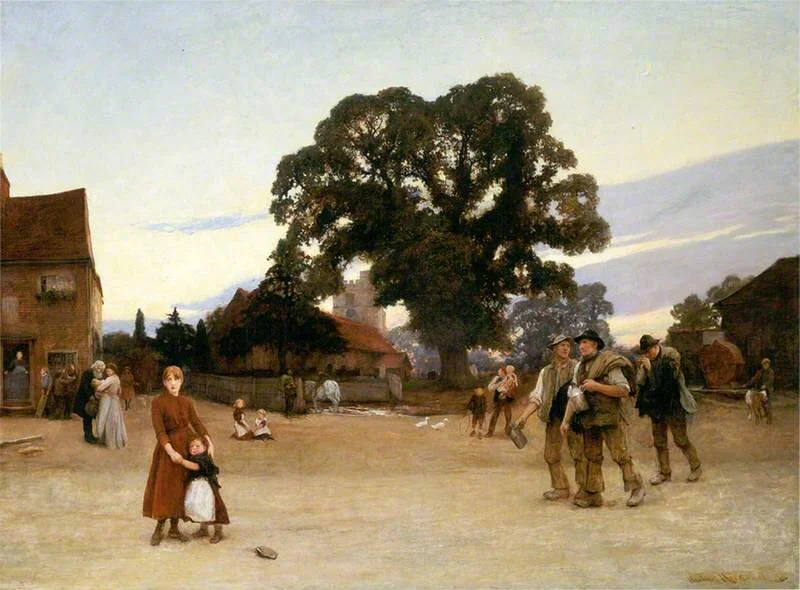
Hubert von Herkomer, Our Village

A naive middle class girl marries a fashionable young man.


Eleanor Eden (1826-1879), niece to Emily Eden (see Novel 036), wrote several children’s novels in addition to this one for adults. Its troubled-marriage plot is supplemented with a pleasant description of life in a village outside London.

“‘Dumbleton Common’ is a charmingly pleasant book; it is full of genial kindheartedness, and there is a thoroughly well-bred tone throughout.  The story is as slight as can hold together; but every individual in it has a distinctive character, and is made of flesh and blood, with a reasonable soul to match. . . .  There is much skill and lightness of hand evinced in the many characters that pass before the reader; for though the incidents are slightly drawn, the personages are numerous.” Athenaeum, March 9, 1867

“The Hon. Eleanor Eden, like the Hon. Emily Eden, has a perfect command of that light, graceful, easy style which is the nearest literary approach to the pleasant chat and gentle raillery of the best English society. . . .  Dumbleton Common, like The Semi-Detached House, is a most graceful and lively picture of a little society. . . .  There is no sketch that is not lively, and not a false stroke of either sentiment or tone from the beginning to the end of the little story.”  Spectator, March 16, 1867

Download this week’s novel:

v.1 https://archive.org/details/dumbletoncommon01eden

v.2 https://archive.org/details/dumbletoncommon02eden

Novel 137: Beatrice May Butt, Delicia (1879)

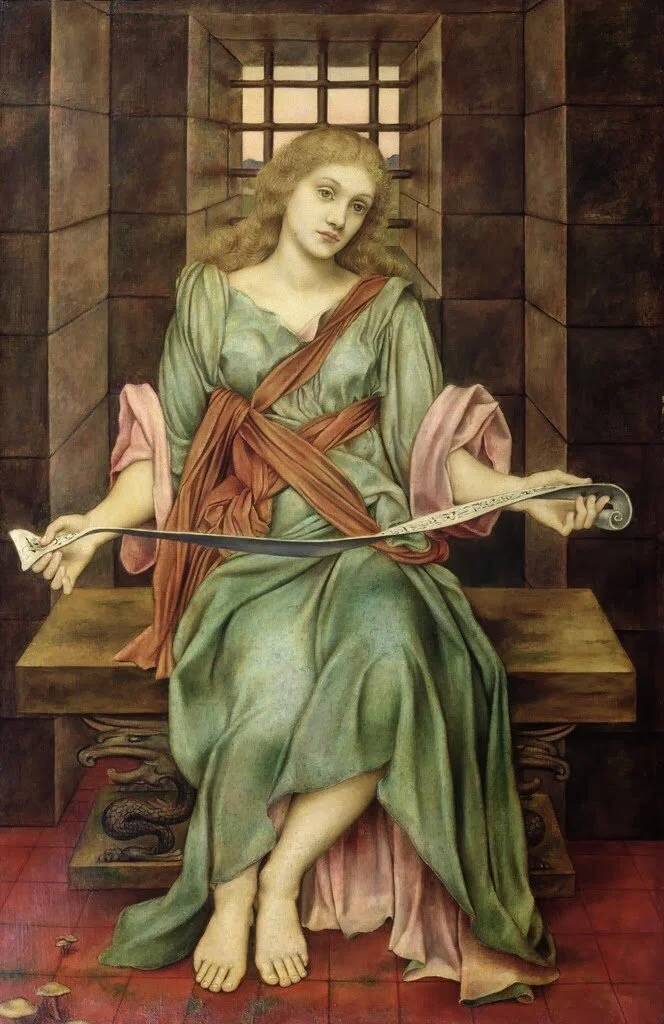
Evelyn de Morgan, The Soul's Prison House

A quiet young woman introduces her best friends to one another, with unexpected consequences.


Here is another novel by Butt (see Novel 045).  It has several vivid characters, and three plots, of which the most prominent is also the best.

“Delicia is one of those womanly portraits that can be drawn only by a high-minded writer. . . .  On the whole, the story will repay the reader’s trouble.”  Athenaeum, July 5, 1879

“That ‘Delicia’ is a good novel nobody who has read it can have the slightest doubt.” It is good because of “the strength, the delicacy, and the freshness of the character-drawing, and . . . the interest of the story. . . .  The Stevens family . . . is really a triumph in its way.  It has all the truth to English domestic life. . . . We have not read so good a novel as ‘Delicia’ this year.” Examiner, July 19, 1879

“Without aspiring to the highest place, it is none the less one of the few books where there is nothing we could wish added or taken away.  This calm sufficiency and graceful tact in proportioning ambition to resources, if not exactly genius, is near akin to it.” Academy, August 30, 1879

Download this week’s novel:

https://archive.org/details/deliciabyauthor00buttgoog/

Novel 136: Margaret Agnes Paul, De Cressy (1856)

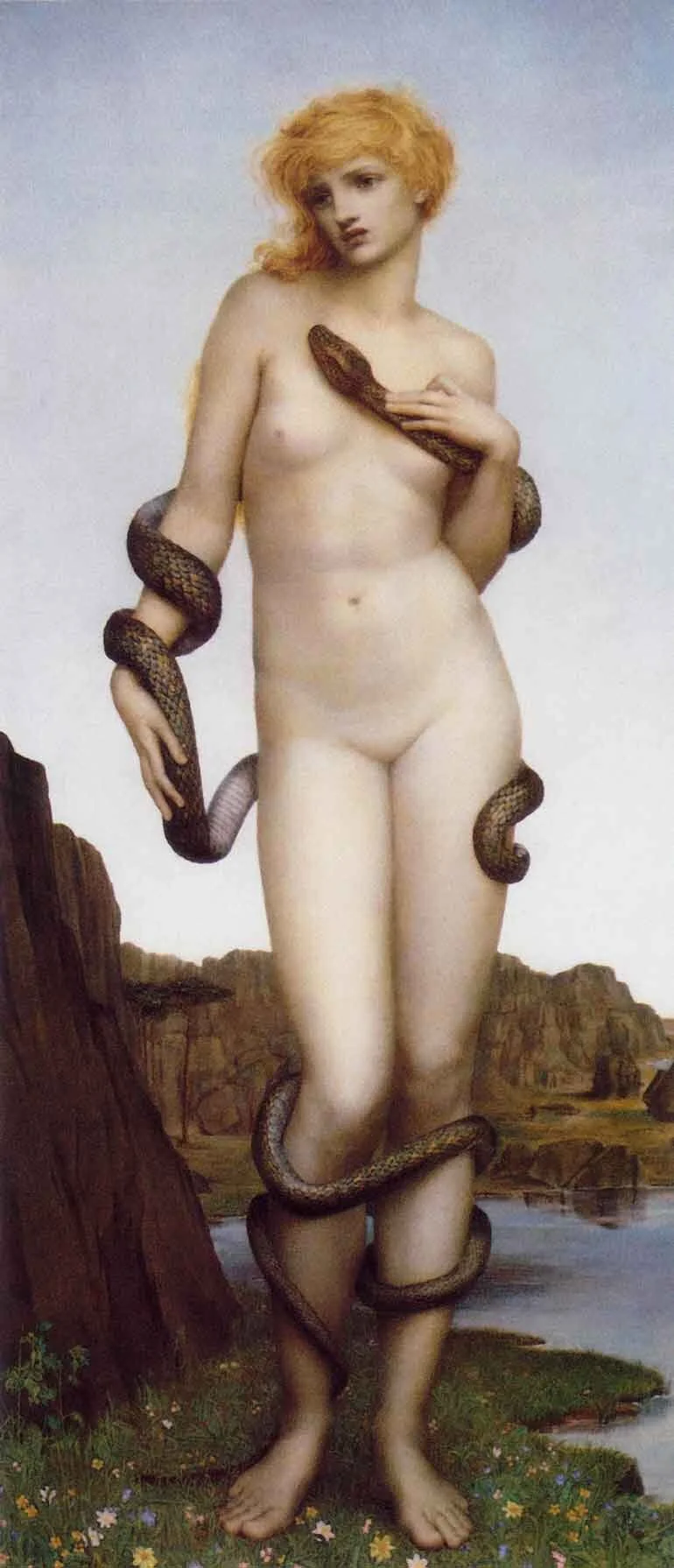
Evelyn de Morgan, Cadmus and Harmonia

An impoverished but virtuous young lady attracts the love of a lord.


Here is another novel by Paul (see Novel 025):  ambivalent characters find themselves entangled in a subtle and apparently intractable conflict—until the author, out of time, or patience, or paper, suddenly resolves it by sending two characters to heaven and a third to South America.

“The persons have much consistency and reality about them; spirit is equable and well sustained throughout.”  Spectator, June 28, 1856

It is “written in an unpretending, pleasing style.”  Saturday Review, July 26, 1856

Download this week’s novel:

https://books.google.com/books?id=Wdq0wgEACAAJ&newbks=1&newbks_redir=0&pg=PP1#v=onepage&q&f=false

Novel 135: William Gilbert, De Profundis (1864)

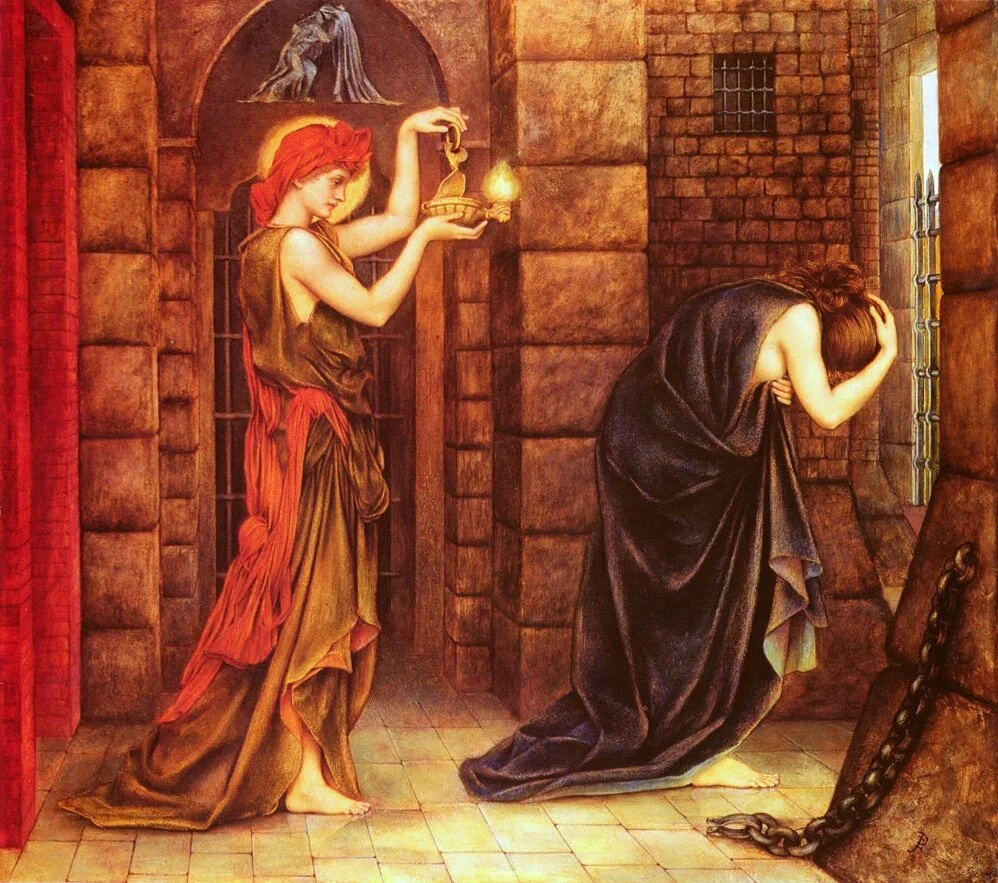
Evelyn De Morgan, Hope in the Prison of Despair

An honest couple do the best they can amid the squalor and vice of the slums.


William Gilbert (1804-1890), father of W.S. Gilbert (of Gilbert & Sullivan), wrote some twelve novels, many, like this one, about the London poor, whose miseries are narrated in a breezy, unsentimental tone, with much wry humor.

“In this story Mr. Gilbert never introduces ‘high life,’ nor people of the better class.  He reveals the mysteries of ‘London labour and the London poor’ in a low metropolitan neighbourhood, and all through the book we get no distinct peeps at any higher social condition.  To interest the general reader in such revelations requires great skill, pathos, and power.  Mr. Gilbert commands them all, and combines with them, in his writing, a deep, true knowledge of human motive and action. . . .  That Mr. Gilbert is a true artist we cannot but admit, for out of the simplest details of low life he produces characters whose very vividness enchains the attention.  He is amongst novelists a realist.  Neither imagination nor caricature influences his portraiture.  Men, women, and children are precisely what he sees them to be, and his vision is correct, his judgment true.”  Manchester Guardian, February 28, 1865

“‘De Profundis’ is an excellently written, unvarnished narrative. . . .  The style well becomes the subject—plain, earnest, unaffected, and with an admirable quaint simplicity of language in relating the most heart-rending details, which is more effective than the most studied artificial effects, as it is perhaps more rarely attained to. . . .  We have never read a story of humble life so well and unaffectedly told as this, and we recommend it as a wholesome contrast to the pictures of vulgar splendour and luxury under which our tables groan.”  Westminster Review, April, 1865

Download this week’s novel:

http://solo.bodleian.ox.ac.uk/permalink/f/89vilt/oxfaleph014418947