Here is the second of Eden’s two novels, its title apparently meant to recall its successful predecessor “The Semi-Detached House,” (see Novel036) though its plot and characters are quite different. Though the second to appear, this was the first to be written (in 1829, according to Sutherland’s Victorian Fiction); it provides a convincing psychological portrait of its troubled heroine.
“A good-humoured social picture, playful in its satire, and very happy in its combinations of characters, sketched . . . with some fantastic exaggeration . . . but alway shrewd and always genial.” Examiner, September 8, 1860
“It has really done our heart good to read this light, slight, pleasant novel”; it is pervaded by a “spirit of kindness, charity, and good breeding.” Athenaeum, September 8, 1860
“Perhaps, the only tale that has been written in Miss Austen’s style of which Miss Austen need not have been ashamed.” Saturday Review, September 8, 1860
A virtuous young lady loves a man unworthy of her.
Here is another novel by the unknown but accomplished Susan Morley (seeNovel 051), every bit as good as the first. And the title is fun to pronounce!
“This is a novel of more than average merit. It is to be highly praised for the moderation, the truly artistic moderation, with which character and incident are handled. The plot is formed out of a perfectly natural and probable complication of social life; there is not a trace of exaggeration. . . . Every character is judiciously managed.” Spectator, December 25, 1875
The author writes “with admirable clearness, correctness, simplicity, and refinement. . . . The action never drags.” Saturday Review, February 5, 1876
For Eleanor Frances Poynter see novel145. This, apparently the last of her works, has little plot, but much careful character analysis.
“The story is perhaps the misfortune of the book, but the characters, situations, and conversations are handled with surehandedness and strength.” Bookman, December 1892
“Very interesting, on the whole, and extremely well written.” Critic, January 14, 1893
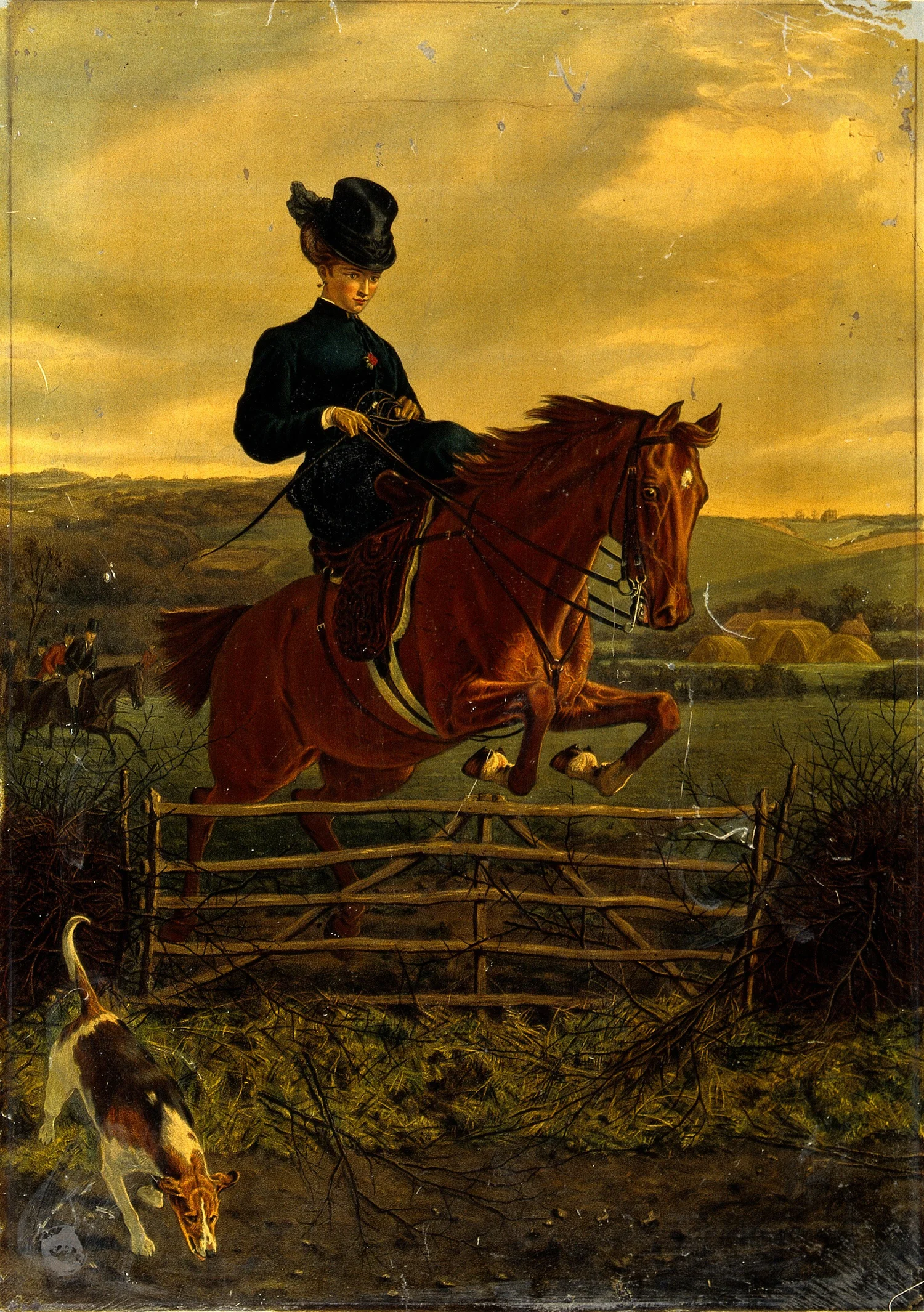
Charles Burton Barber, An Elegantly Dressed Horsewoman Jumping Over a Gate
In Scotland, a self-made millionaire’s daughter and niece fall in love with the same man.
Charles Gibbon (1843-1890) wrote some 30 novels beginning in 1864. This one features, in addition to some stock Victorian-novel figures (the ill-bred, wealthy industrialist, the self-sacrificing virtuous young lady, the young lover enraged by a misunderstanding) two carefully delineated and thoroughly interesting main characters.
Gibbon “has imagined the extraordinary fluctuations of” a main character’s “feelings . . . with remarkable felicity, and has drawn them with great skill. . . . It is an excellent and a very rare thing when the interest of a novel decidedly increases as it goes on.” Academy, September 9, 1875
The novel “should do much to give him a high place among delineators of character. . . . Besides containing several very masterly studies, it is full of humour, of quaint, wise, remark, and may be taken as a reliable picture of life in the district where the scene is laid.” Spectator, October 2, 1875
A new clergyman comes to a country town, which is ruled by his predecessor’s wife.
Richard Orton Prowse (1862-1949) wrote at least a dozen novels between 1892, when this one appeared, and 1934. Though somewhat marred by an implausible lovers’ misunderstanding, it provides a chilling portrayal of unthinking, self-congratulatory enforcers of social norms.
“A neatly and cleverly constructed story of life in a country town” with “skillfully handled characters. The story will repay perusal.” Academy, July 16, 1892
“Decidedly pleasant and readable,” with some “delicate, subdued touches of humour” reminiscent of Jane Austen. Saturday Review, July 16, 1892
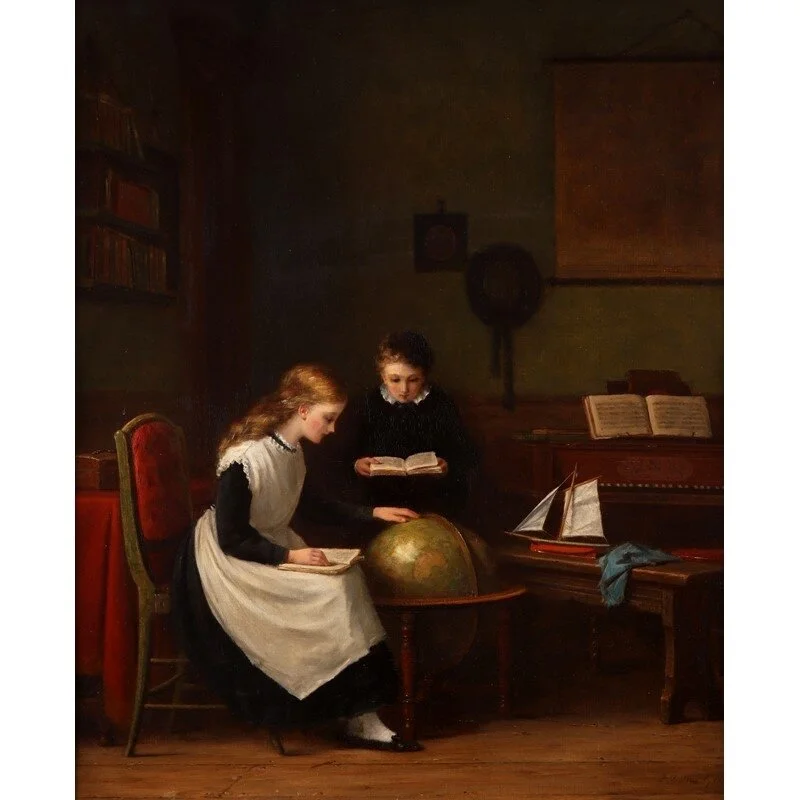
Frederick Daniel Hardy, Two Children Studying with a Globe and Piano
The former Widow Barnaby tours the United States.
Trollope spent some years in the United States, first at an anti-slavery community in Tennessee, then in Cincinnati, where she tried and failed to found a profitable retail business. She turned these failures to account in her first published work, The Domestic Manners of the Americans (1832), which established her literary reputation. She draws again on this material in her final installment of the Widow Barnaby trilogy.
“No writer of the present day possesses a quicker perception of the ridiculous, and a keener eye for detecting the weaknesses and defects in individual or national character, than Mrs. Trollope. To this add an almost masculine vigour of expression, and earnestness of purpose which leads her by the shortest route to the point at which she would arrive, a thorough contempt for the hypocritical conventionalities of society, and you have the key to a very remarkable literary paradox which exists with regard to this author’s works, namely, that although the majority of readers profess to dislike them, there are few contemporary writers who have acquired a greater degree of celebrity. . . . The fact is, she studies less the prejudices of her readers than the fidelity of her pictures. She shrinks not to paint nature as she finds it, to expose those hideous evils which rankle and fester beneath the decently disposed robes of society. . . . Here she . . . exposes the frightful moral taint which pervades society in all the southern states where the abominable system of slavery exists.” Sunday Times, August 13, 1843
We can “assure the reader of a hearty laugh at the versatile faculties of roguery wherewith the leading characters of the tale are endowed. Mrs. Trollope is never as much at home as when dealing with the foibles of her very good friends of the ‘model republic.’ Amidst a great deal of caricature, the most judicious friends of the Americans would admit that there is much in her writings which may serve for hints of a most useful kind.” Morning Post, August 23, 1843
The further adventures of the former Widow Barnaby, after her remarriage.
The saga continues.
“The sketches of life and society are often characteristic and amusing.” Literary Gazette, March 14, 1840
“‘The Widow Married’ will amuse all who are not over nice; and we are not sure that Mrs. Trollope ever hit off two portraits happier and more guiltless of caricature than those of the sisters Perkins.” Athenaeum, April 4, 1840
“It is a picture and an exaggerated one, but still a picture of some very disagreeable and immoral people.” Sunday Times, April 5, 1840
A self-assured social upstart makes her way in the world.
For Trollope, see Novels029,079,138. This is the first installment of a trilogy featuring the title character.
Readers “will be presently enchained in the interest of the tale; for Mrs. Trollope’s usual merit—that of directness of purpose, and a strong belief and interest in her own subject—does not forsake her in the present instance. . . . The tale proceeds naturally, cheerfully, steadily, till the third volume is half over; when a harlequinade of forced combinations and improbable adventures commences. . . . The Widow’s earlier achievements are a genuine and amusing comedy. . . . The account of her earliest exploits . . . is almost worthy of the authoress of ‘Pride and Prejudice:’ higher praise we scarcely know how to give.” Athenaeum, January 5, 1839
“To be sure the writer’s vulgarism, prejudices, and forced combination of melo-dramatic circumstances . . . mar the character of the work; but more than one of the personae dramatis, especially ‘The Widow,’ are originals, and yet truth-speaking portraits. The localities where the story developes itself, such as Clifton, Cheltenham, are capitally sketched, with all their provincial ambitions, scandals, and shabbiness.” Monthly Review, March, 1839
A millionaire philanthropist is haunted by one long-ago act of dishonesty.
William J. Locke (1863-1930) wrote some 40 novels, several successful plays, and a great many short stories. This novel is particularly good at representing the main characters’ mutual misperceptions.
“Character and plot are most ingeniously wrought and the conclusion, when it comes, is fully satisfying.” Spectator, December 7, 1901
“The plot is fresh and ingenious, and it is worked out with a simple directness of style, a resourcefulness of detail, and a fine idealism . . . uncommon enough.” Bookman, January, 1902
A virtuous young man loves an even more virtuous young woman, but is encumbered with a not-so-virtuous father.
Here is another novel by Marsh-Caldwell (see Novel069), uninhibitedly moralistic, but expert in plot and character.
“Though this tale is more tedious in its preamble—more precipitous in its conclusion than can be accredited” it “contains scenes” no other author “could have written so well. Few will be able to escape from her new story when once they have entered on it: few will question the vitality of some of its characters, and the force of some of its situations.” Athenaeum, January 12, 1850
“The characters are sketched with great talent, the incidents are described with vigour and effect, and, above all, the workings of the heart are wrought out in earnest, passionate language.” New Monthly Magazine, February, 1850
Florence Wilford (1836-1897) wrote some sixteen novels between 1858 and 1895, many of them for children or young adults. This one, though it does not directly attack Victorian social constraints, nonetheless vividly represents their destructive effect on talented women.
“A clever woman’s plea for clever women, made in a quiet and feminine manner, and yet ably and humorously turning the tables. . . . It is well and gracefully done.” Saturday Review, January 9, 1869
“Admirably worked out”; the heroine’s character is “delineated in all its true nobility, with really exquisite insight”; “a fine study of character under special circumstances.” Spectator, October 8, 1892
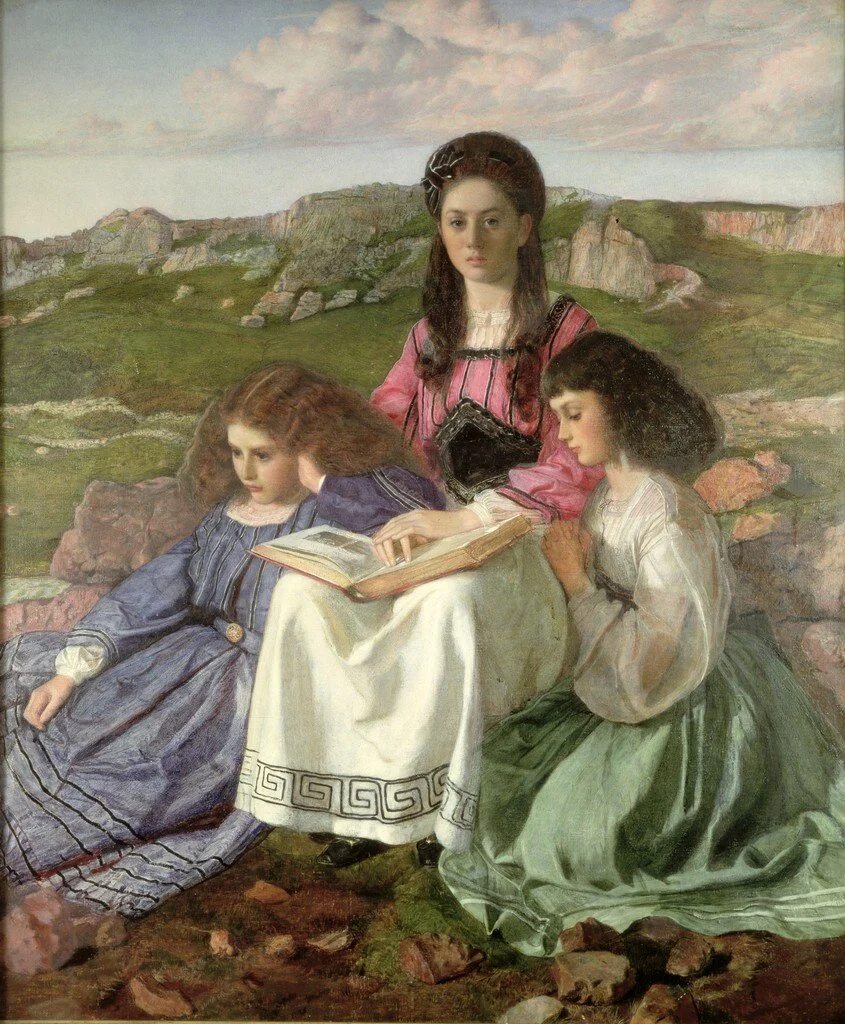
Three middle-class sisters grow up and find various fates.
Nothing is known about Cecil Maxwell, except that she (he?) wrote this one novel—a very good one, on the whole. All through its beginning and middle it is excellent in its kind, with complex, well-defined characters placed in interesting situations. Its end is marred by the sort of lover’s-misunderstanding plot that mars so many Victorian novels—the sort of misunderstanding occasioned by the inexplicable failure of A to ask B a simple yes/no question. But if you accept the premise that anybody might ever act that way, even the ending, though sad, isn’t bad.
“We cannot now do justice to the spirit and verve of ‘A Story of Three Sisters.’ It is full of brightness and colour. It is a poet’s novel. . . . The writer . . . is a very close observer of character and motives.” Westminster Review, January 1875
“This is a well-written story of common-place life, without much incident and without any exaggeration; it is carefully studied and well disseminated.” British Quarterly Review, January 1875
“The charming Story of Three Sisters owes . . . much of its attraction to a pure and graceful style. . . . The characters . . . are drawn with tender care and feeling. . . . It is rare to find so nearly perfect . . . a story . . . , which is one to linger over, and return to with a sort of nostalgie.” Academy, January 30, 1874
A gentleman accused of fraud in a bank failure is loved by two good women.
Here is another novel by Drury (see Novel64), featuring, amid a great deal of virtuous suffering, an eventful plot and some well-drawn characters.
“A thoroughly readable story, well written and well worked out, if due allowance be made for the improbabilities of the plot.” Westminster Review, July, 1863
“The plot is original, and well managed throughout, the characters well conceived and sustained. . . . the style pure, simple, and unaffected, and the interest uninterrupted.” Continental Monthly, January 1864
A virtuous young lady, orphaned and unwanted by relatives, is lured to India, where she has diverse adventures.
Here is another novel by Croker (see Novels013,073, 129), with a good (if somewhat episodic) plot, sharply defined characters, and a vividly realized setting.
The novel presents “the conditions and circumstances of Anglo-Indian life . . . as well as authors who take themselves more seriously. . . . The best part of the story is the picture of a third rate boarding house.” Athenaeum, March 1, 1902
“The book is fresh and vivacious; the pictures of Indian life are vivid and convincing.” Saturday Review, March 15, 1902
Charles Dana Gibson, Cosmopolitan Magazine Cover November, 1910
A dispossessed petty monarch cynically plots to extort money from his country and from an American heiress.
Richard Harding Davis (1864-1916), an American journalist, editor, fashion leader, and crony of Teddy Roosevelt, had time for only a few short novels. The characters in this one, though hardly complex, are entertaining, as is the action-packed plot—which features the unexpected but crucial intervention of a dashing young American journalist.
“It is a very pleasant story, and . . . it is written with not a little brightness and literary skill. Indeed, as a mere teller of a story Mr. Davis has nowadays few superiors: for he can always produce his effect with a few strokes of the pen. He is never diffuse, and consequently never wearisome.” Speaker, September 3, 1898
“Mr. Harding Davis’s new story is very slight, but it has charm. . . . It is extremely well conceived and arranged.” Academy, September 17, 1898
An Irish politician pursues an heiress, while a Polish anarchist and his Tsarist opponents plot against each other.
Here is another novel by Murray (see Novels009,068,127) with vivid characters, some of them remarkably unprincipled, and a thrilling, if implausible, plot.
“Secret societies and Polish and Irish patriots are not as a rule very promising subjects for a novel, and Mr. Murray has increased his difficulties by making his story a study of character first, and only secondarily a tale of exciting incidents. But the chief person is . . . excellently presented, and the plotting is . . . cleverly contrived.” Athenaeum, February 6, 1886
“It is hardly needful to say that the book is thoroughly readable, and a piece of skilled workmanship.” Academy, February 13, 1886
To support her ailing father, a virtuous young lady becomes a paid companion on an English estate.
Nothing is known about Mrs. Thomas Erskine except that she published four novels, of which this is the second. Its quietly interesting plot and striking characters ought to have led its author to a more prominent career.
“In the sustained fidelity with which the characters, few and simple as they are, maintain their consistency and distinctness, Mrs. Erskine shows . . . care and minuteness of observation.” Athenaeum, November 21, 1874
“It is admirable for observation, for humour, for pathos; it is refined without affectation, and interesting without effort. Even the subordinate characters—the supernumeraries who only cross the stage—are carefully studied and full of life.” Academy, December 1, 1874
A virtuous young lady marries a middle-aged attorney to please her dying mother.
Here is another novel by the other Molesworth (see Novel100), with well-defined characters placed in a carefully developed, interestingly uncomfortable situation.
“We have read it with a pleasure which is due partly to the inherent interest of the subject, hackneyed as it is, but mainly to the quiet dignity of the style, and a certain sub-acid flavour discernible throughout.” Molesworth has “hit off many of the weak points of provincial life.” Athenaeum, January 27, 1872
“The author . . . is an exceedingly graceful writer, with a good deal of literary taste. Her pair of sisters have evidently been a work of love, and some pride as well. We may congratulate her on a success.” The main character “is certainly made so life-like that we have learned to look at her with her creator’s partial eyes.” Saturday Review, June 15, 1872
A man of towering intellect resists the power of love.
Ellen Georgiana Clutton-Brock (1845-1894), née Eyre, wrote two novels, of which this is the first. The first volume is good, and the second excellent, as complex characters make believable mistakes; the third, in which Providence intervenes to reward and punish them, is not so disappointing as to ruin the the whole.
“The author of ‘James Gordon’s Wife’ has succeeded by sheer cleverness of writing in making readable, and occasionally really interesting, a story which in less able hands would probably have been insufferably dull.” Athenaeum, May 27, 1871
“The story is an ordinary one enough, with the incidents too obviously arranged to suit a moral; but it is told with a force and a liveliness which altogether redeem the book from the charge of being dull.” Spectator, September 2, 1871
Here is another novel by Aïdé (see Novel076), with a good plot and some striking characters.
“‘Penruddocke’ is a novel which shows a certain amount of power”; several characters are “well enough drawn to raise a story, in other respects carefully told, above the ordinary level.” Athenaeum, July 5, 1873
“Even the most blasé of novel-readers would find in this tale a plot sufficiently interesting to arouse his jaded senses, and yet it contains, at the most, only two incidents that can fairly be reckoned ‘sensational.’ It mainly depends for its interest on the clever way in which the plot is worked out, nothwithstanding the presence of an unusual number of dramatis personae.” Examiner, July 5, 1873
“Mr. Hamilton Aïdé has given us another of his carefully written and interesting stories. Without anything remarkable in power or new in incident, Mr. Aïdé always succeeds in engaging and holding our attention. . . . The plot is carefully worked out. . . . And he is careful in his writing; his English is simple, correct, and elegant.” Spectator, July 19, 1873