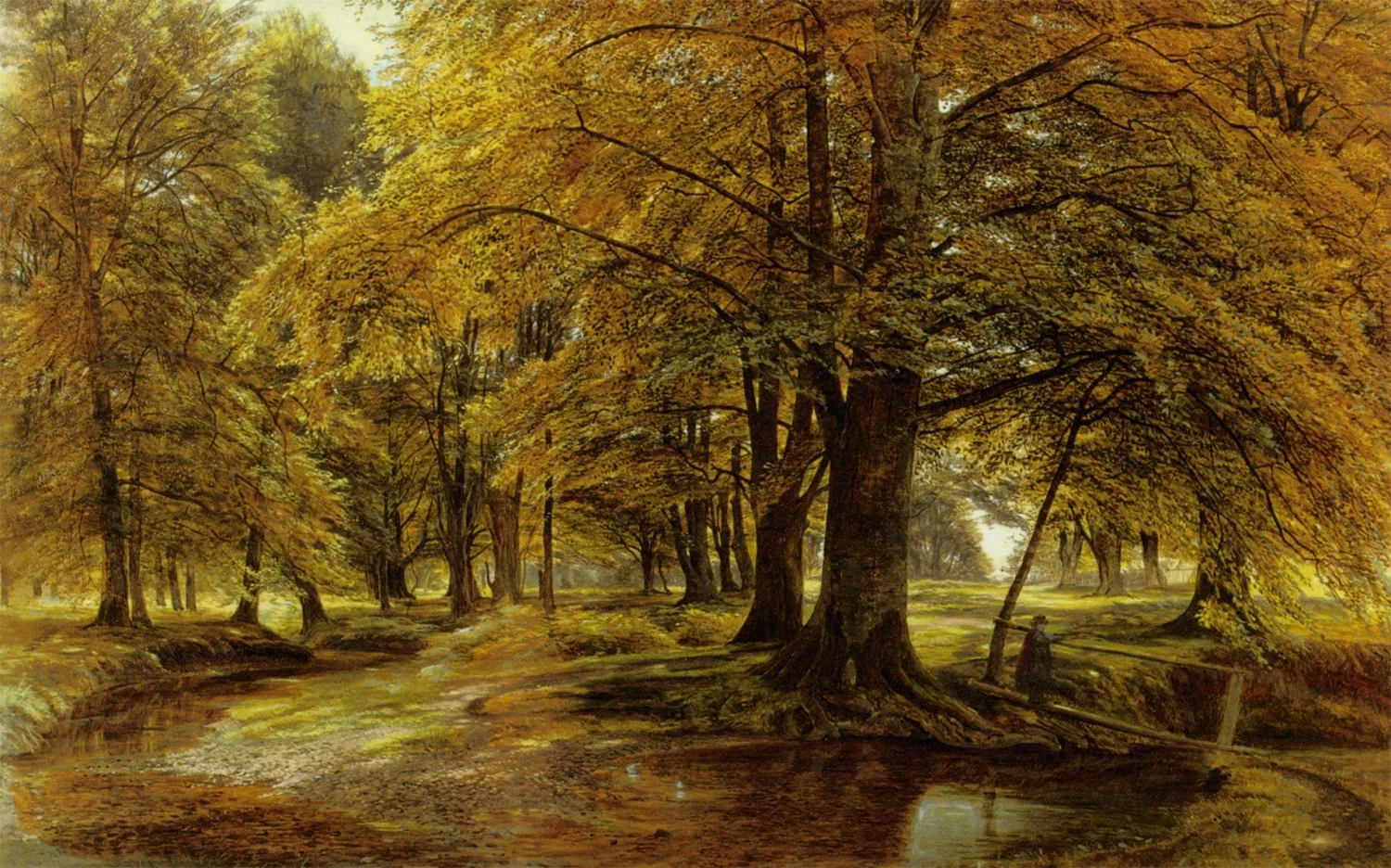
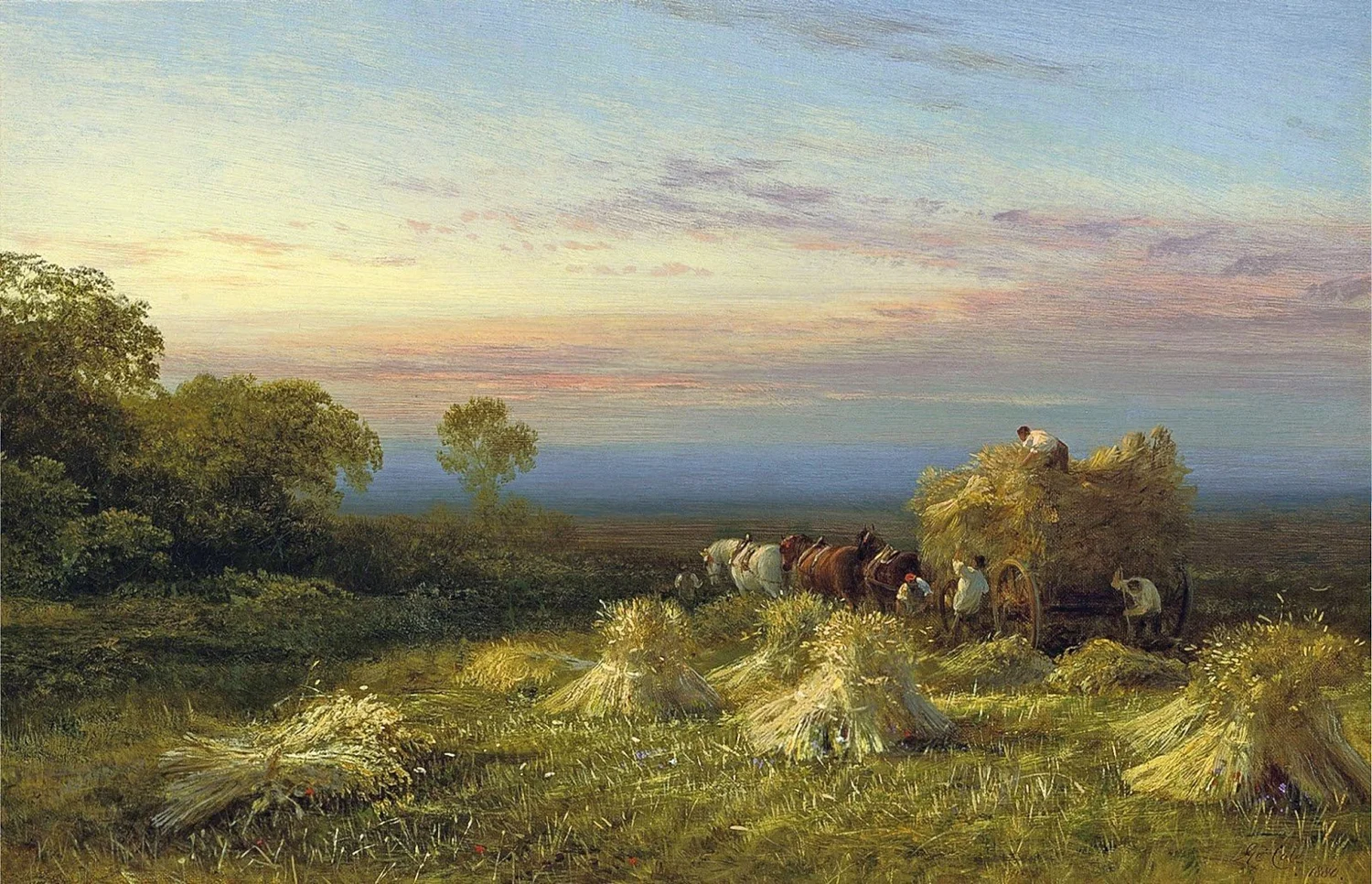
Thomas Sidney Cooper and Thomas Creswick, Farmyard Scene in Summer
Short-sighted solvers might be inclined to scoff at 60 Across in this week’s puzzle. But so did short-sighted critics scoff at Picasso’s cubes, at Rothko’s daubs, at Pollock’s drips—and who had the last laugh? When crosswords cease to make any sense at all, solvers will look back at 60 Across, and its relative nearness to sense, with a kind of bitter nostalgia, while future cultural historians will hail its ground-breaking, boundary-smashing departure from the dull routine of sense-making that had previously held puzzledom in its thrall. But go ahead and scoff—if you don’t mind the prospect of posterity’s scoffing at you.
This is a sort of sequel toPuzzle 188, but even more likely to produce in the solver not only sighs, but rolls of the eyes, shrugs of the shoulders, and other activities that increase blood flow, oxygen absorption, and synaptic transmission. Studies have claimed to disprove the theory that regular crossword-solving can delay the onset of dementia, but those studies did not employ the crosswords available here at David Alfred Bywaters’s Crossword Cavalcade and Weekly Victorian Novel Recommender.
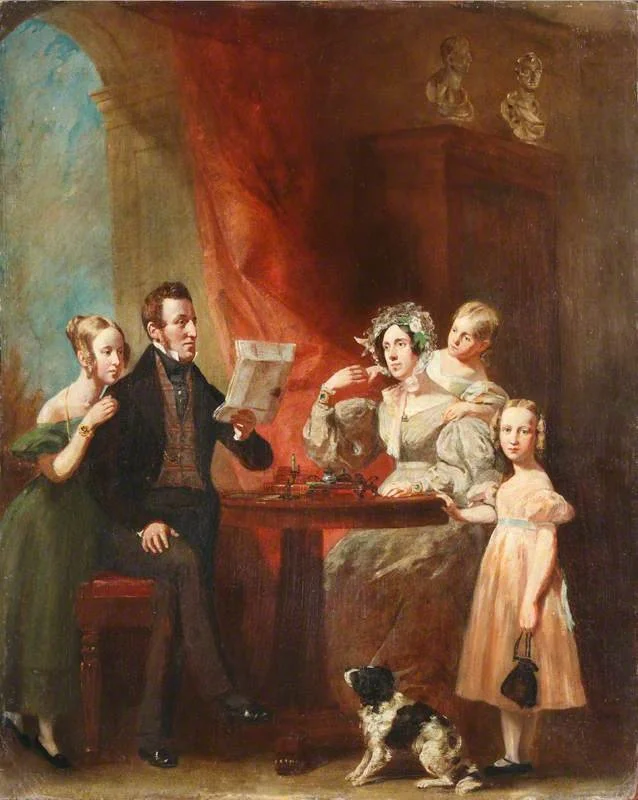
George Hayter, The Town Clerk of Brecon and His Family
Don’t let the title worry you—you can solve this puzzle, as you can all my puzzles, with the whole family gathered admiringly around you—unless, that is, you want to protect your progeny, during their impressionable years, from witnessing serious violations of linguistic norms.
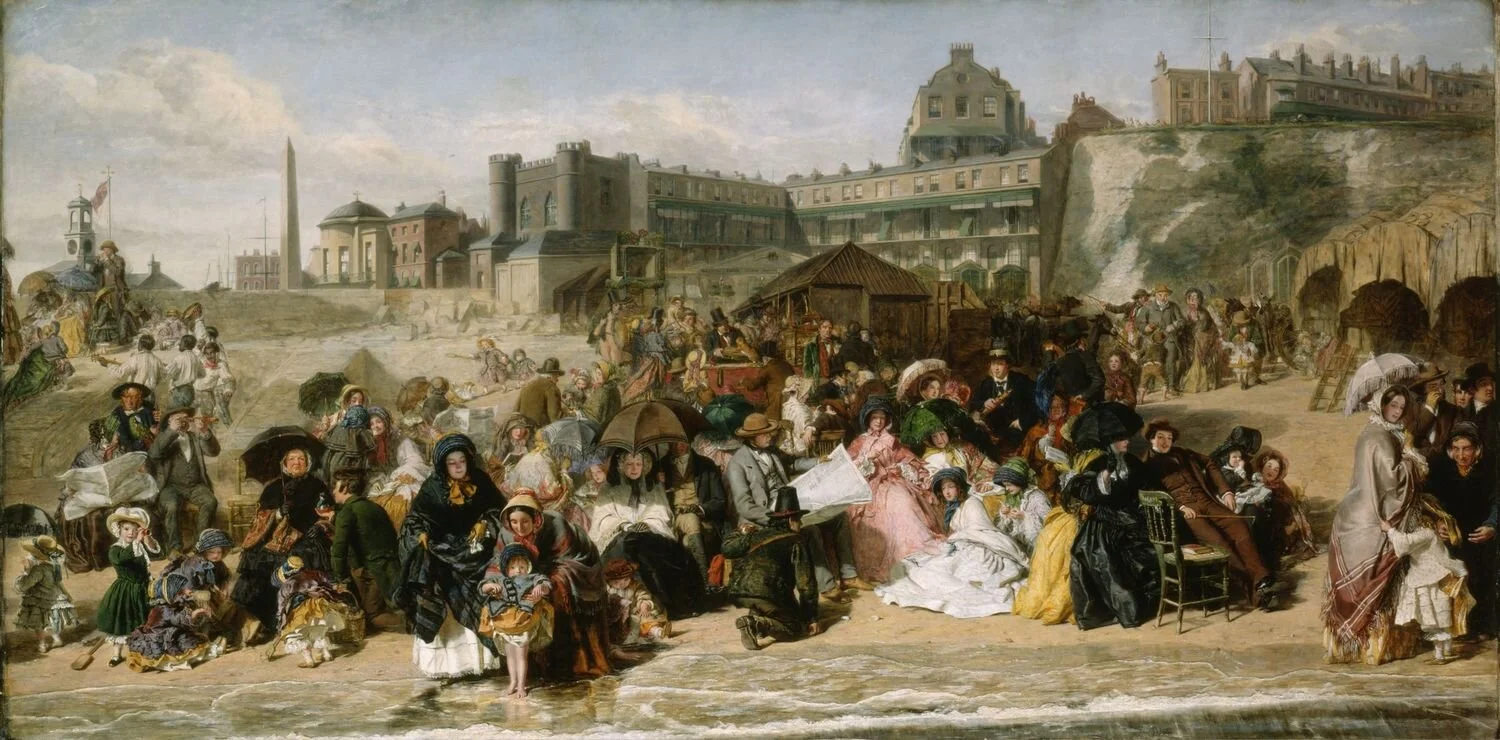
John Callcott Horsley, Critics on Costume, Fashions Change
After five weeks of unrelenting cruciverbal depression, it’s time for a change of pace; and that’s exactly what this week’s puzzle provides. Of course, you’ll nonetheless find in it all the usual qualities of puzzles on this site: norm-shattering formal innovation, the latest in culture, and a daring willingness to speak truth to power. (Also some wordplay.)
We at David Alfred Bywaters’s Crossword Cavalcade and Weekly Victorian Novel Recommender aren’t satisfied with the gems of wordplay that can be purchased in the public marketplace. We prefer to dig our own out of the bowels of the earth, braving darkness and damp, noxious vapors and the ever-present threat of semantic collapse—all so that you, the solver, can adorn your mental domicile at our expense, little suspecting the cost. But we wouldn’t have it any other way.
I give you fair warning: the Downs in this puzzle (at least the themed ones) are all Across. Now that’s just the kind of startling, long-overdue innovation you’ve come to expect of my puzzles; but, like most wonderful things, it comes at some risk: if you’re subject to vertigo, you might want to solve the puzzle while lying on your side.
I meant this website to be a cheerful place, filled with smiles and sunshine, and look what’s happened! Why, I wonder? Maybe it’s the crossword genre itself, which necessarily makes us cross and takes us down. As I’ve said before, I think the time is overdue for a radical reconceptualization of the form, one that ceases to valorize traditional numerical hierarchies (why should 2 always be greater than 1?), one that shatters the old boundaries imposed by binary grids of black squares and white squares, one that replaces the cross with the happy, the down with the up. I’m working on it.
Last week’s puzzle was called “Tossing It Down.” This week’s is called “Downspout.” The alert solver will suspect a pattern. In fact this puzzle is the second of this year’s summer series on David Alfred Bywaters’s Crossword Cavalcade and Weekly Victorian Novel Recommender, the fifth in a series of such serieses. It’s all about downness, explored from various points of view. Are you “down with that,” as the hipsters would say? Then it’s time to “get down,” as the hipsters would say.
When we at David Alfred Bywaters’s Crossword Cavalcade and Weekly Victorian Novel Recommender indulge in an occasional flagon of mead or snifter of usquebaugh, we like to savor it slowly, meanwhile discussing the issues of the day in an incisive but nuanced manner. However, we have no interest in confining ourselves to making only crosswords that “look like us.” We hope to cater to all tastes and types. So if you are one of those people whose approach to liquor, or to life, is to “toss it down,” here’s one that looks like you.
I’ve thought of converting this website to an “etail” enterprise—charging a dollar apiece for the crosswords, fifty cents per volume for the novel recommendations, and offering for sale an array of t-shirts, coffee mugs, and tote bags with my logo. I’m pretty sure I’d get rich quick. But I don’t do it. Why? Because I care about you, inadequately compensated solver. It would be simply wrong to tempt you into squandering on crosswords what you might spend on winter fuel or shoes for the children. I just can’t do it, and I won’t.
You can find alternating pentads in lots of places, and the same is true of biconsonantal pentads—but where else but here, at David Alfred Bywaters’s Crossword Cavalcade and Weekly Victorian Novel Recommender, can you find alternating biconsonantal pentads?
I’ve mentioned before my ambition of taking my art form to a new level heretofore undreamed of, one from which I and my disciples can look down on our rivals and predecessors with scorn—as abstract painters long ago learned to do at representational ones, or atonal at tonal composers. I think I’ve hit at last on a promising idea—crosswords in which the words don’t cross. Such post-crosswords will allow me to break through the limits by which other constructors are sadly constrained, forced as they are to think up words that share letters with other words at certain crucial points, and to free myself to achieve—what exactly? I haven’t quite decided, but certainly something incomprehensible to those hidebound traditionalists who continue to think that crossing words is the whole point of crosswords. If you are yourself such a traditionalist, I pity you; meanwhile, however, here is what may be one of my last works you’ll understand, though its title hints at the coming transition.
I’ve already posted a puzzle entitled “Yes” (Crossword 213); here’s another that celebrates this best of all possible worlds with a hearty cry of joyous affirmation, this time in radio jargon. Next, “You Betcha!”—a puzzle in which “you” is replaced by “tcha.” So far I’ve got LAT CHAT (“Shop-talk between physical trainers”); I’m sure three or four more will occur to me eventually.
(Clues to 25 Across and 50 Across were provided by test-solver Kevin Walker, whose clue-writing genius I’ve drawn on more than once already.)
Are you one of those good-natured solvers who claims to be “glad to learn about” some proper name or obscure fact that made some crossword difficult or impossible for you to complete? As a solver myself, I don’t share this gladness: I am never glad to learn, for example, that the actor who portrayed a character I’ve never heard of on a TV show I’ve never wanted to watch has such-and-such a first name. But as a constructor, I am, like all constructors, in debt to such solvers: and whenever I’m attacked for obscure crossword fill, I’m happy to claim that I’m just telling people things that they are, or should be, “glad to learn about.”
If you’re one of these easily gladdened solvers, I apologize for what may seem a certain lack of educational fill in this puzzle. There’s a writer at 67 Across and a Spanish word at 46 Across, but both are pretty well known. I’ll make up for this lack, however, right now, by telling you four things about “aces” I just learned myself from the internet.
1. The University of Illinois calls its College of Agricultural, Consumer & Enviornmental Sciences “ACES.”
2. A military airplane pilot qualifies as an “ace” only after destroying at least five enemy airplanes.
3. Some psychologists refer to adverse childhood experiences as “ACEs.”
4. Ace Hardware was founded in Chicago in 1924 by Richard Hesse, E. Gunnard Lindquist, Frank Burke, Oscar Fisher, and William Stauber.
Are you glad to have learned about these things? Well, I confess that I am not—but I am glad that there are people in the world who are.
As we trudge down life’s weary way, our point of origin forgotten, our destination unknown, the sun beating down on us, sand in our eyes, sores on our feet, oppressed alternately by boredom and by dread—isn’t it nice to have a new crossword every week?
We all got together without even telling you, much less inviting you, and decided that, for the future, you weren’t ever going to be invited again. A few suggested that maybe, out of pity, you might be allowed just to watch every now and then, when nothing very important was going on, but they were quickly and easily talked down. Sorry.
Success in any worldly endeavor—art, literature, law, dentistry, even crossword-constructing—depends on two things: a talent for self-promotion, and blind luck. To be sure, it doesn’t hurt—may even, in some cases, help—to do well the thing that you profess to do. But if you don’t know the right people, or if, knowing them, you don’t know how to persuade them of your ability, actually possessing that ability will avail you nothing; whereas if you do know these things, you don’t need actually to know anything else—even how to paint, write, litigate, fix teeth, or make crosswords. We here at David Alfred Bywaters’s Crossword Cavalcade and Victorian Novel Recommender have no ambition for success in anything but living well and doing good. But maybe you crave more solid rewards; if so, here’s a crossword that will give you some practice in self-promotion.
Rear ends have always been funny (see Chaucer’s “Miller’s Tale” for an early example in English), but rear-enders haven’t—until now! This week’s puzzle is one more installment in my effort to make everything funny. Next week: mildew!
There certainly is a lot going on in this week’s crossword, much of which will, I fear, escape the superficial observer. Like all my puzzles, of course, this one shapes society by including things I recommend (like garden statuary) and excluding things I deplore (like nuclear waste). But beyond that, it initiates several conversations we all need to be having these days—about the commercial appropriation of our wetlands, about big tech, about political polarization. I hope you’ll give it the close attention it deserves, even if it challenges some of your most deeply held habits and beliefs. Only through such ruthless self-interrogation can you hope to grow, not just as a solver, but as a human being.
Do you ever get the impression that people aren’t being entirely honest with you—that their stories are fabricated, their professions hollow, their affection feigned? Do you ever wonder whether in fact everybody else in the world is just a cleverly designed automaton, part of an experiment of which you, the only real person, are the subject? It would explain so much, wouldn’t it? Well, stop thinking this way—it isn’t healthy! We have a nice little crossword puzzle for you. Solve it; you’ll feel better.