A virtuous young lady is intended by her parents for one man but loves another.
Emma Newby (1825-1899) wrote 13 novels between 1854 and 1879. This one is chiefly notable for the chillingly calculated behavior of the heroine’s parents.
“The consciousness and confidence of power are visible in Mrs. Newby’s latest work, in which the reader will find a very romantic story very cleverly told.” Manchester Guardian, August 28, 1866
“The plot is sufficiently improbable, and its principal incident has been already made familiar to us by more than one novelist; but Mrs. Newby tells her tale with simplicity and feeling, and thus renders it touching and attractive.” London Review, September 8, 1866
A young intellectual becomes interested in a plain young lady neglected by her family.
Nothing seems to be known of Hope Stanford. This, the first of her two novels, though quite good, in my opinion—its heroine especially is refreshingly unusual in her plainness and ill-temper—was not very well received.
“There is a good deal that is thin and common-place in this novel, but also decided tokens of originality and dramatic instinct. . . . One or two of the characters on which the author has spent most pains are exceedingly well done.” Contemporary Review, July, 1884
“This is a pleasant, simply written story with which there is little fault to find. We think the writer has aimed somewhat too high, and that her characters are hardly sufficiently worked up. . . . Still the interest is well kept up. . . . Finally the writer possesses one merit dear to the heart of all critics. She knows what she wishes to say, and says it in clear simple language, pleasantly free from mannerisms and strainings after effect.” Scottish Review, October 1884
A contrasting view:
“There is practically no plot, and the incidents are neither happy nor well contrived. The situation selected for study is tolerably good” but “the three volumes demand more compression and conciseness.” Athenaeum, May 10, 1884
A needy aristocrat falls in love with a proud cotton-manufacturer’s daughter.
Archibald Boyd (1801-1864), born in Scotland, emigrated to Australia in 1838, and in the 1840s worked to represent the interests of the Australian squatters in the British Parliament. In 1849 he returned to England and took up novel writing; this is the second of the four novels he wrote between 1850 and 1856.
The obviousness of its plot “does not prevent ‘The Delameres’ from being a fairly good novel of its kind.—Too much time is spent at its commencement among the small people of the small town where the tale begins . . .; but from the moment that the curtain falls upon their twaddle and tea-drinking, the action and passion move rapidly enough:—and we read on, with as much eagerness as though we had been unable to foresee for a page’s length what was going to befall the lessoned hero and the lesson-giving heroine!” Athenaeum, January 24, 1852
“The most remarkable quality of this novel is style, or the power of presenting the writer’s images and ideas neatly, tersely, and with a quiet but sustained animation. . . . The author has studied the externals of life and nature; he has a certain knowledge of present society from observation or hearsay, and of the past from books or tradition; he is clever in the mere contrivances of the fictionist to extricate his story from entanglements, or to carry it on. . . . But . . . he is better in narrative than in dramatic development. . . . When the author has to plunge his dramatis personae into difficulties in order to clear them up . . . he breaks down, from the want of knowledge of the events of life.” Spectator, May 22, 1852
A young man is called to war in India; meanwhile the brother of the woman he loves strives to begin a literary career.
“An exceedingly pleasant story, partaking of the kind called rattling, but with some strong situations, and some characters by no means ill drawn.” Academy, November 29, 1879
“It happens but rarely that among the number of novels which call for . . . attention . . . we find one we regret to part with. . . . Mr. Follett-Synge’s novel is a rarity of this kind. . . . The book is full of character, and the kind of wisdom which we can only call knowledge of the world. . . . There is . . . a spirit as kindly as it is discerning . . . a true delineation of the ‘gentleman’ and ‘gentlewoman,’ a refined playful humour. . . . It is, . . a book which becomes a friend.” Spectator, December 13, 1879
“The author . . . is an ingenious novelist, whose calm audacity of conception does him credit. By assuming, as a matter of course, the probability of the incredible, he has laid the foundations of a decidedly clever novel, and may carry nine-tenths of his readers triumphantly along with him.” Saturday Review, December 13, 1879
A contrasting view:
“We have seldom come across so unequal a book. . . . At times, both in style and dramatic force, it is excellent, while at others flat and unprofitable.” Examiner, January 17, 1880
Two Quaker orphans are brought to live with their worldly great aunt.
Agnes Macdonell (1840-1925) wrote three novels in the 1870s, of which this is the last. The title characters’ earnestness grows wearing at times, but their selfish, self-deluded aunt is a lot of fun.
“There is a natural ease about the progress of events which is the result of care and thoughtfulness. The story is, in fact, in admirable harmony with the refinement and self-restraint shown in the characters.” Athenaeum, March 22, 1879
“A book for people who prefer homely scenes described with humour and delicacy.” Academy, April 19, 1879
A (somewhat) contrasting view:
“A very readable novel” but “spun out with gratuitous prolixity.” Saturday Review, May 10, 1879
“The book is decidedly both good and interesting. The drawing-room conversation and small-talk of a country town are well given, as far as the dialogue is concerned; while the incidents are natural and the characters well sustained. There are touches of pathos here and there, which we must rank with a higher style of composition than that usually attained in works of this class.” New Quarterly Review, April, 1859
“The best idea we can give the reader of the work before us, is to suppose the celebrated philosopher in Goldsmith's Citizen of the World transformed into” its narrator. “As he is a man of vast sympathies, very enlightened views, and a great love for his kind, and having withal peculiar facilities from his position for studying character, it may be imagined that his letters are pregnant with philosophical reflections on modern society. . . . ‘Confidences’ is written in the most pleasing manner of any novel we have read for years past.” Leader and Saturday Analyst, June 11, 1859
A contrasting view:
“These ‘Confidences’ are of the mildest interest. If we were ill-natured, we should call them insipid. The style is pleasant and well bred, but the matter in hand has neither bone nor muscle. The story, if story it may be called, is rambling gossip about a small parish. . . . There is no precision of touch in either the dialogue or description, whether of people or their belongings. There is a rather pleasant flavour in its gentle dullness, but the ‘Confidences’ were not worth making.” Athenaeum, July 9, 1859
A childless baronet with an entailed estate, living unhappily with his wife, decides to adopt a child.
For Gore see Novels012,072,118,172. The characterization here is excellent throughout, even if the plot, towards the end, grows a little over-fanciful.
“Mrs. Gore has added another charming work to her delightful list; a work no less conspicuous than its predecessors for the interest and naturalness of its plot, the ease and simplicity of its development, the flesh and blood and bone of its characters, the pointed, happy satire, the good humour, and the pathos and passion of its language.” It is “a work that from the first page to the last has scarcely a barren page—scarcely a leaf in which some trait of character—some powerful yet natural incident, some witty yet good-tempered observation on life, its men or its puppets—does not promise to secure it from the fate which, season after season, awaits tens of thousands of leaves denominated fashionable novels.” Examiner, October 14, 1838
“Like all Mrs. Gore’s novels, The Heir of Selwood displays an intimate observation and no slight acquainance with the human heart. The story . . . is replete with interest; and the effects upon the principal actors at different periods of their lives, when young, middle-aged, and elderly, are very naturally as well as very forcibly painted.” Literary Gazette, October 29, 1838
A (somewhat) contrasting view:
It is “excellent in the complication of its story” but “sadly deficient in the solution of the same.” Athenaeum, October 27, 1838
A factory-owner’s nephew falls in love with a working girl.
Sabine Baring-Gould (1834-1924) wrote some fifty works of fiction and nearly a hundred other works in various genres, including the hymn “Onward, Christian Soldiers.” This novel consistently entertains despite its sometimes contrived damsel-in-distress plot.
“A domestic novel of some merit. . . . The narrative, simple as it is, is worked out so well, and with so true an adherence generally to nature, that . . . the author deserves considerable credit”; he has also “a fund of shrewd sense.” Athenaeum, June 27, 1868
“A highly original and vigorous novel, although the promise of the first volume is not quite sustained.” Spectator, September 12, 1868
A contrasting view:
“In incident and plot it is most deficient, and in style it is decidedly vulgar. It possesses no redeeming point.” Examiner, September 12, 1868
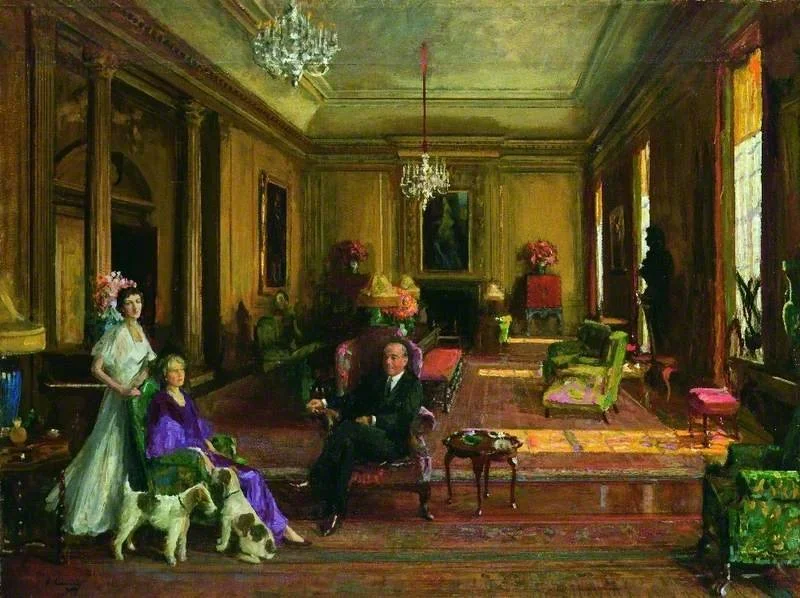
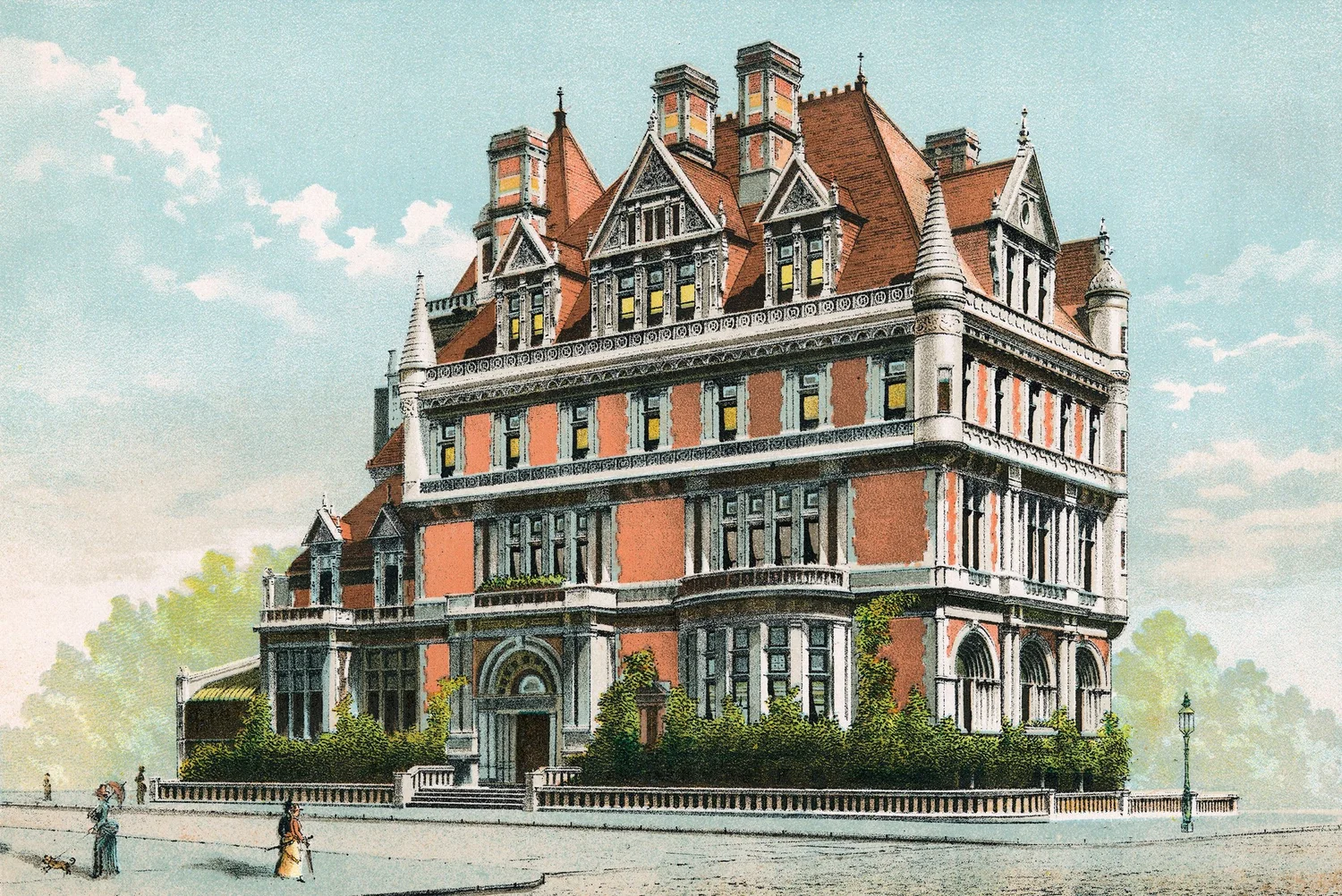
Cornelius Vanderbilt II Mansion, Fifth Avenue, New York City
The superlatively beautiful nieces of a New York City plutocrat are suspected of his murder.
Anna Katharine Green (1846-1935) was a pioneer in detective fiction; this was her first and most successful novel.
Green “has worked up a cause célèbre with a fertility of device and ingenuity of treatment hardly second to Wilkie Collins or Edgar Allen Poe.” Christian Union, January 22, 1879
“An interesting story of mysterious crime. . . . The characters act and speak much as they might do in the circumstances, and every detail has been carefully thought out.” Academy, February 22, 1879
A (somewhat) contrasting view:
“It seems to us a defect in this story, that the very beginning of it gives a tolerably plain hint of the end. . . . Compression, too, might have been applied, with much benefit. . . . Still, The Leavenworth Case is a meritorious effort.” Spectator, March 15, 1879
The orphaned daughter of an impecunious clergyman makes her way in the world.
Mary Emma Martin (1845-1931) wrote some 32 novels during the Victorian period, many of them directed to children or young ladies. This one, her first, though equipped with routine Victorian characters following a routine Victorian plot, is nonetheless intelligent and engaging.
“There is no praise too high for Mrs. Martin’s delightful story.” Academy, June 21, 1878
An “admirable little novelette, . . . spirited, interesting, refined and humorous.” Spectator, November 23, 1878
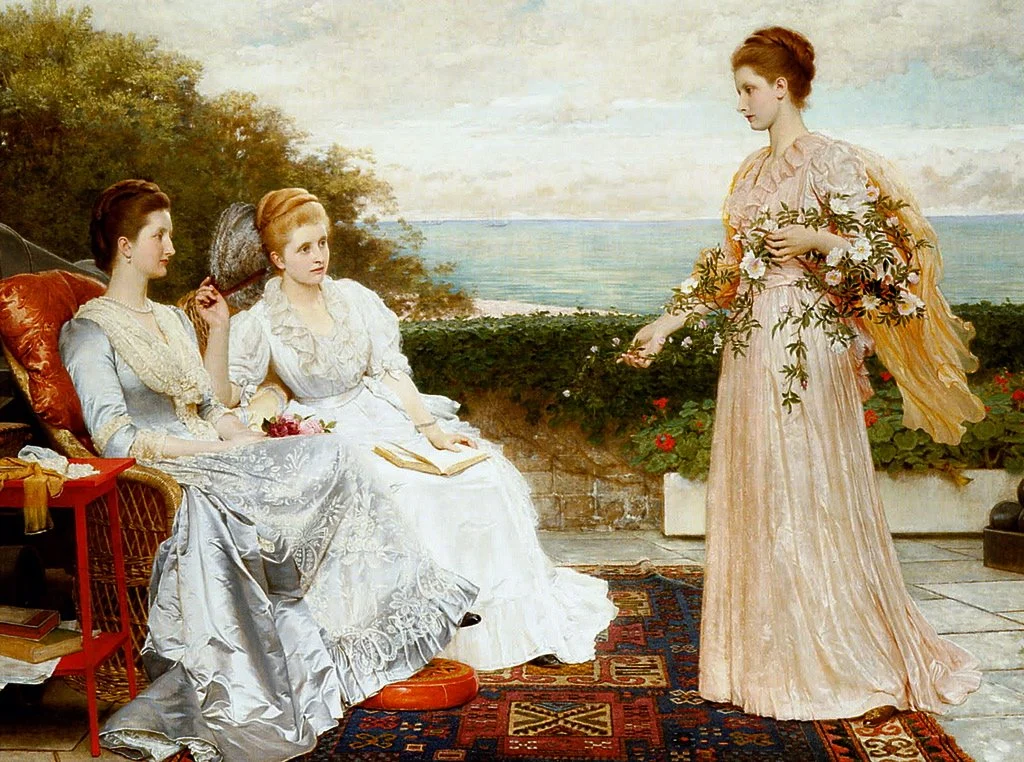
Charles Edward Perugini, The Ramparts, Walmer Castle
A young man, finding himself heir to a lordship and large estate, is besieged by scheming relatives.
Julian Sturgis (1848-1904) specialized in light comic novels, of which he wrote a dozen or so, including, obviously, this one.
“Mr. Julian Sturgis’s ‘Comedy of a Country House’ is something like what a comedy should be—bright and vivacious, rapid and amusing, yet with occasional touches and suggestions of deeper feeling. The cynicism is cheery rather than depressing, and there are some typical men and women lightly and knowingly sketched. The dialogue is sprightly and natural.” Athenaeum, July 6, 1889
“The finish and lightness of touch which characterize Mr. Julian Sturgis’ work appear at their best in this entertaining story.” Literary World, November 9, 1889
A contrasting view:
“Mr. Julian Sturgis is a very clever man, and there is so much cleverness in his Comedy of a Country-House, that no reader who knows good work when he sees it can fail to render hearty and ungrudging admiration. And yet . . . mere cleverness is an essentially unsatisfying quality. . . . Like a display of fireworks . . . it is very attractive for the time, but it leaves nothing behind it.” Spectator, July 27, 1889
Three orphaned girls live with an unsympathetic guardian.
Here is another novel by Scott (seeNovel 022), with vivid characters and an involving, complex plot.
“The . . . incidents of this story . . . are so many, minute, and intricate, that it would be a very hard task to unravel them intelligibly, even if we could spare a full folio column for the attempt. However, we will say of them that they amuse and interest, and in their development the authoress has displayed great tact and no small share of talent. . . . As a story confined to domestic occurences it would not be easy to point out one of recent date more amusingly narrated.” Observer, April 29, 1850
“There is a strain of pleasant, lively narrative in this novel, which carries the reader onward with unflagging attention, and permits no single page to be dull or wearisome. The characters are drawn with uncommon spirit. . . . The story is well contrived, and the denouement ingeniously kept out of view till the latest moment; curiosity is ever on the stretch to know how it will end.” Critic, May 1, 1850
A contrasting view:
A “record of family intrigues, put together, perhaps not without skill, but unenlivened by any graces of composition or by any display of the feelings that raise and dignify human nature.” Morning Post, May 18, 1850.
In a small Indiana town, an idealistic young woman marries an unstable young man.
Here is another novel by Eggleston (see Novel162) this one set not in New York City but in an Indiana town like that in which the author was born and raised.
“‘Roxy’ may be accepted as the latest example of a purely American novel, and to say the least, one of the very best. . . . It is the genuine product of the Western soil, inspired by familiar personal knowledge of the people and profound sympathy with primitive life in its early imperfect manifestations. The writer has drawn exclusively from Nature, without the aid of caricature or fictitious embellishments.” New York Tribune, October 1, 1878
“A remarkable novel, so remarkable that you feel bound, having once begun its perusal, to finish the two volumes at a sitting, and inclined to dip into them at odd moments afterwards, and roll passages as sweet morsels under your tongue.” Spectator, October 5, 1878
A contrasting view:
The author “is often lively, at times vigorous, though his liveliness and vigour would have been far more apparent had he cut down his story at at least one quarter.” Saturday Review, November 9, 1878
Annie Louisa Walker (1836-1907), encouraged by her second cousin Margaret Oliphant, wrote half a dozen novels between 1873 and 1894. This one is inventive and amusing, and also reassuringly conventional.
“As a piece of genuine, careful, and successful work, Lady’s Holm will bear a very favourable comparison with most of the ‘new novels’ of the season. There are a grace and ease in the writing, a faithfulness in the execution, and a tenderness in the manipulation which more than make up for a certain want of freshness and originality.” Academy, August 31, 1878
“While there is a great purity and freshness about what she writes she also has considerable power of drawing character, and making it harmonize with its surroundings”; the novel “will be found well worth reading by all who can enjoy picturesque description and good incisive delineation of character.” Spectator, September 7, 1878
A contrasting view:
“A rather pretty story, quite harmless, and suitable for unexacting novel-readers of every age.” Athenaeum, August 3, 1878
A virtuous young lady falls in love with a Byronic hero, her brother with their pretty cousin.
Here is another novel by Walford, for whom see Novels018,066,121, and174.
“The incidents are as interesting as is consistent with probability, and . . . the principal characters behave and talk like ladies and gentleman. . . . Walford has a keen appreciation of the irony of life.” Athenaeum, October 13, 1877.
Walford has a “faculty for observing certain types of society, which to a more careless eye would present no salient points to be seized and tabulated”; she can “take a perfectly commonplace mortal out of a crowd, and so . . . set him before a reader that the truthfulness of the presentation shall be at once recognised, and the individual become a personal acquaintance.” Academy, November 3, 1877
A contrasting view:
“There is an air about the book, a pretentiousness, an aplomb, which led us to feel that there must, somehow, be something in it. . . . Unquestionably there is something about it different from other novels; but we are unable to say that this difference is in its favour. The story never gets hold of us, and the characters come like shadows, and so depart.” Observer, October 14, 1877
A pair of British criminals try their fortunes in Canada.
Here is another novel by Murray (see Novels009,068,127,181), filled with vivid characters and exciting adventures.
“Slight as is the tale, its cleverly managed incidents, local colouring . . . and first-hand knowledge of some curiously freakish products of our complicated modern life will reward the rapid reader.” Athenaeum, May 15, 1897
“We found it excellent reading. . . A fine spirit of farcical humour makes all his rascality sympathetic.” Saturday Review, May 22, 1897
A contrasting view:
“As a whole, it does not seem to hang together very well.” Spectator, February 19, 1898
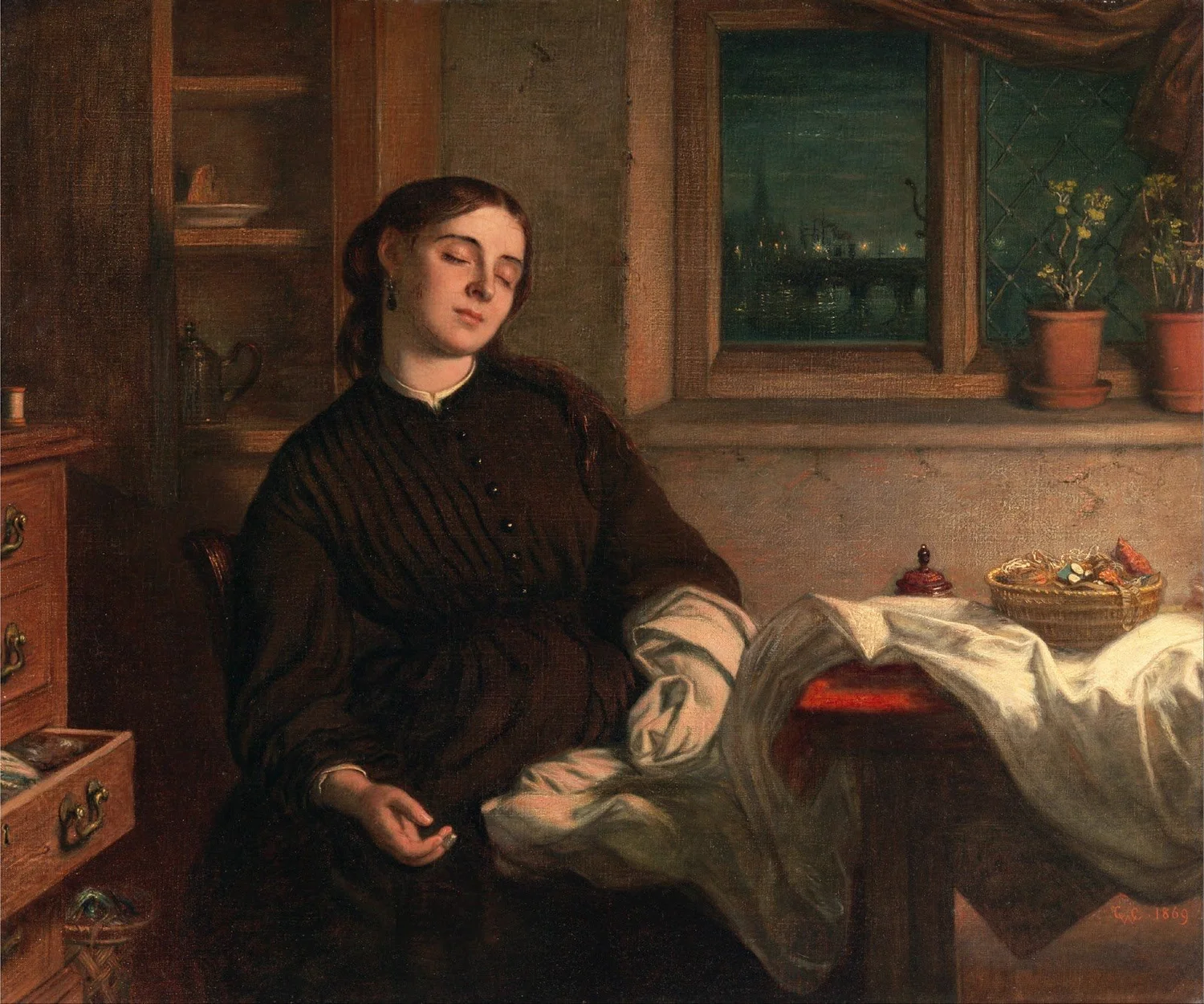
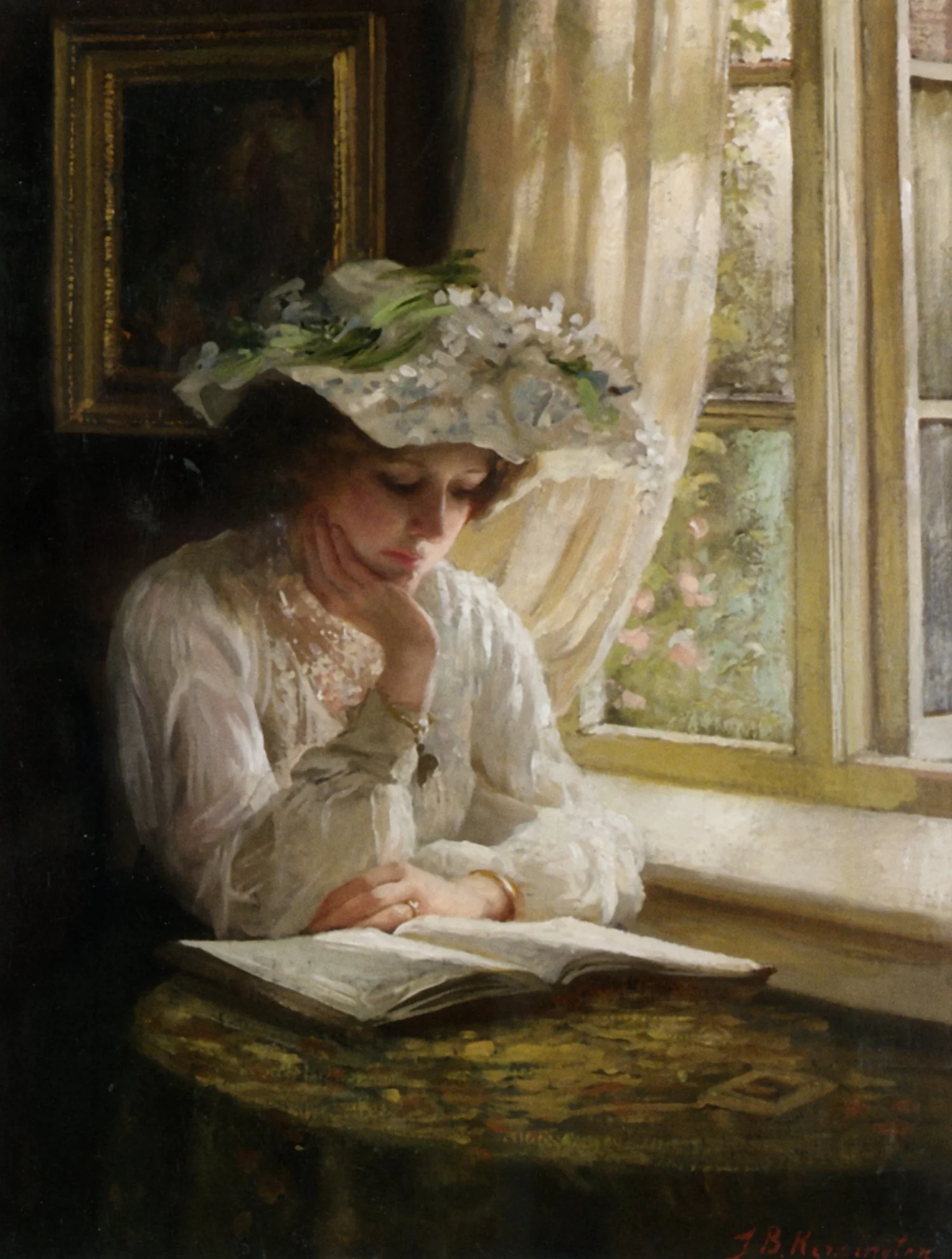
Thomas Benjamin Kennington, Lady Reading by A Window
An ordinary middle-class girl lives with her neglectful father in a small, gossip-prone city.
About Jane Ashton nothing appears to be known. This is her only novel. It is odd in its abrupt ending and its jaded view of human nature, which however it convincingly represents.
“The author has copied nature with fidelity. Her descriptions are minute and painstaking; and her manner, formed after Jane Austen, is not ill-adapted to convey a clear and distinct impression.” Athenaeum, May 11, 1878
“Sophia is a very brief tale of a very dull life in a small cathedral city. It . . . merits commendation for the attentive study which the writer has given to certain social types discoverable in most country towns, but so handled in this story that they are persons and not lay figures. The skill of the work lies in the fact that, although the heroine is . . . thoroughly commonplace . . . yet a certain compassionate interest in her fortunes is aroused . . . by means of . . . uncompromising realism of treatment.” Academy, July 13, 1878
A supplementary remark:
The Athenaeum review continues: “Miss Ashton will never please a large circle of readers if she devotes so much more care to the detection of the weaknesses of characters than to the illustration of their virtues. It is an unprofitable kind of cynicism which gives us only two endurable characters out of two dozen, and which exhibits those two as impersonations of the commonplace.”
The further adventures of an unscrupulous dentist and the heiresses who attract his interest.
Here, as promised, is the sequel to last week’s novel.
“Miss Braddon’s enlarged experience as a writer of fiction is very discernible in this volume, which is decidedly one of her best, if not the best, she has given to the public. . . . Charlotte’s Inheritance is well written, and contains some excellent character-drawing, unspoiled by exaggeration for mere effect. Even the very repulsive personage, so indispensable to the authoress . . . is not, it is painful to confess, without his probabilities.” Spectator, October 25, 1868
A contrasting view:
It “seems to have been put together for the stage, and with an eye to effects. It is an extremely disagreeable story, and it has nothing to redeem its coarse reality.” Athenaeum, March 21, 1868
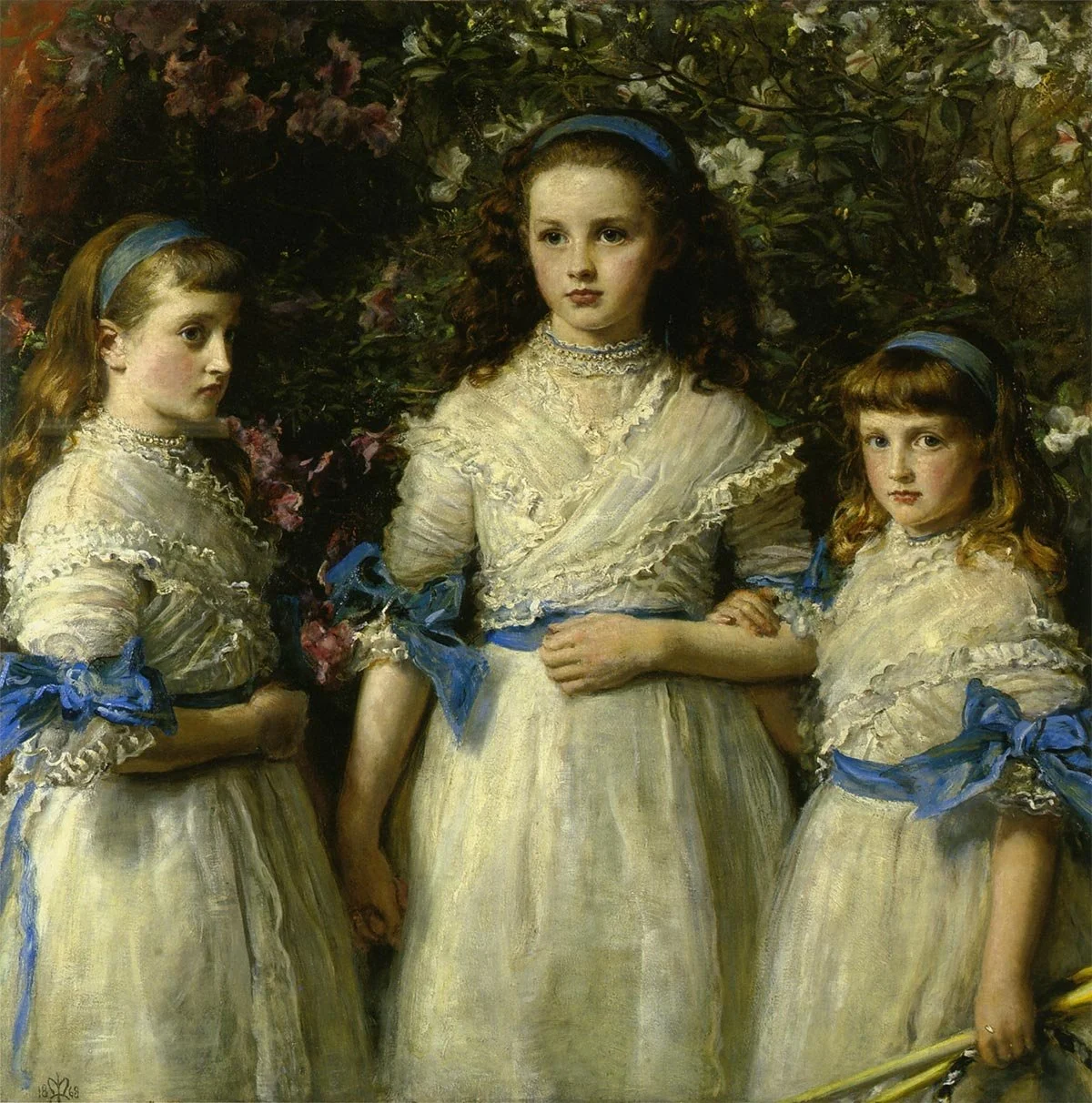
James Jacques Joseph Tissot, Portrait of Miss Lloyd
An unscrupulous dentist will stop at nothing to acquire the fortune of a vulnerable heiress.
For Braddon, seeNovels 004,061,115, and170. The sequel of this shocking tale will be recommended next week!
I was unable to find a good review of this novel, so here are some bad ones:
It “excites unsatisfied curiosity at the commencement, weariness in the middle, and indignation at the end.” Athenaeum, October 12, 1867
“The book, we cheerfully concede, has one merit. It is in Miss Braddon’s power, and the power is very rare indeed, to create by her pen a sort of mental atmosphere, to tinge the air of her tales so that you must see the characters under the false colour she pleases to throw over them.” Spectator, October 26, 1867
For McCarthy, see Novels059,163. This one includes, surprisingly, an episode set in a university town in the American midwest.
“There is a delightful variety in Mr. McCarthy’s characters, who are drawn with precision and distinctness, and with a freshness which gives them originality. . . . ‘Dear Lady Disdain’ is never dull; the incidents are well woven into the story; and, though the plot is not intricate, the interest is excellently kept up, and the book is bright and healthy throughout.” Athenaeum, December 4, 1875
“Mr. Justin McCarthy’s new story has much freshness and merit, and marks progress in care and finish. . . . Mr McCarthy deserves one further word of commendation for his American scenes, which are quite free from the exaggeration, caricature, and occasional vulgarity of treatment which writers who could only copy the faults of Mrs. Trollope and Charles Dickens have made too common in ephemeral literature.” Academy, January 29, 1876
A contrasting view:
“Justin McCarthy will write novels no matter what critics advise to the contrary. Very well. There is no literary law against it; it is nowhere recorded that the silkweaver, if he chooses, shall not chop wood. . . . But for all that Justin McCarthy can not write novels. . . . The man appears to have no fancy. As for dramatic power he does not know what it means. In his English there is a monotone like the striking of a board upon a board.” St. Louis Post-Dispatch, January 15, 1875