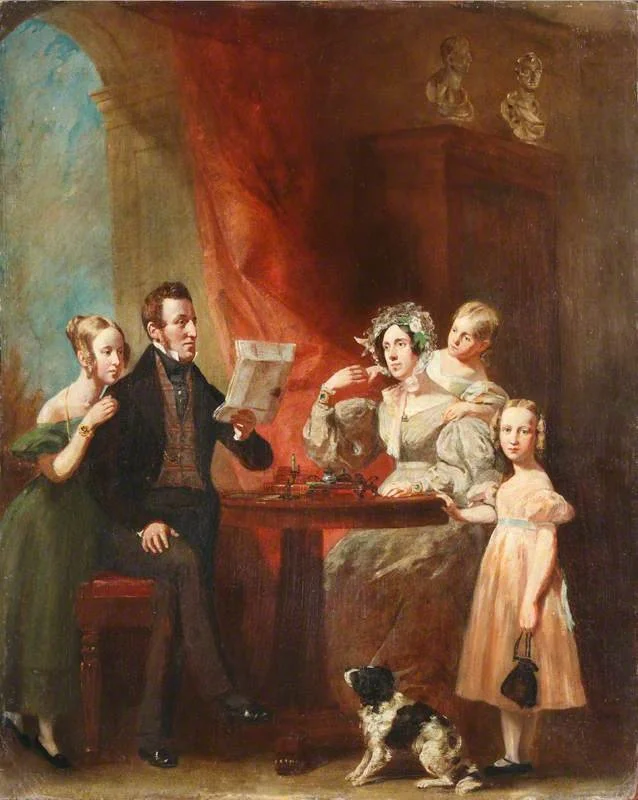
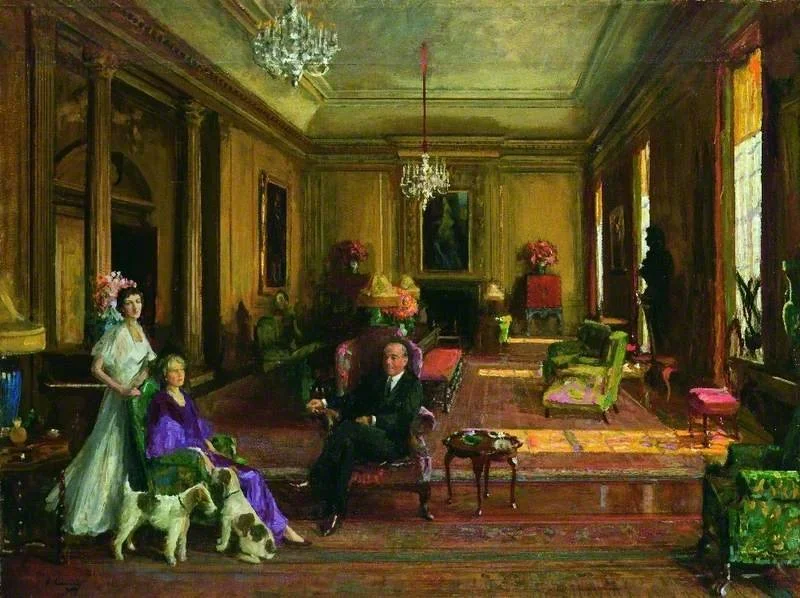
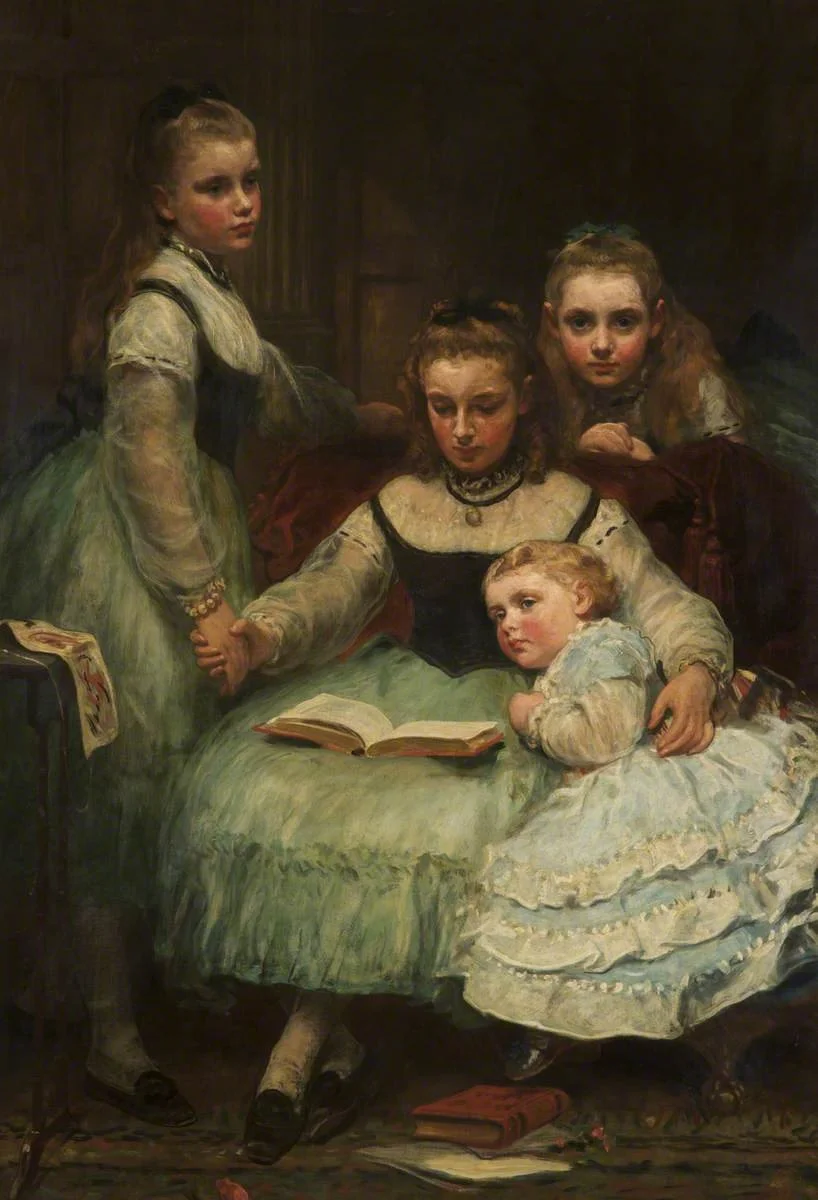
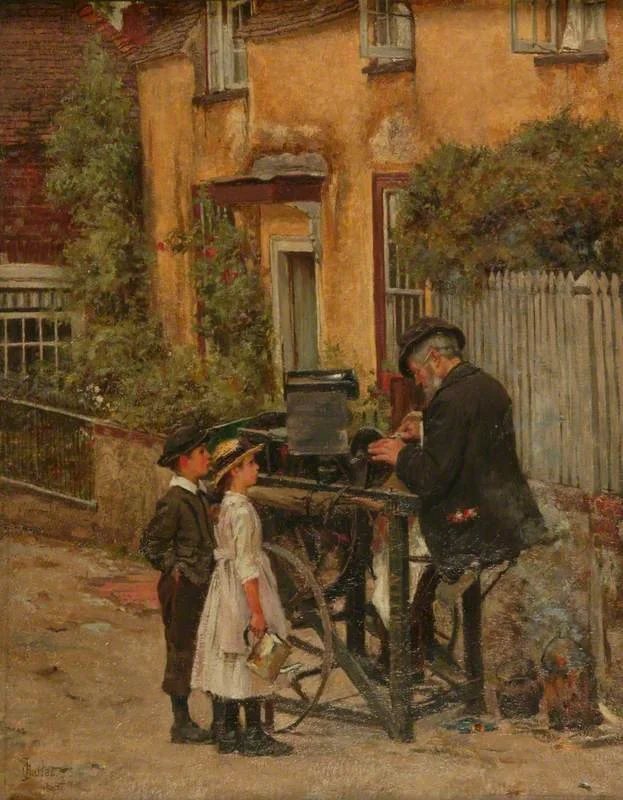
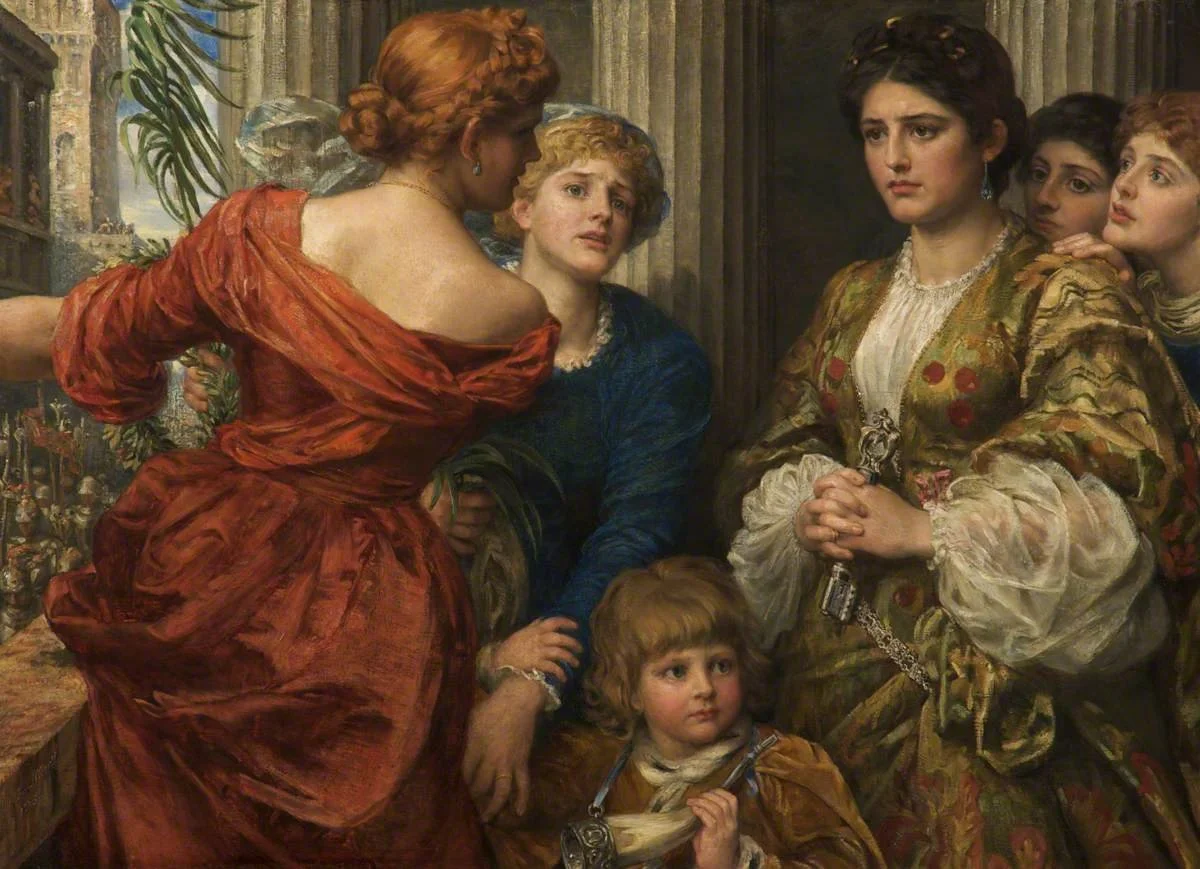
George Hayter, The Town Clerk of Brecon and His Family
Don’t let the title worry you—you can solve this puzzle, as you can all my puzzles, with the whole family gathered admiringly around you—unless, that is, you want to protect your progeny, during their impressionable years, from witnessing serious violations of linguistic norms.
Two genteel sisters, one virtuous, one beautiful, are left in poverty, to make a living as seamstresses.
For Marsh-Caldwell, see Novels069,187. Despite the obvious didactic purpose of the contrast between the novel’s sisters, its characters are lifelike and its plot involving.
“We like the tale for its delicate shading of individual characters chosen from the most every-day life.” Literary World, August 3, 1850
The author “has depicted, with her usual vigorous and truthful colouring” the wretched lives of seamstresses. Critic, November 15, 1850
A (somewhat) contrasting view:
“‘Lettice Arnold’ is the work of a woman—a woman who has great facility of composition, and considerable imagination, but little judgment. It is literally ‘stuffed full’ of prejudices, especially against light literature as it is produced in France”; but it “is well written; and . . . it is one of the few novels which can be perused with pleasure and resumed without pain.” Observer, November 4, 1850
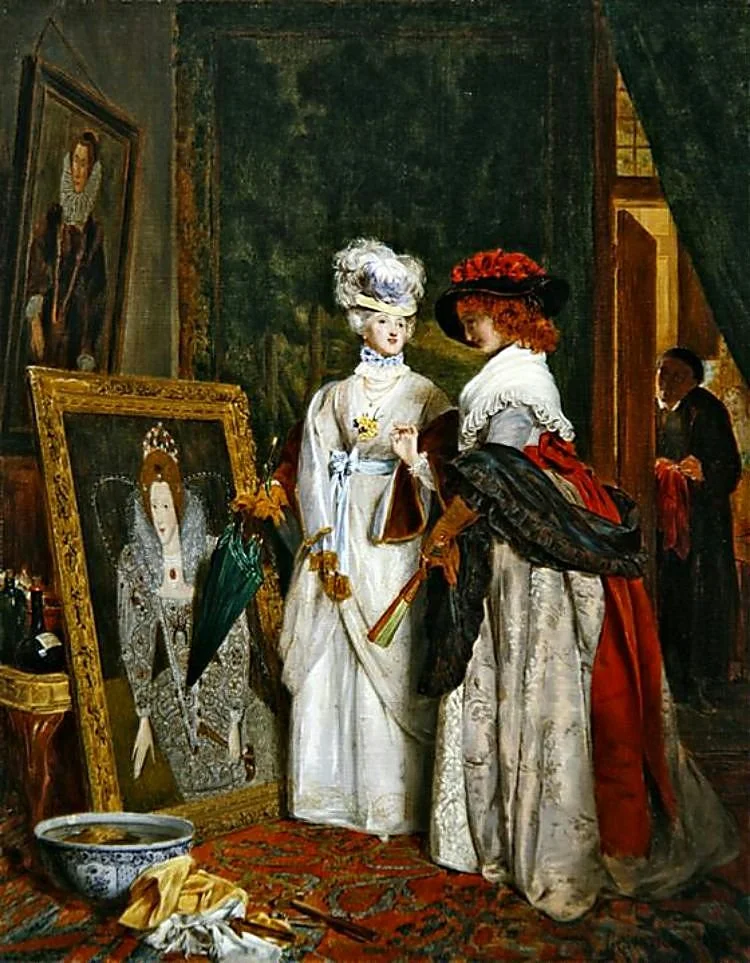
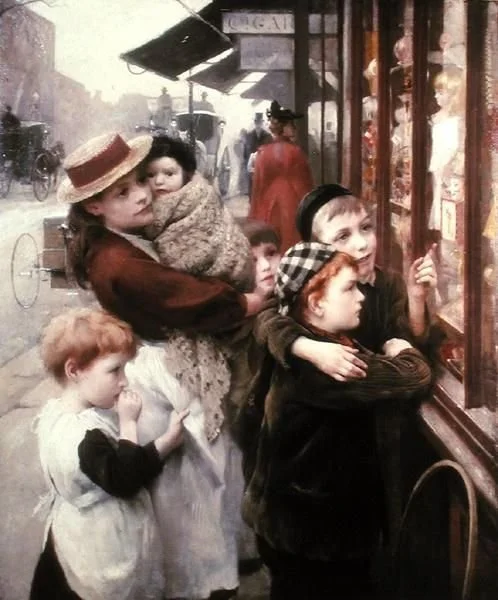
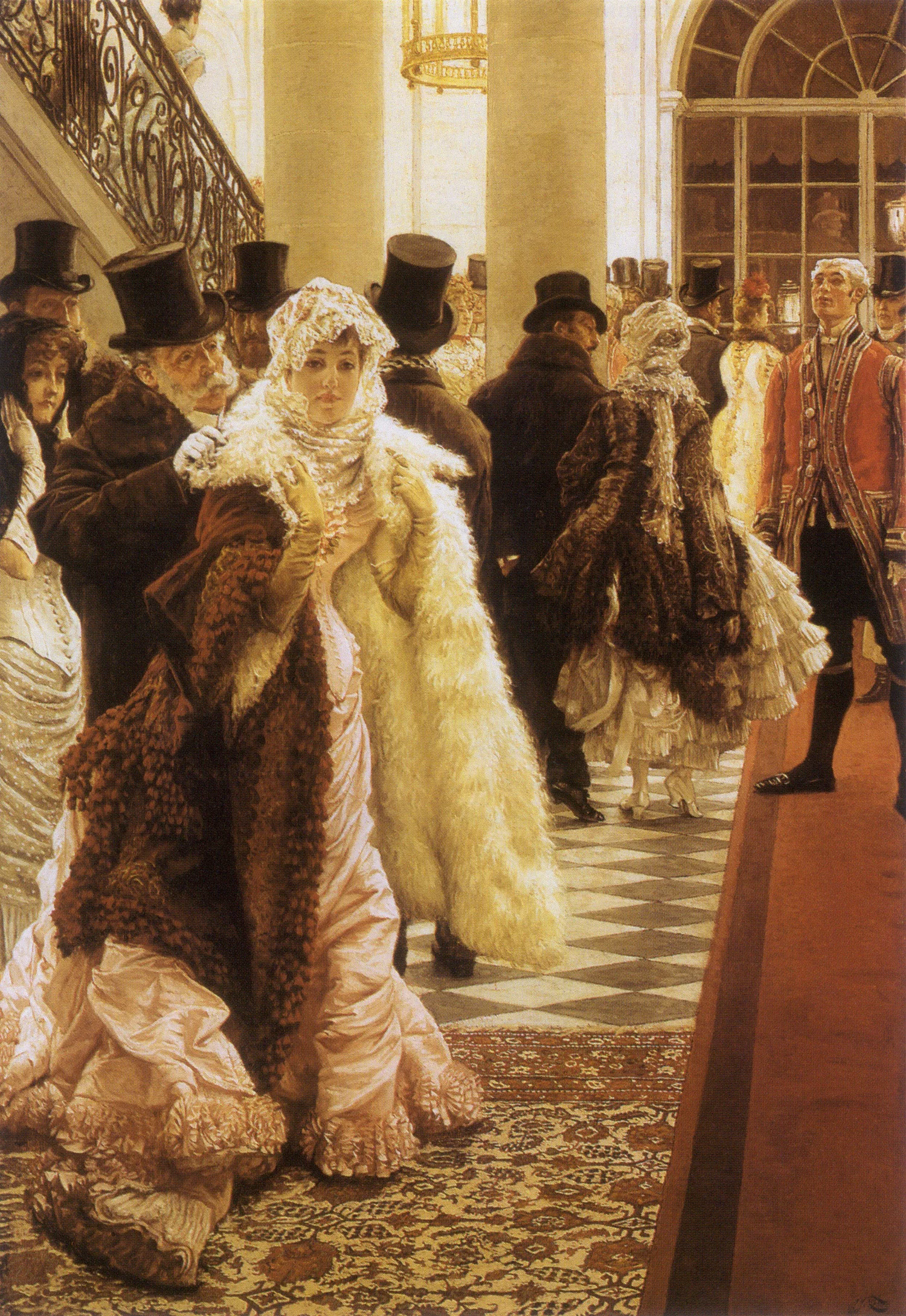
John Callcott Horsley, Critics on Costume, Fashions Change
After five weeks of unrelenting cruciverbal depression, it’s time for a change of pace; and that’s exactly what this week’s puzzle provides. Of course, you’ll nonetheless find in it all the usual qualities of puzzles on this site: norm-shattering formal innovation, the latest in culture, and a daring willingness to speak truth to power. (Also some wordplay.)
Finding herself a social failure, an aging countess courts popularity by adopting her niece.
Alexander James Beresford-Hope (1820-1887), a well-known politician and patron of architecture, took up novel writing late in life, producing this and its sequel (The Brandreths) a couple of years later. His spirited delineation of his hapless characters is entertaining, if a little ruthless.
“The author . . . loves to look on the lively side of things, and his novel may be described as a comedy of life and character. All his personages are more or less conspicuous by some eccentricity, foible, or amiable weakness; his incidents and complications are generally humorous, and the drollery is brought to a climax in the dénouement.” Saturday Review, October 16, 1880
“Thoroughly and in every sense a novel, conceived in a light and happy vein, and scarcely even demanding a serious thought from beginning to end.” Athenaeum, October 23, 1880
A contrasting view:
It is “lively enough as regards some passages” but “there is not a single character capable of creating a genuine interest in the mind of the reader. . . . It seemed somewhat coarse all through, and left a nasty taste in the mouth.” Academy, November 20, 1880
We at David Alfred Bywaters’s Crossword Cavalcade and Weekly Victorian Novel Recommender aren’t satisfied with the gems of wordplay that can be purchased in the public marketplace. We prefer to dig our own out of the bowels of the earth, braving darkness and damp, noxious vapors and the ever-present threat of semantic collapse—all so that you, the solver, can adorn your mental domicile at our expense, little suspecting the cost. But we wouldn’t have it any other way.
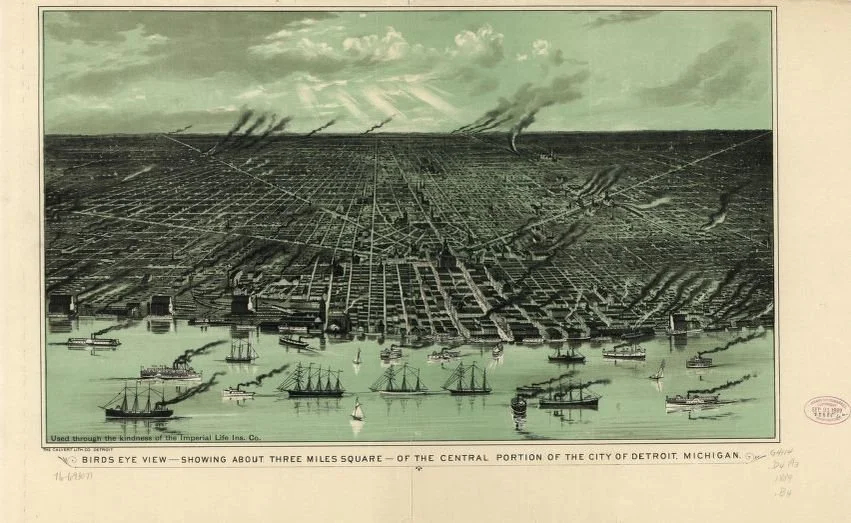
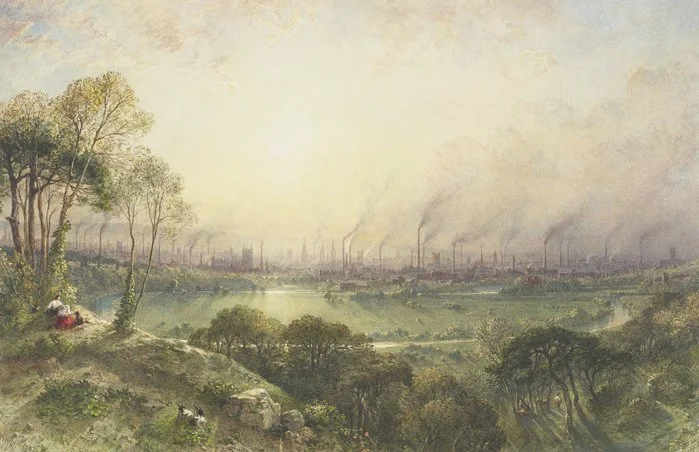
Calvert Lithographing Co., Birds Eye View of the City of Detroit, c.1889
After the sudden collapse of his uncle’s business, a young man works to establish himself in Detroit; meanwhile, a young German immigrant girl finds work as a governess in Milwaukee.
Edward Everett Hale (1822-1909), a Unitarian minister and prominent American social reformer, also wrote several novels. This one, though sometimes marred by its author’s enthusiasms, has some lively characters and several interesting settings.
A “quiet story of domestic life in America . . . , a life as homely and picturesque as any that Mrs. Gaskell or George Eliot has described.” Saturday Review, October 25, 1873
“A very characteristic story of American life . . . written with humour and pathos.” Spectator, November 29, 1873
I give you fair warning: the Downs in this puzzle (at least the themed ones) are all Across. Now that’s just the kind of startling, long-overdue innovation you’ve come to expect of my puzzles; but, like most wonderful things, it comes at some risk: if you’re subject to vertigo, you might want to solve the puzzle while lying on your side.
In an old-fashioned Suffolk town, c.1820, as social and religious habits change, an aristocratic family is troubled by a dark secret.
John Cordy Jeaffreson (1831-1901) wrote, in addition to much nonfiction, fourteen novels between 1854 and 1890. An over-attention to historical and regional setting and a surplus of morality and sentiment are redeemed here by some well-defined characters and a good plot.
“The story is interesting throughout; the characters stand well on their feet, and are real human beings marked with individual character.” Athenaeum, March 28, 1863
It is “a good, sound novel. It may not be vividly interesting; but it is clever, truthful, and observant.” Literary Times, April 28, 1863
A (somewhat) contrasting view:
Though “told in a manner which . . . it would be easy to criticize, . . . still it succeeds . . . in exciting the interest . . . and some of the characters are drawn with no little delicacy and discrimination. Still the book is, in its general effect, a provoking one, for it might so easily have been made much better than it is. The simple process of leaving out altogether about two-thirds of the first volume would have wrought wonderful improvement in the novel. Not only is the first part of the story drawn out to an extent which is at once extremely wearisome and entirely useless, but Mr. Jeaffreson appears, in the earlier portion of the work, to have not unfrequently forgotten that he was telling a story at all.” Spectator, May 23, 1863
I meant this website to be a cheerful place, filled with smiles and sunshine, and look what’s happened! Why, I wonder? Maybe it’s the crossword genre itself, which necessarily makes us cross and takes us down. As I’ve said before, I think the time is overdue for a radical reconceptualization of the form, one that ceases to valorize traditional numerical hierarchies (why should 2 always be greater than 1?), one that shatters the old boundaries imposed by binary grids of black squares and white squares, one that replaces the cross with the happy, the down with the up. I’m working on it.
A virtuous young lady is intended by her parents for one man but loves another.
Emma Newby (1825-1899) wrote 13 novels between 1854 and 1879. This one is chiefly notable for the chillingly calculated behavior of the heroine’s parents.
“The consciousness and confidence of power are visible in Mrs. Newby’s latest work, in which the reader will find a very romantic story very cleverly told.” Manchester Guardian, August 28, 1866
“The plot is sufficiently improbable, and its principal incident has been already made familiar to us by more than one novelist; but Mrs. Newby tells her tale with simplicity and feeling, and thus renders it touching and attractive.” London Review, September 8, 1866
Last week’s puzzle was called “Tossing It Down.” This week’s is called “Downspout.” The alert solver will suspect a pattern. In fact this puzzle is the second of this year’s summer series on David Alfred Bywaters’s Crossword Cavalcade and Weekly Victorian Novel Recommender, the fifth in a series of such serieses. It’s all about downness, explored from various points of view. Are you “down with that,” as the hipsters would say? Then it’s time to “get down,” as the hipsters would say.
A young intellectual becomes interested in a plain young lady neglected by her family.
Nothing seems to be known of Hope Stanford. This, the first of her two novels, though quite good, in my opinion—its heroine especially is refreshingly unusual in her plainness and ill-temper—was not very well received.
“There is a good deal that is thin and common-place in this novel, but also decided tokens of originality and dramatic instinct. . . . One or two of the characters on which the author has spent most pains are exceedingly well done.” Contemporary Review, July, 1884
“This is a pleasant, simply written story with which there is little fault to find. We think the writer has aimed somewhat too high, and that her characters are hardly sufficiently worked up. . . . Still the interest is well kept up. . . . Finally the writer possesses one merit dear to the heart of all critics. She knows what she wishes to say, and says it in clear simple language, pleasantly free from mannerisms and strainings after effect.” Scottish Review, October 1884
A contrasting view:
“There is practically no plot, and the incidents are neither happy nor well contrived. The situation selected for study is tolerably good” but “the three volumes demand more compression and conciseness.” Athenaeum, May 10, 1884
When we at David Alfred Bywaters’s Crossword Cavalcade and Weekly Victorian Novel Recommender indulge in an occasional flagon of mead or snifter of usquebaugh, we like to savor it slowly, meanwhile discussing the issues of the day in an incisive but nuanced manner. However, we have no interest in confining ourselves to making only crosswords that “look like us.” We hope to cater to all tastes and types. So if you are one of those people whose approach to liquor, or to life, is to “toss it down,” here’s one that looks like you.
A needy aristocrat falls in love with a proud cotton-manufacturer’s daughter.
Archibald Boyd (1801-1864), born in Scotland, emigrated to Australia in 1838, and in the 1840s worked to represent the interests of the Australian squatters in the British Parliament. In 1849 he returned to England and took up novel writing; this is the second of the four novels he wrote between 1850 and 1856.
The obviousness of its plot “does not prevent ‘The Delameres’ from being a fairly good novel of its kind.—Too much time is spent at its commencement among the small people of the small town where the tale begins . . .; but from the moment that the curtain falls upon their twaddle and tea-drinking, the action and passion move rapidly enough:—and we read on, with as much eagerness as though we had been unable to foresee for a page’s length what was going to befall the lessoned hero and the lesson-giving heroine!” Athenaeum, January 24, 1852
“The most remarkable quality of this novel is style, or the power of presenting the writer’s images and ideas neatly, tersely, and with a quiet but sustained animation. . . . The author has studied the externals of life and nature; he has a certain knowledge of present society from observation or hearsay, and of the past from books or tradition; he is clever in the mere contrivances of the fictionist to extricate his story from entanglements, or to carry it on. . . . But . . . he is better in narrative than in dramatic development. . . . When the author has to plunge his dramatis personae into difficulties in order to clear them up . . . he breaks down, from the want of knowledge of the events of life.” Spectator, May 22, 1852
Here’s another puzzle on the very cutting edge of cruciverbal development. Unfortunately for me, I’m so far in advance of current trends, so near the horizon of word-crossing possibility, that few of my contemporaries enjoy sufficient keenness of vision to discern either the cutting edge itself or my presence there. But never mind; as I’ve said before, I create not for the current generation of fools, but for posterity.
A free-spirited young lady flees from her ill-tempered husband.
Here is a third novel by Hart, for whom see Novels006,140. Its heroine achieves unexampled heights of Victorian girlishness.
“It is clever, amusing, genuinely in earnest. . . . There is life and stir in every chapter.” Academy, August 17, 1878
A “most entertaining book”; the heroine is “a creation of singular merit. To have made so striking an addition to that gallery of imaginary portraits which a reader’s mind possesses is no slight achievement in a novelist.” Spectator, February 15, 1879
A (somewhat) contrasting view:
Despite the improbability of the plot “the result is more substantial than seemed possible . . . and there is pathos as well as farce in the tale. But the author has escaped by a hair’s breadth from downright imbecility.” Athenaeum, July 27, 1878
I’ve thought of converting this website to an “etail” enterprise—charging a dollar apiece for the crosswords, fifty cents per volume for the novel recommendations, and offering for sale an array of t-shirts, coffee mugs, and tote bags with my logo. I’m pretty sure I’d get rich quick. But I don’t do it. Why? Because I care about you, inadequately compensated solver. It would be simply wrong to tempt you into squandering on crosswords what you might spend on winter fuel or shoes for the children. I just can’t do it, and I won’t.
A young man is called to war in India; meanwhile the brother of the woman he loves strives to begin a literary career.
“An exceedingly pleasant story, partaking of the kind called rattling, but with some strong situations, and some characters by no means ill drawn.” Academy, November 29, 1879
“It happens but rarely that among the number of novels which call for . . . attention . . . we find one we regret to part with. . . . Mr. Follett-Synge’s novel is a rarity of this kind. . . . The book is full of character, and the kind of wisdom which we can only call knowledge of the world. . . . There is . . . a spirit as kindly as it is discerning . . . a true delineation of the ‘gentleman’ and ‘gentlewoman,’ a refined playful humour. . . . It is, . . a book which becomes a friend.” Spectator, December 13, 1879
“The author . . . is an ingenious novelist, whose calm audacity of conception does him credit. By assuming, as a matter of course, the probability of the incredible, he has laid the foundations of a decidedly clever novel, and may carry nine-tenths of his readers triumphantly along with him.” Saturday Review, December 13, 1879
A contrasting view:
“We have seldom come across so unequal a book. . . . At times, both in style and dramatic force, it is excellent, while at others flat and unprofitable.” Examiner, January 17, 1880
You can find alternating pentads in lots of places, and the same is true of biconsonantal pentads—but where else but here, at David Alfred Bywaters’s Crossword Cavalcade and Weekly Victorian Novel Recommender, can you find alternating biconsonantal pentads?
Two Quaker orphans are brought to live with their worldly great aunt.
Agnes Macdonell (1840-1925) wrote three novels in the 1870s, of which this is the last. The title characters’ earnestness grows wearing at times, but their selfish, self-deluded aunt is a lot of fun.
“There is a natural ease about the progress of events which is the result of care and thoughtfulness. The story is, in fact, in admirable harmony with the refinement and self-restraint shown in the characters.” Athenaeum, March 22, 1879
“A book for people who prefer homely scenes described with humour and delicacy.” Academy, April 19, 1879
A (somewhat) contrasting view:
“A very readable novel” but “spun out with gratuitous prolixity.” Saturday Review, May 10, 1879