What did the aging man use to hide his bald spot? A replacement part! Get it? With the clue “comb-over consequence?” I’m going to put that phrase in a funny hairstyles-themed crossword, as soon as I think up three more funny-hairstyle puns of symmetrical length. Meanwhile the phrase will do, in the plural, as a title for today’s puzzle.
A family tries out various apartments and houses in New York City and vicinity.
Albert Bigelow Paine (1861-1937) is remembered mainly as Mark Twain's literary executor and biographer. This brief work is less interesting for its humorous caricatures than for the light it throws on New York apartment living at the end of the 19th century.
“It seems . . . real to those who have had any experience in this line.” Detroit Free Press, October 14, 1901
“Amusingly told . . . , cleverly written . . . , a jolly companion for an unfilled hour.” Baltimore Sun, October 31, 1901
A contrasting view:
“At times fresh and amusing, but in part forced and over-done.” Literary World, January 1902
Have you duly considered, mortal solver, that everything you now see will someday disappear? That the sun, by the light of which you see everything, will itself disappear? Of course, by the time that happens you will have ceased either to see or to be seen—and have you thought about that lately, solver, really thought about it? Would you like to think about it? Or would you rather do a crossword puzzle?
A pair of British criminals try their fortunes in Canada.
Here is another novel by Murray (see Novels009,068,127,181), filled with vivid characters and exciting adventures.
“Slight as is the tale, its cleverly managed incidents, local colouring . . . and first-hand knowledge of some curiously freakish products of our complicated modern life will reward the rapid reader.” Athenaeum, May 15, 1897
“We found it excellent reading. . . A fine spirit of farcical humour makes all his rascality sympathetic.” Saturday Review, May 22, 1897
A contrasting view:
“As a whole, it does not seem to hang together very well.” Spectator, February 19, 1898
This puzzle contains some of the filthiest puns ever to appear in any crossword! They affront the finer feelings! They set good taste at defiance! In fact, you probably shouldn’t even open this puzzle!
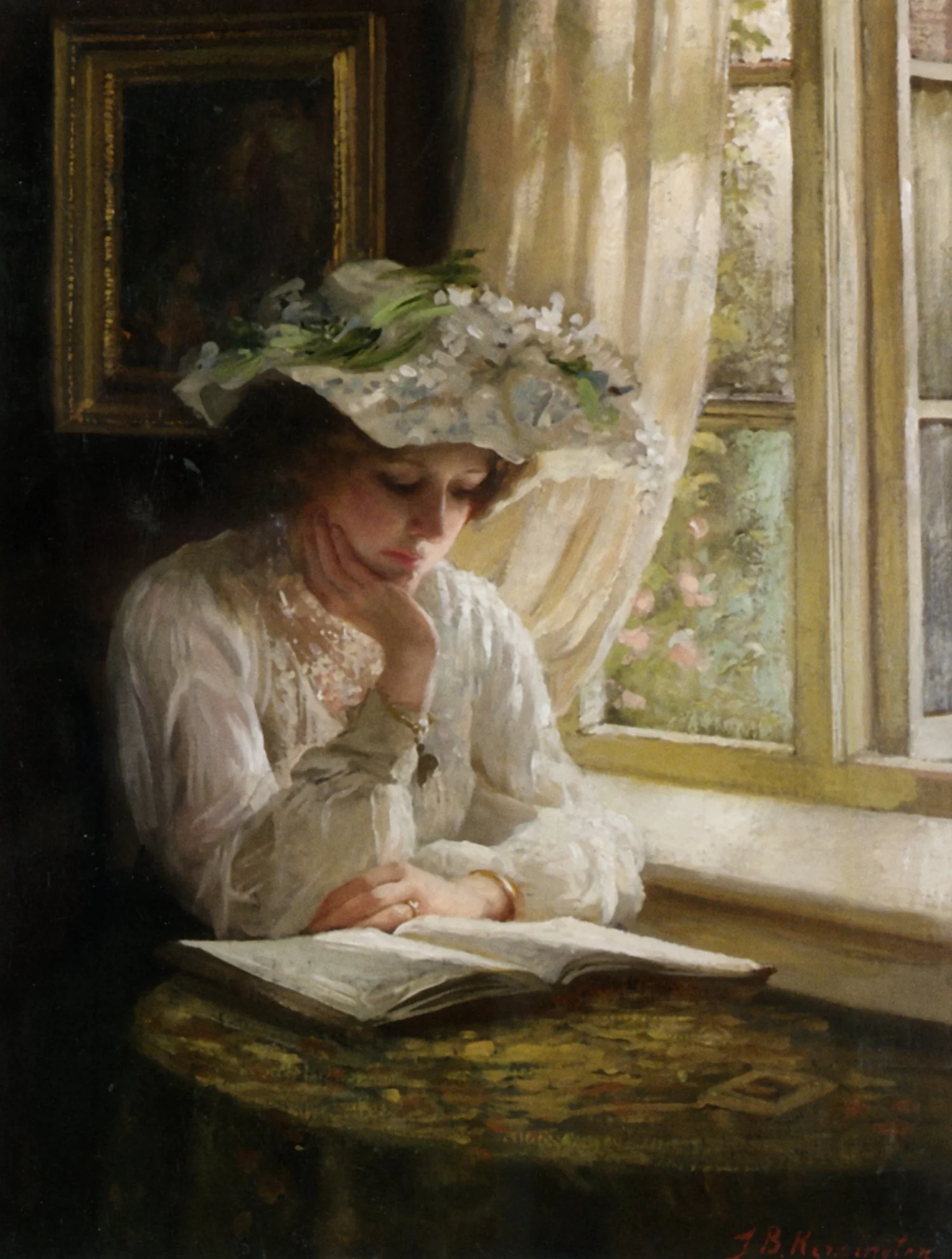
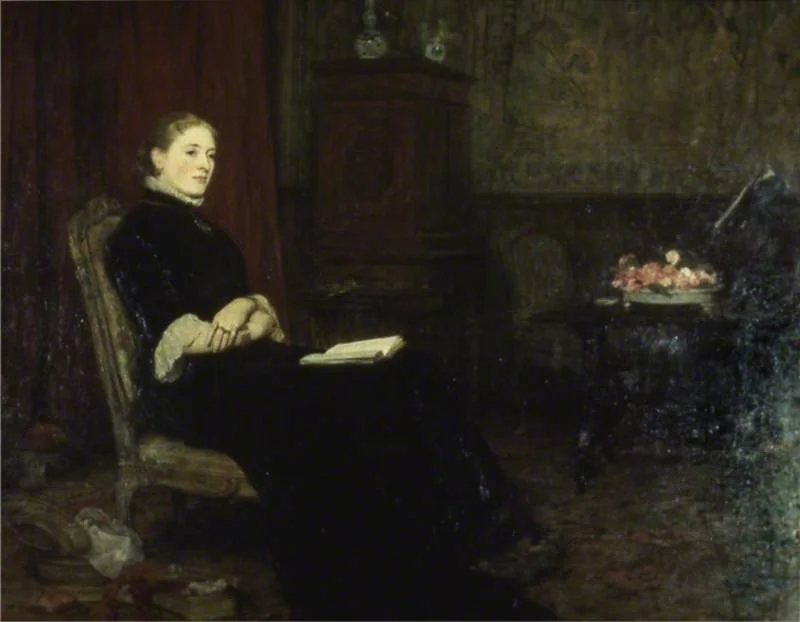
Thomas Benjamin Kennington, Lady Reading by A Window
An ordinary middle-class girl lives with her neglectful father in a small, gossip-prone city.
About Jane Ashton nothing appears to be known. This is her only novel. It is odd in its abrupt ending and its jaded view of human nature, which however it convincingly represents.
“The author has copied nature with fidelity. Her descriptions are minute and painstaking; and her manner, formed after Jane Austen, is not ill-adapted to convey a clear and distinct impression.” Athenaeum, May 11, 1878
“Sophia is a very brief tale of a very dull life in a small cathedral city. It . . . merits commendation for the attentive study which the writer has given to certain social types discoverable in most country towns, but so handled in this story that they are persons and not lay figures. The skill of the work lies in the fact that, although the heroine is . . . thoroughly commonplace . . . yet a certain compassionate interest in her fortunes is aroused . . . by means of . . . uncompromising realism of treatment.” Academy, July 13, 1878
A supplementary remark:
The Athenaeum review continues: “Miss Ashton will never please a large circle of readers if she devotes so much more care to the detection of the weaknesses of characters than to the illustration of their virtues. It is an unprofitable kind of cynicism which gives us only two endurable characters out of two dozen, and which exhibits those two as impersonations of the commonplace.”
I feel sad for the double space, the typographical equivalent of the horse-drawn carriage, of the dial telephone, of the compact disc, of the former planet Pluto, once so very important to anyone who cared about transportation, or telephones, or music, or planets, and now in a fair way of being utterly forgotten. So here’s a tribute, for those who remember how, in a world of fixed-width type, the double space used to follow humbly but honestly after the period, the question mark, and the exclamation point.
The further adventures of an unscrupulous dentist and the heiresses who attract his interest.
Here, as promised, is the sequel to last week’s novel.
“Miss Braddon’s enlarged experience as a writer of fiction is very discernible in this volume, which is decidedly one of her best, if not the best, she has given to the public. . . . Charlotte’s Inheritance is well written, and contains some excellent character-drawing, unspoiled by exaggeration for mere effect. Even the very repulsive personage, so indispensable to the authoress . . . is not, it is painful to confess, without his probabilities.” Spectator, October 25, 1868
A contrasting view:
It “seems to have been put together for the stage, and with an eye to effects. It is an extremely disagreeable story, and it has nothing to redeem its coarse reality.” Athenaeum, March 21, 1868
I had this really great idea for a crossword that would offer a radically new template for social change based on string theory filtered through a Zen understanding of human subjectivity—but then that dog downstairs started barking again.
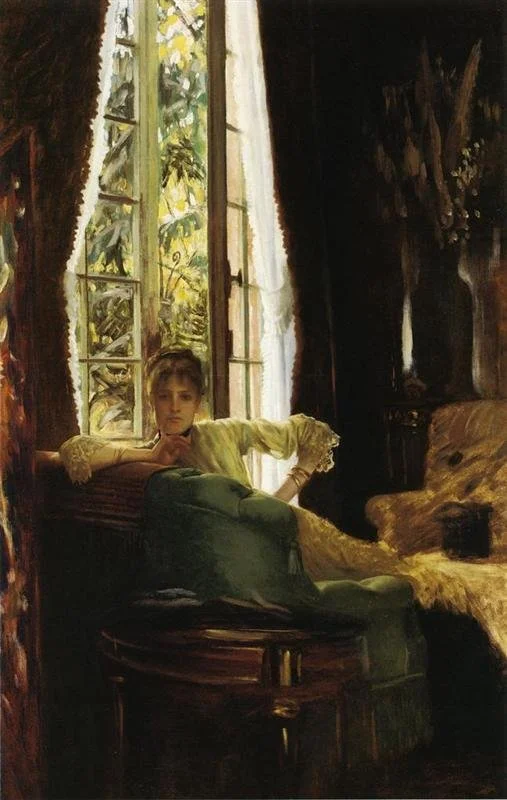
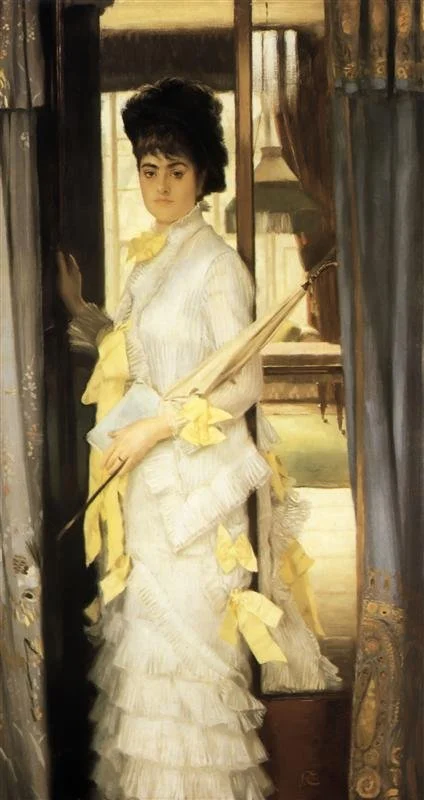
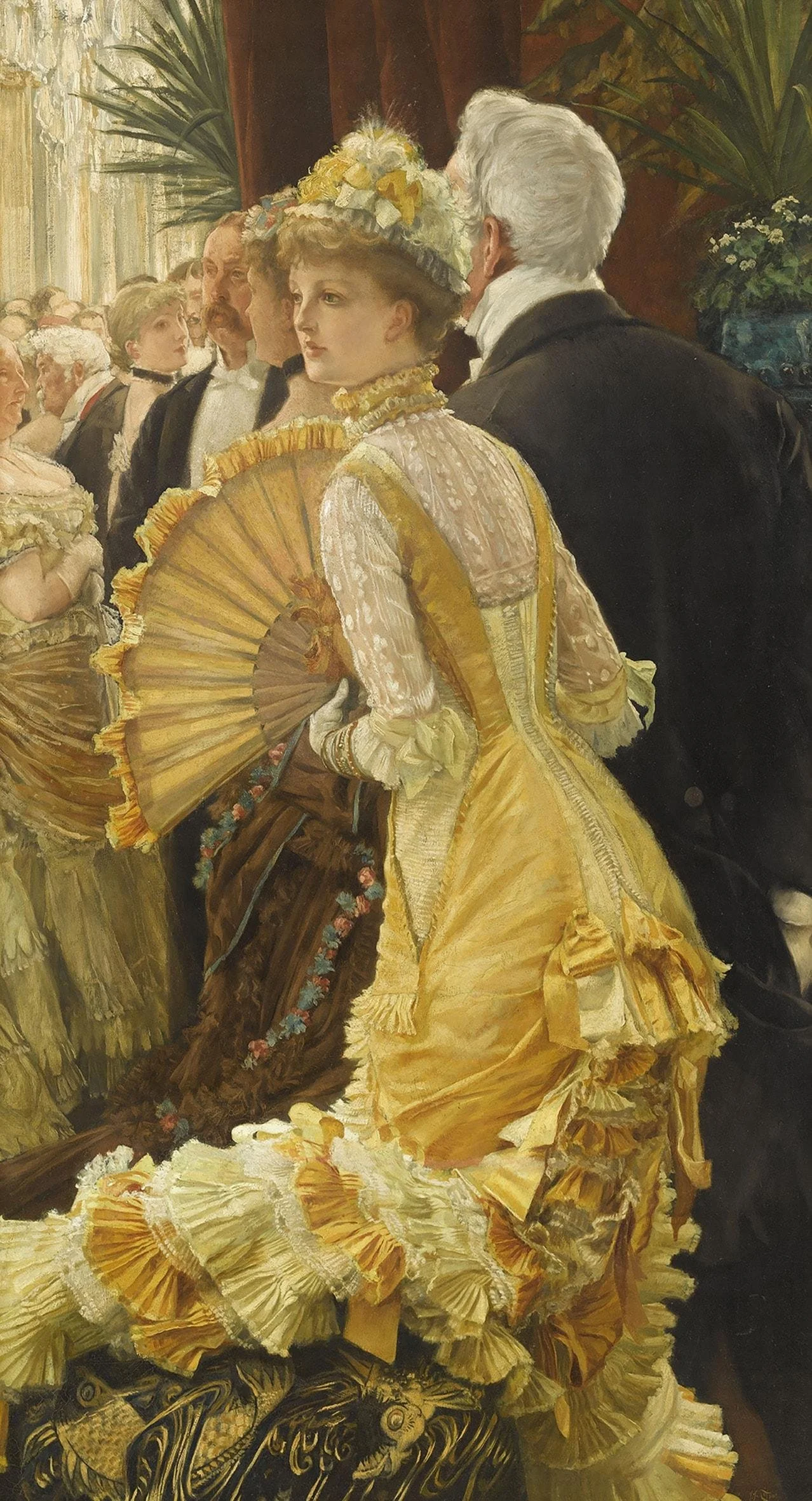
James Jacques Joseph Tissot, Portrait of Miss Lloyd
An unscrupulous dentist will stop at nothing to acquire the fortune of a vulnerable heiress.
For Braddon, seeNovels 004,061,115, and170. The sequel of this shocking tale will be recommended next week!
I was unable to find a good review of this novel, so here are some bad ones:
It “excites unsatisfied curiosity at the commencement, weariness in the middle, and indignation at the end.” Athenaeum, October 12, 1867
“The book, we cheerfully concede, has one merit. It is in Miss Braddon’s power, and the power is very rare indeed, to create by her pen a sort of mental atmosphere, to tinge the air of her tales so that you must see the characters under the false colour she pleases to throw over them.” Spectator, October 26, 1867
I was feeling a little low recently, when the thought struck me—maybe I hadn’t been spending enough time and energy on self-congratulation! It’s a main theme of my remarks on this web site, of course, and I don’t stint on it during my daily routine, assuring myself, as I read the news especially, that my impulses are purer, my thoughts nobler, my opinions more righteous, than most anybody else’s. But lately that just hasn’t been enough. So I began this week’s puzzle with a self-congratulatory title, and then, with every theme answer I devised (having imposed stricter limits on myself than other constructors, and having arrived nonetheless at cleverer answers), with every word I added to the fill (having given due attention to deserving people and resolutely ignored their undeserving counterparts), with every clue I wrote (having alluded to many things that the average solver will feel uncool for not knowing), I shouted, “Ta da!” I invite you to join me in this exercise, and shout “Ta da!” (in your heart, if you aren’t alone) with every word you solve. We’ll all feel better about ourselves, and that’s what crosswords are for.
A man’s widow is disinherited in favor of a kinsman.
Here is another excellent novel by the excellent Annie French, née Hector, for whom see Novels001,063,113, and168.
“The situation is striking, and is admirably described”; and the main character’s inner conflict “is given with much power. The minor characters, too, are excellent. . . . In fact, the whole story is as clever and readable a thing as we have lately seen.” Spectator, May 27, 1876
The author “is always good-humoured even when satirical, and she is discreet in her sympathy with her characters”; she “is always bright, amiable, and amusing”; the plot “is excellently done; there is not a touch too many, not an indication too broad, but all is painted in with the lightness and delicacy which distinguish Mrs. Alexander’s style, and which we find wonderfully refreshing after so much that is heavy . . . in modern literature.” Saturday Review, June 3, 1876
A contrasting view:
“Mrs. Alexander will not add to the reputation her earlier books earned for her by the present novel, though it is a fair enough story as times go. . . . The two [main] characters are rather coarsely drawn.” Athenaeum, April 22, 1876
The inspiration for this puzzle, at 17 Across, was an actual true-life experience that really happened to me! It’s another example of this uncanny ability I have to elevate the sordid miseries of the human condition into the realm of transcendent art.
For McCarthy, see Novels059,163. This one includes, surprisingly, an episode set in a university town in the American midwest.
“There is a delightful variety in Mr. McCarthy’s characters, who are drawn with precision and distinctness, and with a freshness which gives them originality. . . . ‘Dear Lady Disdain’ is never dull; the incidents are well woven into the story; and, though the plot is not intricate, the interest is excellently kept up, and the book is bright and healthy throughout.” Athenaeum, December 4, 1875
“Mr. Justin McCarthy’s new story has much freshness and merit, and marks progress in care and finish. . . . Mr McCarthy deserves one further word of commendation for his American scenes, which are quite free from the exaggeration, caricature, and occasional vulgarity of treatment which writers who could only copy the faults of Mrs. Trollope and Charles Dickens have made too common in ephemeral literature.” Academy, January 29, 1876
A contrasting view:
“Justin McCarthy will write novels no matter what critics advise to the contrary. Very well. There is no literary law against it; it is nowhere recorded that the silkweaver, if he chooses, shall not chop wood. . . . But for all that Justin McCarthy can not write novels. . . . The man appears to have no fancy. As for dramatic power he does not know what it means. In his English there is a monotone like the striking of a board upon a board.” St. Louis Post-Dispatch, January 15, 1875
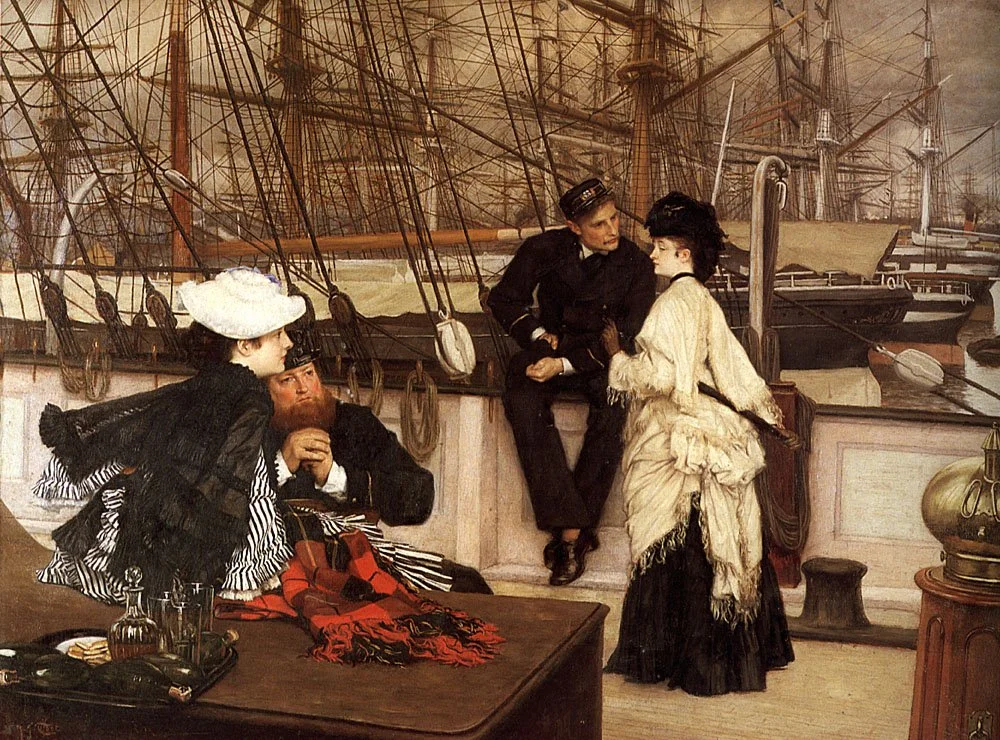
James Jacques Joseph Tissot, The Captain and the Mate
This puzzle speaks for itself; so I’ll devote this space not to praising my own work, but attacking that of other constructors—specifically those constructors who don’t exercise reasonable restraint in fill related to “Star Wars.” LEIA is fine, I suppose, and HAN, though I prefer the Chinese dynasty. ARTOO is useful, but a casual watcher of only the first two movies (me, for example) will remember the name as R2D2. “There is no try,” commonly used in YODA clues, is maybe the stupidest, most annoyingly meaningless adage ever fobbed off as wisdom by anyone anywhere. But what really infuriates me is WOOKIEE. Everybody in “Star Wars” speaks English, though that is presumably not the language of the galaxy far, far away in which the series is set. That language is, one must suppose, being translated, and—since its speakers presumably did not coincidentally invent the Roman alphabet—transliterated as well, into English. But what possible rule of transliteration would explain the soundless extra E at the end of WOOKIEE? It doesn’t make any sense. Why torment the solver with it? Let’s everybody stop.
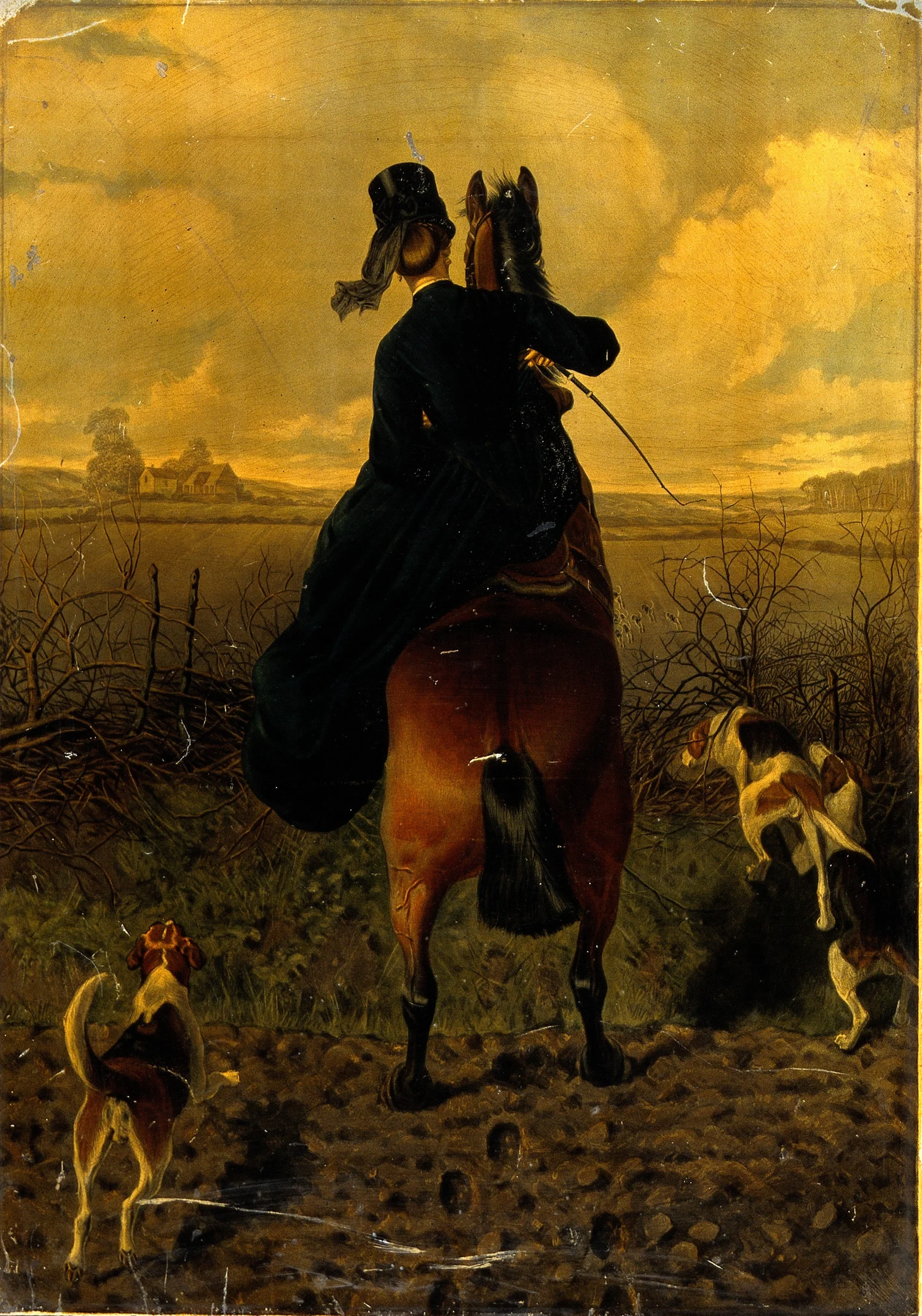
Charles Burton Barber, An Elegantly Dressed Horsewoman Approaching a Fence, Seen from Behind
A fashionable girl marries a journalist; a female horse trainer has love troubles.
Edmund Hodgson Yates (1831-1894) managed to offend seriously both William Makepeace Thackeray and Anthony Trollope in his work as a gossip journalist. He wrote some nineteen novels, of which this, his first, was perhaps the most popularly successful. Its most distinctive feature is its representation—sometimes fascinating but sometimes tediously knowing—of contemporary society.
“We have read it with lively interest, and we lay it aside with an agreeable sense of refreshment.” Athenaeum, November 26, 1864
“We cannot do more than state the almost unexceptionable excellence of all these volumes contain, and add our impression of the value of the many moral lessons the author has conveyed in Broken to Harness.” Manchester Guardian, January 17, 1865
A (slightly) contrasting view:
“A spirited, effective tale of to-day, full of people one understands, who do things they are likely to do . . . with incidents which excite without being improbable”; but while the “subordinate characters” are “alive . . . the higher characters are not.” Spectator, November 26, 1864
This was going to begin a series of puzzles featuring the major Egyptian deities, but nobody understood the other one I made, “Isis,” an experimental crossword in which “is” just is—that is, in which phrases containing the word “is” continue to contain the word “is” and so are not altered in any way. It was to be the crossword equivalent of Marcel Duchamp’s urinal, or John Cage’s 4'33''. Oh well, it will remain among my unpublished works, to be appreciated when posterity has at last begun to make up for the incomprehension of my contemporaries.
If anybody knows anything about S. Vere, aside from her (?) authorship of this one short novel, I have been unable to discover it. In fact, I have found only two reviews, excerpted below. The novel’s characters are well delineated, even if its plot is clumsily didactic.
“The story is carefully and tastefully written, and the character of the proud, wayward, but noble-hearted Lady Helena is well drawn.” Academy, August 18, 1877
A contrasting view:
"It is not clever, nor original, nor vulgar, nor anything. It is toneless and colourless.” Athenaeum, July 7, 1877
I warn you frankly: this week’s puzzle contains puns. If you don’t like puns, however, don’t despair: you can make your own pun-free bird-themed puzzle. Here’s how! Take words that can appear before bird—“black,” “red,” and “blue,” say—make new phrases beginning with these words, like “black hole,” “red herring,” “blue cheese,” whatever—finish with the revealer “early bird,” and voilà! Or find phrases with bird names in the middle—“lo(w ren)t,” “Dan(te Al)ighieri,” “ge(t it) in the neck”—and finish with the revealer “birdcage.” Or find phrases with bird names at the ends—”du(mp tru)ck,” “cr(iminally ins)ane,” “fin(ishing tou)ch,”—revealer “stuffed bird.” A good software program will take care of your grid, fill, and clues, and you’ll end up with something as pun-free, and fully as inspired, as many a puzzle you’ll find any day in the major crossword venues.
The beautiful daughter of a miserly gardener craves money and social position.
Katharine S. Macquoid (1824-1917) wrote some fifty novels between 1862 and 1898; of this one she was particularly proud: in 1898 she was still identifying herself on her title pages as “Author of ‘Patty.’”
“A pleasant novel; not, perhaps, of the highest class, but, on the whole, well imagined, and satisfactorily worked out.” Athenaeum, December 2, 1871
“The authoress of this novel combines several very unusual excellencies. The materials of the story and of the plot are derived from the commonplaces of fiction, and from the events of ordinary life. . . . A group of imperfect, abnormally defective humanities, all distinguished by strong impulses, lack of ballast, and subtle selfishness are brought into contact. . . . There are many admirably drawn portraits, there is in it a high moral tone blended with a fine appreciation of natural and artistic beauty, and a blessed absence of cant.” British Quarterly Review, January, 1872
A contrasting view:
“All the characters in it, all the interests which it involves, are small. . . . It is impossible to care very much about the human beings in the story”; however, it “stands considerably above the level of the average novel. The literary skill which the writer displays throughout is of no common kind, and there are fine things in the narrative.” Spectator, February 24, 1872