An impecunious baronet takes in a difficult French orphan girl reputed to be his hostile neighbor’s niece.
For Beale, see Novel60. The first two volumes of this novel are excellent, with striking characters, especially the French girl heroine, placed in dramatic situations—excellent enough to make up for the third, which loses itself in idiotic lovers’ misunderstandings and tedious sentimental fantasy.
“Fay is not an unattractive heroine . . . and her freaks as a child are amusing.” Graphic, October 23, 1875
A novel with “really fine studies, drawn to the life, and from beginning to end full of vitality and individuality.” Spectator, January 2, 1892 (the novel was then republished).
I stopped going to musical performances years ago, because the loud ones hurt my ears, and the soft ones were invariably spoiled by somebody in the row behind me elaborately unwrapping a piece of hard candy. And I’ve always wondered—did the people behind me at the loud performances also come equipped with plastic-wrapped pieces of hard candy, the unwrapping of which I was unable to hear over the music? Or do people only bring wrapped pieces of hard candy to soft musical performances—just as they generally wait for the quietest moments of those performances to do their best unwrapping? It’s a mystery.
But what isn’t a mystery is that this website is now concluding its fourth year, and I will mark the moment, as I did the conclusions of its first three years, with two 21 x 21 puzzles, and an opportunity for grateful solvers to make a donation. Are you a grateful solver? As in previous years, you may donate using the button below, or through PayPal or Venmo using my email address. There are four donation levels. Donate $12 and receive a 15 x 15 crossword which employs only words current during the Victorian era (and, of course, still current today). Donate $13.50 and receive a large, 21 x 21 crossword. Donate $15 and receive both. Be the first to donate $10,000,000 and the website will be renamed in your honor, so that if your name is, say, Mackenzie Scott, the name of the website will be “Mackenzie Scott Presents David Alfred Bywaters’s Crossword Cavalcade and Weekly Victorian Novel Recommender.”
And speaking of Mackenzie Scott, this year I’m offering a discount to billionaire divorcees. Divorce can be hard, even for billionaires, and we at David Alfred Bywaters’s Crossword Cavalcade and Weekly Victorian Novel Recommender understand that. So if you’re a divorcing billionaire (Jeff? Bill? Melinda?) I’ll rename the site in your honor for a mere $9,000,000. That’s a million-dollar discount! And just think how envious your ex will feel at the sight of your name on the most fabulous crossword site on (or off) the internet! Get there first!
For Davies, seeNovel 094. This novel includes perhaps a few too many intrusive authorial reflections, but otherwise provides a good, straightforward plot, a well developed social setting, and entertaining characters.
“There is an air of unexaggerated truth about The Browns and the Smiths that is sure to find a fair number of readers who will appreciate its sterling merits.” Observer, November 9, 1863
It is “harmless in its plot and gentle in its satire. . . . a pleasant and instructive narrative.” Examiner, April 30, 1864
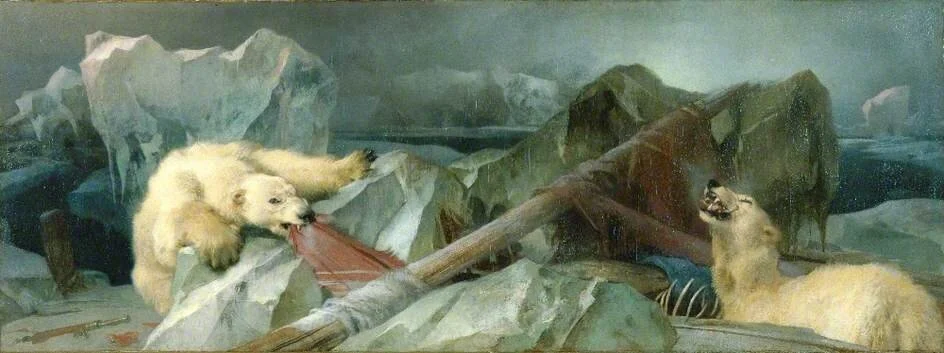
Sir Edwin Henry Landseer, Man Proposes, God Disposes
This puzzle, as its title implies, has men in it, and frankly I have some qualms about posting it. I’m troubled not so much by the lack of gender-inclusiveness (for which I atone right away, in the answer to 1 Down) as I am by the presence of people of any kind. For, regardless of gender, race, sexual orientation, etc., people, in my experience, are annoying. There are some exceptions—myself, for example, and my near relations, and my current friends—but most people, if they’re not doing something absolutely wrong, are at best getting in the way. So please, as you solve this puzzle, do not take it as in any way an endorsement of humanity in general.
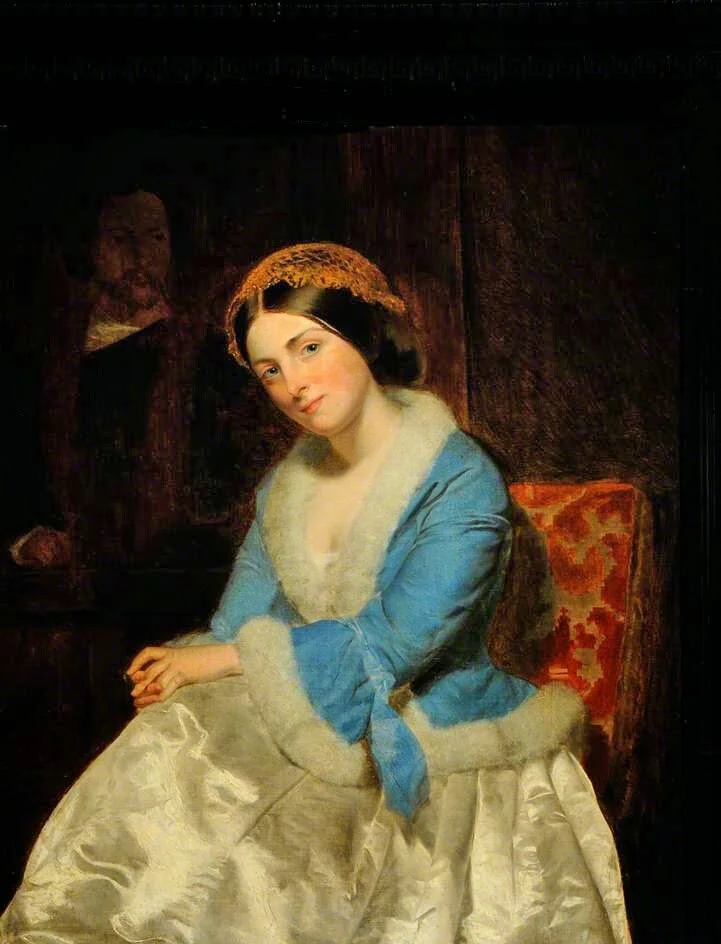
A young wife is troubled by her husband’s thriftless pleasure-seeking.
Here is the sequel to last week’s novel, narrated by the same engaging middle-aged Scotswoman.
“In giving individuality and expression to the characters of the young people in the tale, the author has been very successful, and this, with the pen as with the pencil, is no easy achievement in art. The other characters throughout the story are well drawn, and the novel will sustain the reputation gained by the former work, of which it is a companion and continuation. Both contain good pictures of Scottish life.” Literary Gazette, November 24, 1855
“The concluding series of ‘Some Passages’ is to our thinking superior to the beginning, and this we take to be about the most satisfactory compliment we can pay the authoress. There is a vein of simple good sense and pious feeling running throughout, for which no reader can fail to be the better.” Athenaeum, December 8, 1855
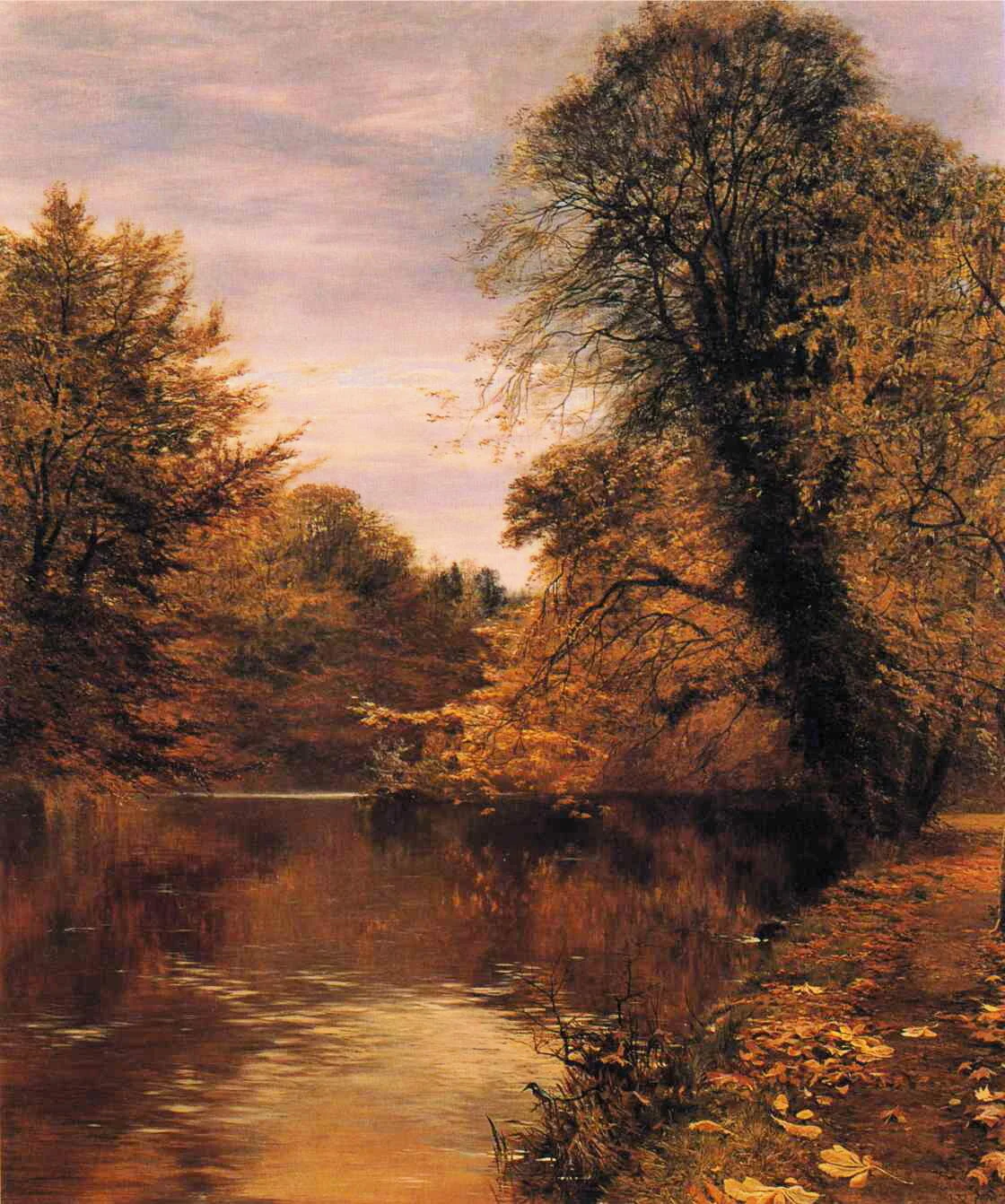
George Vicat Cole, Leaves are but the Wings on which the Summer Flies
It’s time to test your etymological knowledge! To which question might this puzzle’s title phrase, in its original meaning, have been an appropriate response? A. “How do I make this blob of tofu look like a turkey?”
B. “A bird is attacking me—should I shoot to kill?”
C. “What’s a good slogan for a specialized chicken restaurant with no thighs, or breasts, or legs?”
D. “I forgot to learn the play I’m acting in this afternoon—what should I do?” The answer may be found in the first letter of 2 Down in the attached puzzle.
A Scottish spinster supervises the lives and loves of two virtuous young ladies.
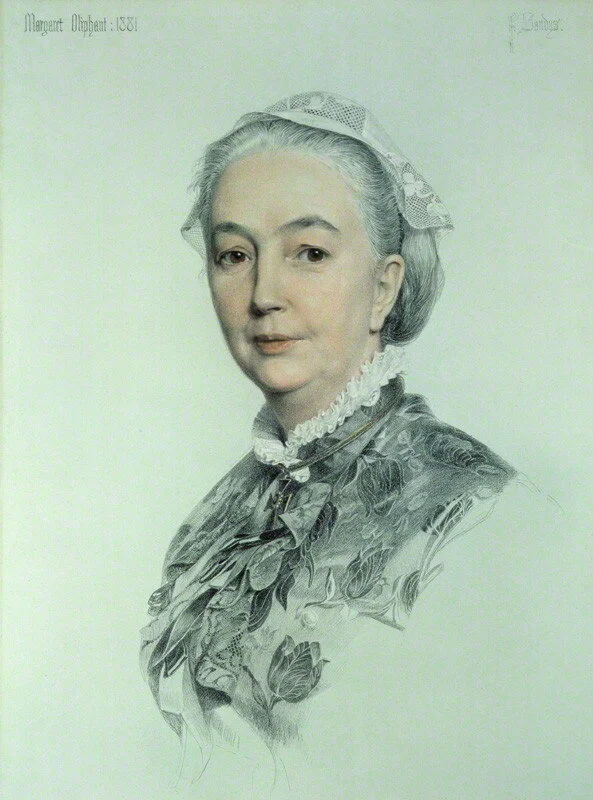
For Oliphant, see novels007,008,056,107, and152. This was the first of her hundred-some novels, published when she was 21 years old, but featuring a fully convincing time-worn middle-aged narrator.
“There is not much of story in this . . . but there is so much nature, truthfulness, and quiet strength in the manner of telling it, that the narrative possesses much interest, especially for readers whose taste has not been vitiated by the exciting doses of the intense school.” Spectator, December 22, 1849
“Dispositions and motives of conduct are shown as clearly as if every person in the story had a window placed opposite the heart to reveal its most secret throes. We come to know them all slowly, but with a perfect knowledge, as we advance through their long conversations, and the daily routine of their affairs.” Fraser’s, November, 1850
This week’s puzzle has a theme no one has ever tried before—at least so far as I know—in which added letters, and parsing, and synonyms, and puns, are all daringly combined in no fewer than six original nonsense phrases! I’m a little worried that releasing it into the universe will result in the creation of a semantic black hole from which meaning can never escape, and that then nothing will ever make sense again. But I’m going to chance it!
A virtuous but self-willed young lady with a discreditable family attracts the love of both a faithful farmer and a haughty aristocrat.
Here is a another novel by Mann, for whom see Novels016and154. A priggish clergyman character is especially well done.
“In very few recent novels will there be found anything approaching its grasp of character and firmness of touch. The writer looks at life with a very straight eye. She certainly does not err on the side of idealizing character, and is not at all averse to laughing at those with whom she is on friendly terms. . . . Her characters are not made of ink and paper, but of flesh and blood, and her book has no flimsiness in either its thought or its workmanship.” Bookman, February 1893
For the author it “has clearly been recreation as well as work, and it happens not unnaturally that the reader as well as the writer is recreated. . . . It has impulse, movement, sprightliness, life.” Academy, March 4, 1893
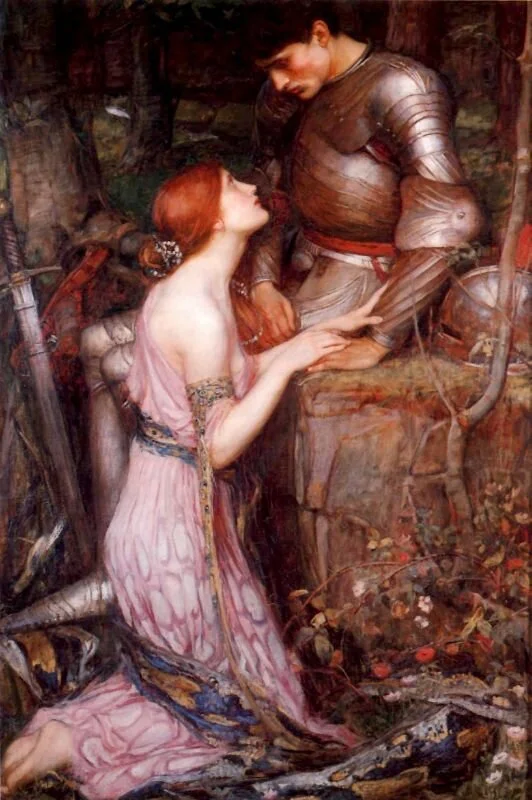
22 Across is not the first joke I’ve made about knights in armor. There’s something irresistibly comic, at least to me, about grown men dressing in metal suits and hacking away at each other—though of course it can’t have been funny at the time. There’s a display of armor at the Metropolitan Museum of Art, in which at least one of the helmets is screwed tight—at nose level—by what is clearly a wing-nut. I can’t look at it without smiling, and wondering when and how wing-nut technology was developed.
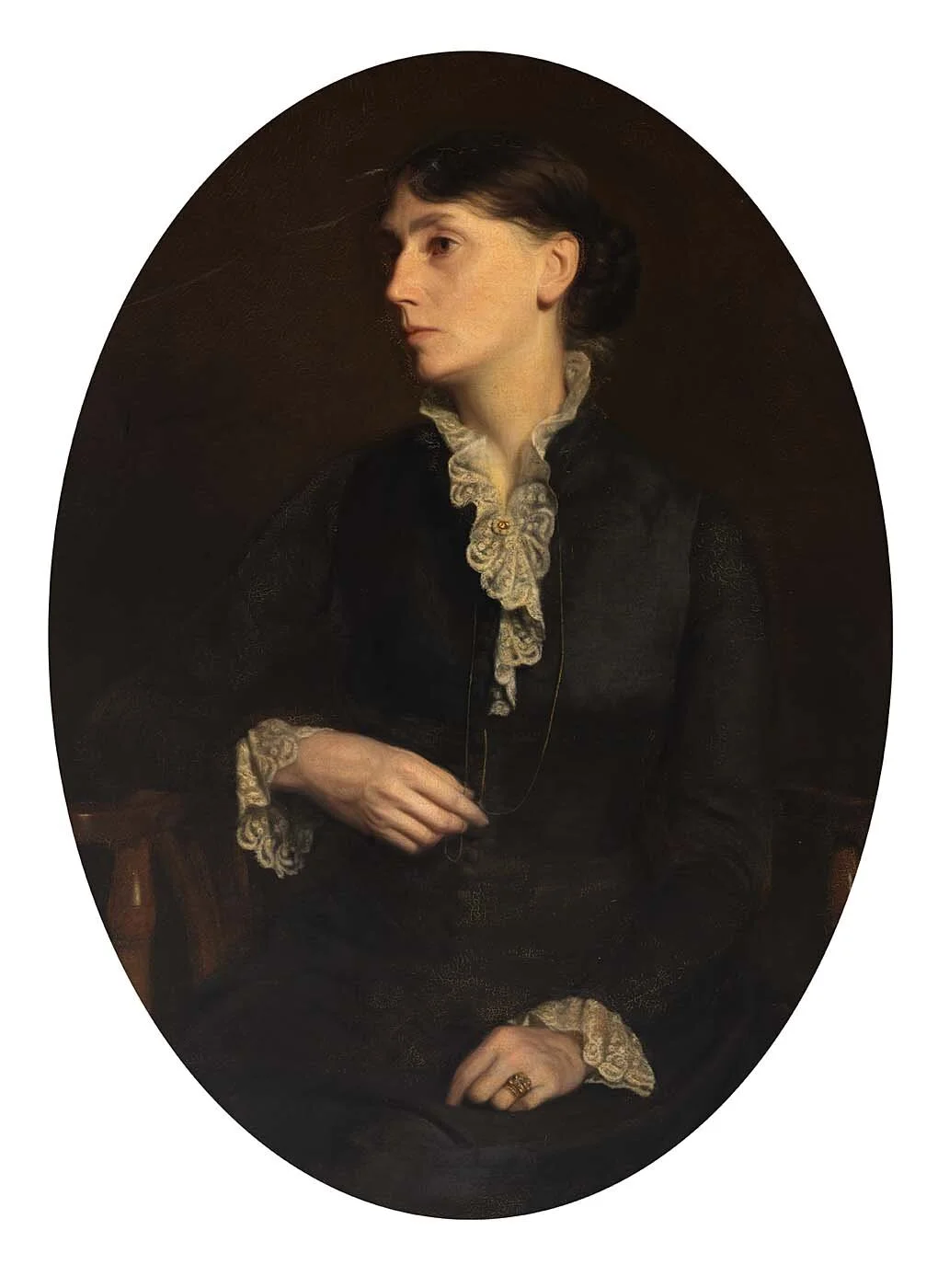
In a New England town, a society leader takes up a poor but talented widow.
Harriet Waters Preston (1836-1911) wrote five novels between 1871 and 1888, but she was better known as a translator. The title here is a self-denigrating reference to the novel’s somewhat cursory plot; Preston’s interest is focused instead on the New England setting and on the protagonist, a married, middle-aged woman.
“A pleasant little story, with a rather ostentatious absence of completeness or definiteness in its plot.” Academy, February 3, 1877
“To be really entertaining in one volume is a great merit, and more especially is it a merit when an author is not only entertaining in small compass, but able to present us with a picture of manners and of a life which we but half know, and wish to know more thoroughly. . . . The interest of the tale lies partly in its intrinsic vivacity, and partly in the bright glimpse it gives us of the higher social culture of the Northern States of the American Union. . . . Short as it is, almost every figure in it is distinctly outlined and freshly painted.” Spectator, February 24, 1877
What makes my crosswords so exceptionally adorable? It’s not their symmetrical features; most crosswords have those. They aren’t rounded or fuzzy—on the contrary, they are geometrically rectilinear and semantically exact. But their babbling delight in language, their wide-eyed, uncomplicated openness to life give them an infantile appeal very unlike the hard-edged affect of their adolescent meme-grubbing, slang-repeating, hipster-referencing competitors.
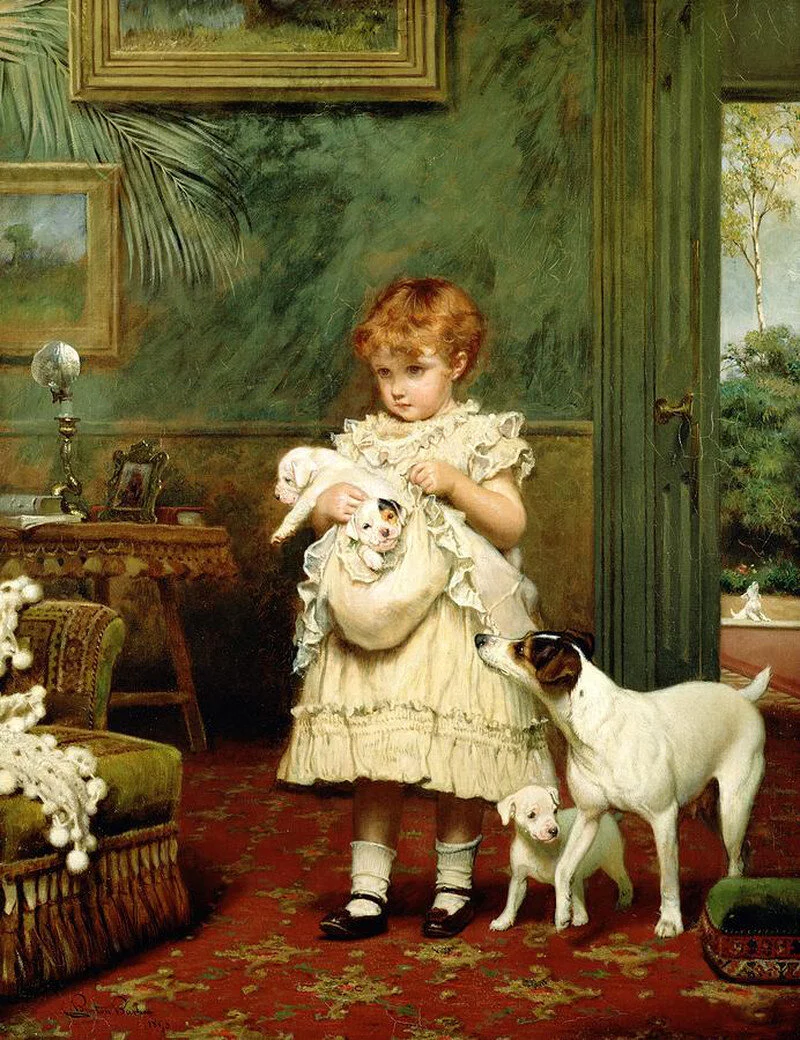
A virtuous young lady has a not-so-virtuous sister.
This was the first novel published by Frances Eleanor Trollope, for whom see Novels033,108; it is briefer and quieter than either of those.
“The characters are well drawn, and contrasted with satisfactory distinctness”; “the author never anticipates her catastrophes, but works up to a crisis with a cautious and self-denying reticence. . . . She writes with that genuine feeling which is necessary to enlist the sympathies of the reader; and . . . she has the art of making revelations by a delicate touch.” Athenaeum, August 25, 1866
“After wading through the ordinary novels of the season, after learning to what depths of dulness and folly the human intellect can descend, and wondering at the hideous pictures of vice or inanity which men and women can paint as representations of human life, it is positive mental refreshment to come across a such a book as Aunt Margaret's Trouble, which for pathos and idyllic tenderness may compete with even the best novels of the day. . . . It is a charming book, and worth half a hundred fictions of the more ambitious and elaborate kind.” Saturday Review, September 1, 1866
I went to Pismo Beach once. I was driving with friends from San Francisco to Los Angeles and saw the sign. The beach itself was disappointing—sand, ocean, that sort of thing. But I liked, and still like, the name, which to me suggests a combination of the exotic with the fun. So I’m glad I went there, because I’m glad to say I went there, because I like to say, “Pismo Beach.”
In Cumberland, a lonely young lady, adored by a reforming clergyman, loves a swaggering mine supervisor.
For Linton, see Novels044,134. Here she sets vivid characters at cross-purposes amid a carefully realized Cumberland setting.
“Mrs. Linton, thoroughly acquainted with the life of the Lake Country, paints an imaginary dale with its lake, its fells, its force and its Styebarrow, colours it in every detail with truth to nature, shuts it out from tourist life, and peoples its nooks and corners with characters of unsophisticated Cumberland life through which she weaves the action and passion of her story. . . . As a true picture of forms of English life that are already vanishing, this novel . . . has an interest beyond the attraction of its tale of an unhappy girl’s life beating itself out in tragic passion.” Examiner, May 12, 1866
Linton “has chosen a subject which she can handle well. . . . The interest of her story is greatly enhanced by the fidelity with which the local colour is preserved.” Saturday Review, July 14, 1866
Linton “makes her really original plot natural with a thousand touches of explanation . . .. and has set her figures before a background which would make them seem natural were they far more bizarre.” This is “a novel . . . indefinitely superior to the mass of those we are so often condemned to read.” Spectator, July 21, 1866
Here we are at Crossword 200, and it seems only yesterday that I was refusing to apologize for the obviousness of the theme ofCrossword 100. Anyway, as the puzzle below will show, I’ve learned nothing in the interim. If I make it to Crossword 300, I might have to think up some other approach.
An old-fashioned young lady, living with her flirtatious half-sister, falls in love with a local landowner.
Here is another novel by Sidgwick (see Novels082,142). It was not actually published during the Victorian period, but it is named for it—and it looks back on it with a sort of ambivalent nostalgia.
“Mrs. Alfred Sidgwick introduces one to a world in which there are always a number of delightful people, and ‘Victorian’ . . . is no exception.” The Queenslander, July 15, 1922
Ahoy! Avast! Clear the decks! Batten down the hatches! Trim the jib! Man the sheets! Belay the taffrails! Man the jib! Trim the sheets! Hoist up the John B. sail! See how the mainsail sets! Call for the captain ashore! I want to go home.
A young lady returns home to a remote Appalachian village, where she finds her father and stepmother behaving mysteriously.
Here is another novel by Woolson, for whom see Novel057. This novel, however, is as focused as the other is diffuse.
“For the Major is a book few Europeans, if any, could have written, concentrating, as it does, such nervous power and earnest sentiment upon purely domestic incident. . . . There are at least three creations in it of extreme merit” who “form a truly pathetic and truly beautiful group; very difficult to draw, but very well drawn indeed.” Academy, August 18, 1883
“The sketches of American life and character in a remote village in the south are quaint, interesting, and read life-like; and the whole slender edifice of the story, reminding us of the paper houses of Japan, holds well together.” Spectator, August 25, 1883
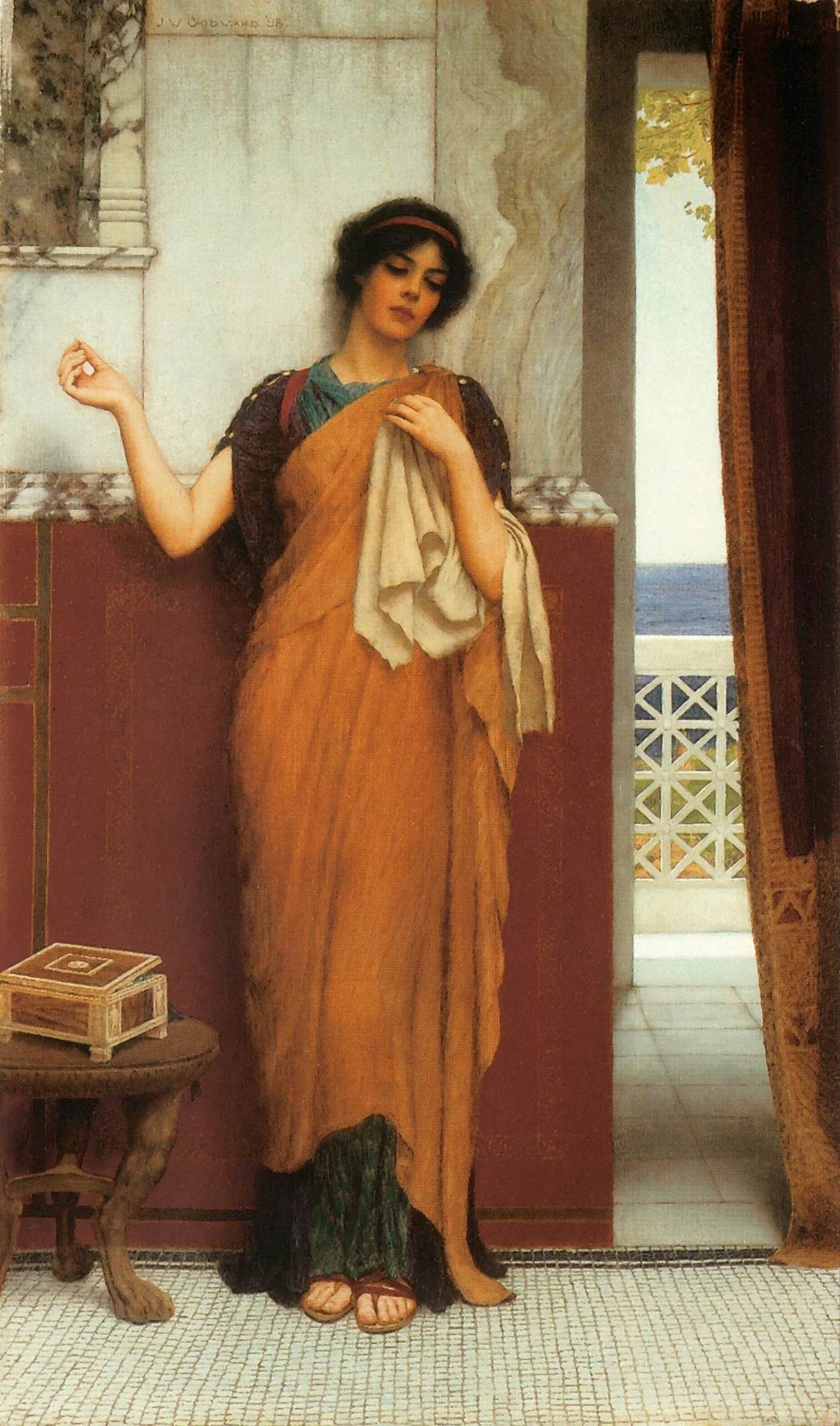
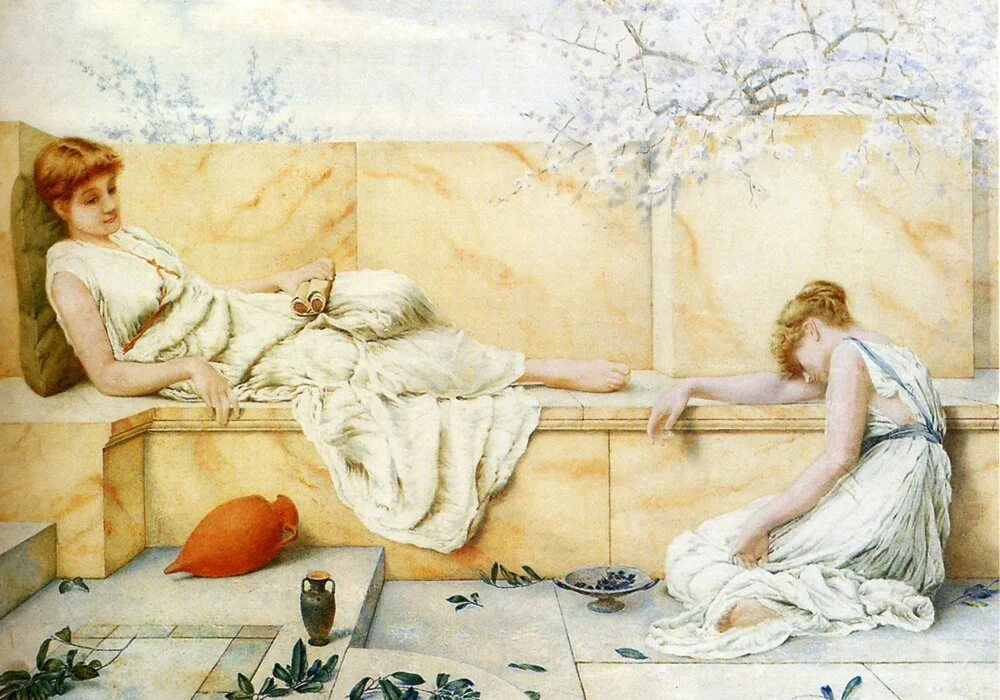
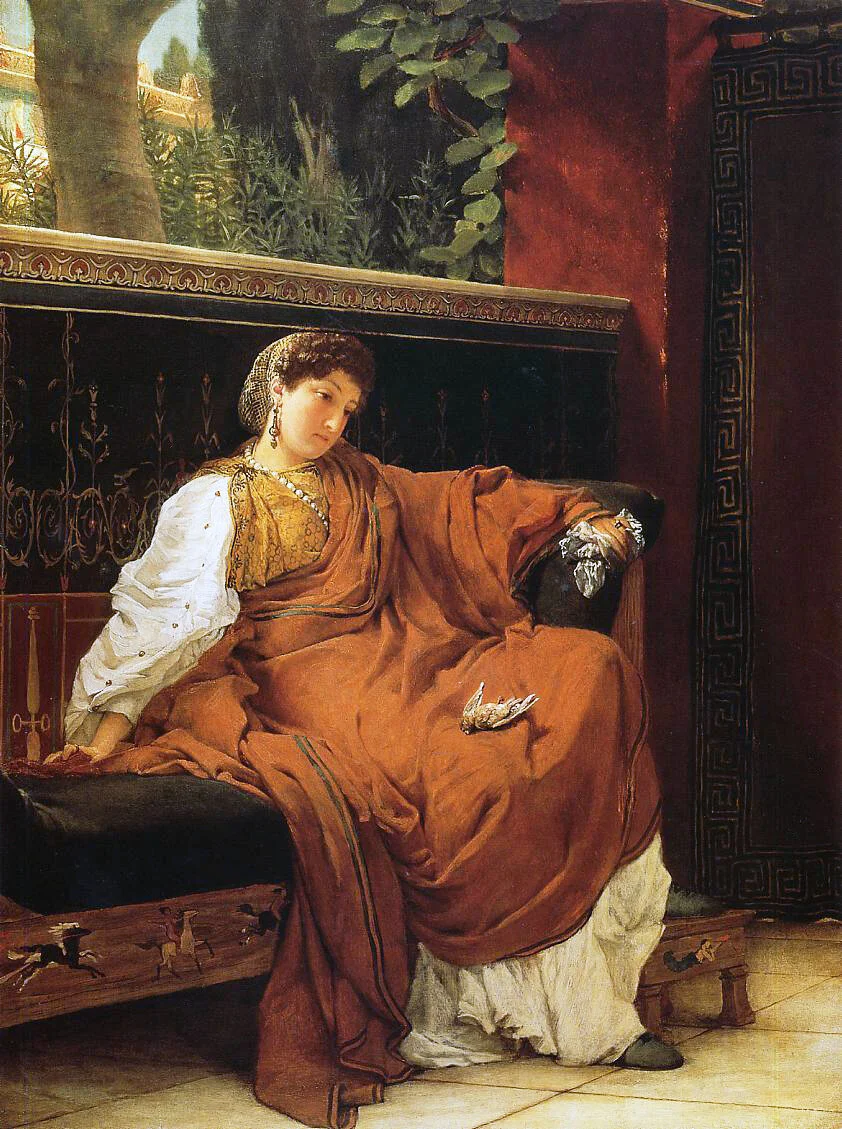
Sir Lawrence Alma-Tadema, Lesbia Weeping over a Sparrow
Taking my cue from the Victorian heroine who runs a risk of coming down with the brain fever if she doesn’t find a release in tears, I’ve been crying all week long, for myself, for the world, and for you, troubled solver, and I feel better now. If you want to return the favor by crying for me, this week’s puzzle will get you started.